
Day 101 — Summoned and Set Apart
When God Calls You Closer and Calls You Holy
However you can engage today, we’re here. Read, listen or both.
The written portion gives an overview, with verses broken down into smaller bites, and journaling/prayer prompts for reflection. In the podcast, Steve Traylor reflects on today’s passage with Scripture reading, a deeper pastoral teaching, and prayer (about 15 minutes). Perfect for morning coffee, commutes, or when your eyes need a rest.
📖 Resources: Printable Bible Book Guides (Genesis & Job) · Hard Questions, Honest Answers
We’ve written three articles That go further into the questions Exodus raises—for those who want more. We will leave them here throughout the Exodus studies:
When the God of Love Sends Plagues — How do we reconcile the harshness of the plagues with a God of lovingkindness? A companion to Days 88–93.
What Is a Miracle? — What miracles actually are in Scripture, why they cluster rather than continue, and what that means when God seems quiet. A companion to Day 95.
Not the Same God — Why the worship God prescribed in Exodus is structurally different from every other sacrificial religion in the ancient world. A companion to Days 101–124.
Exodus 19
Draw near carefully.
Three months have passed since Israel walked out of Egypt. They have seen the sea split and swallow an army. They have drunk from bitter water made sweet, eaten bread that appeared on the ground each morning, and watched Moses hold up his arms while Joshua fought below. They have been carried, fed, kept, and protected by a God they are still learning to know.
And now, the wilderness opens into a wide plain at the foot of a mountain. They make camp. The journey is not over—they won’t leave this place for almost a year—but something has changed. This is not another campsite. This is the place God pointed to from the burning bush: When you have brought the people out of Egypt, you shall serve God on this mountain. The promise has arrived.
God is about to draw close. And the drawing-close of a holy God is not a casual thing. It is wonderful and terrifying in equal measure. It requires preparation—not because preparation earns anything, but because the people need to feel the weight of what is happening. You cannot rush into the presence of holiness as though it costs nothing.
This passage is not primarily about what Israel must do. It is primarily about who God is and what He has already done. The requirements come inside a story of grace—and they point, eventually, toward the One who would meet those requirements in full.
Today we see that God calls His people into covenant not as a reward for their faithfulness but as an act of His own sovereign love—and that the call to holiness is a call toward the God who has already made the way.
1. Arrival and Appointment
Exodus 19:1-3
In the third month after the children of Israel had gone out of the land of Egypt, on that same day they came into the wilderness of Sinai. 2 When they had departed from Rephidim, and had come to the wilderness of Sinai, they encamped in the wilderness; and there Israel encamped before the mountain. 3 Moses went up to God, and Yahweh called to him out of the mountain, saying, “This is what you shall tell the house of Jacob, and tell the children of Israel:
The narrator marks the timing with unusual precision: the third month, on that same day. This is not casual record-keeping. This is the fulfillment of a specific word God spoke to Moses at the burning bush: “When you have brought the people out of Egypt, you shall serve God on this mountain” (Exodus 3:12). What God promised at the bush is coming true at the mountain. God keeps His word.
The word wilderness does not mean a vast emptiness of sand. The Hebrew describes grazing country—rough, open, unsettled. Israel is not in a comfortable place. They are still between where they came from and where they are going. And it is in this between-place—not after arrival, not after the promise is fully complete—that God comes to speak.
God does not wait until you are settled to call you into covenant. He comes to the wilderness, precisely to the place that is not yet home.
Moses went up to God—not because Moses had earned proximity, but because God called him. God descends in order to speak; Moses ascends in order to listen.
Journaling/Prayer: Where are you right now—in a wilderness, still between what was and what will be?
If you can’t yet identify this as a meaningful place, that is all right. But notice: God did not wait for Israel to reach their destination before speaking. He came to the in-between place. He comes to yours.
2. Eagles and Exaltation
Exodus 19:4-6
4 ‘You have seen what I did to the Egyptians, and how I bore you on eagles’ wings, and brought you to myself. 5 Now therefore, if you will indeed obey my voice and keep my covenant, then you shall be my own possession from among all peoples; for all the earth is mine; 6 and you shall be to me a kingdom of priests and a holy nation.’ These are the words which you shall speak to the children of Israel.”
Before God gives a single requirement, He gives a recitation. You have seen what I did. The covenant does not begin with command; it begins with remembrance. God points to what He has already done—the plagues, the exodus, the parting of the sea—before He asks anything of the people. Grace precedes obligation. Deliverance comes before demand. This is the shape of every covenant God makes with human beings.
“I bore you on eagles’ wings.” The image is of a parent eagle carrying its young—not the people straining to fly on their own, but God carrying them at His own exertion, at His own pace, under His own power. The weight was not theirs. The journey was not something they accomplished. They were borne.
Then come the words that have filled centuries of theological reflection: “You shall be my own possession from among all peoples.” The Hebrew word translated possession is segulah—not a generic word for property but the word used for a king’s personal treasury, the jewels kept close, the things most prized. Israel is not God’s possession the way a field is. She is God’s treasure.
A kingdom of priests and a holy nation. Priests in the ancient world stood between people and God—they represented the human before the divine and the divine before the human. To call Israel a kingdom of priests was to name her vocation: not merely to receive God’s blessing, but to become a conduit of it. She was not chosen for privilege alone. She was chosen for purpose—to carry the knowledge of God toward a world that did not yet know Him.
The conditionality here—if you will indeed obey my voice—is real, and it should not be softened away. But it must be read in its right order. God did not say: Obey, and I will deliver you. He said: I have delivered you; now, if you obey, this is what your life together will be. The covenant flows out of an already-accomplished rescue. It is a response to grace, not a means of earning it.
Journaling/Prayer: Has God ever called you ‘precious’—and you found it hard to receive?
If you're in a season where you feel discarded or forgotten, sit with this word: segulah—treasured possession, the jewels a king keeps closest. If you belong to Him, this word belongs to you. If you're not yet sure you do—that question is worth bringing to Him today.
3. Consecration and Caution
Exodus 19:7-15
7 Moses came and called for the elders of the people, and set before them all these words which Yahweh commanded him. 8 All the people answered together, and said, “All that Yahweh has spoken we will do.”
Moses reported the words of the people to Yahweh. 9 Yahweh said to Moses, “Behold, I come to you in a thick cloud, that the people may hear when I speak with you, and may also believe you forever.” Moses told the words of the people to Yahweh. 10 Yahweh said to Moses, “Go to the people, and sanctify them today and tomorrow, and let them wash their garments, 11 and be ready for the third day; for on the third day Yahweh will come down in the sight of all the people on Mount Sinai. 12 You shall set bounds to the people all around, saying, ‘Be careful that you don’t go up onto the mountain, or touch its border. Whoever touches the mountain shall be surely put to death. 13 No hand shall touch him, but he shall surely be stoned or shot through; whether it is animal or man, he shall not live.’ When the trumpet sounds long, they shall come up to the mountain.”
14 Moses went down from the mountain to the people, and sanctified the people; and they washed their clothes. 15 He said to the people, “Be ready by the third day. Don’t have sexual relations with a woman.”
The people’s answer is unreserved: All that Yahweh has spoken we will do. They mean it. They are moved. This is the right response to a God who has borne them on eagles’ wings.
God tells Moses to sanctify the people with two concrete acts: wash their garments, and abstain from marital relations. These instructions are not a judgment on clothing or on marriage. Normal things are being set aside because an extraordinary thing is about to happen. The outward washing pointed to an inward reality: you are entering the presence of One who is utterly clean, and the contrast matters. The abstinence was not an implication that sex was impure; it was the setting-aside of even good and lawful things to focus entirely on what is about to occur.
Boundaries were drawn around the mountain itself. Anyone—any person, any animal—who touched the mountain would die. This is one of the most unsettling passages in Exodus for modern readers, and the discomfort is appropriate. The holiness of God is not a therapeutic concept. It is a reality that ancient Israel was made to feel in their bodies, their schedules, their proximity to the earth. Sin separates. The barrier was not arbitrary cruelty; it was a physical inscription of a spiritual truth the whole story of Scripture is trying to tell: there is a gap between God’s holiness and human sinfulness that no human effort can close.
Moses is the one who moves between the people and God. He goes up and comes down, carries words in both directions, sanctifies the people, prepares the boundary. His role here is not incidental. Every time Moses crosses between the people and the mountain, the text is showing us something about the shape of mediation—and pointing toward the One who would one day cross that boundary once, permanently, in both directions at once.
Journaling/Prayer: What does it mean to you that approaching God requires preparation—not to earn entrance, but to acknowledge what is real? If you can’t yet frame your faith in terms of holiness, start smaller: Is there something in you that recognizes God is not casual? That His presence has weight?
If even that feels far, just stay here, in the gap. Christ is holding it open.
4. Thunder and Trembling
Exodus 19:16-25
16 On the third day, when it was morning, there were thunders and lightnings, and a thick cloud on the mountain, and the sound of an exceedingly loud trumpet; and all the people who were in the camp trembled. 17 Moses led the people out of the camp to meet God; and they stood at the lower part of the mountain. 18 All of Mount Sinai smoked, because Yahweh descended on it in fire; and its smoke ascended like the smoke of a furnace, and the whole mountain quaked greatly. 19 When the sound of the trumpet grew louder and louder, Moses spoke, and God answered him by a voice. 20 Yahweh came down on Mount Sinai, to the top of the mountain. Yahweh called Moses to the top of the mountain, and Moses went up.
21 Yahweh said to Moses, “Go down, warn the people, lest they break through to Yahweh to gaze, and many of them perish. 22 Let the priests also, who come near to Yahweh, sanctify themselves, lest Yahweh break out on them.”
23 Moses said to Yahweh, “The people can’t come up to Mount Sinai, for you warned us, saying, ‘Set bounds around the mountain, and sanctify it.’”
24 Yahweh said to him, “Go down! You shall bring Aaron up with you, but don’t let the priests and the people break through to come up to Yahweh, lest he break out against them.”
25 So Moses went down to the people, and told them.
The third day arrives with noise and fire. Thunder and lightning, thick cloud, a trumpet that no human hand was sounding, smoke pouring from a mountain engulfed in fire, the ground shaking under every foot. The people trembled. This is not metaphor. They stood at the base of something erupting with the weight of divine presence and their knees went weak.
This is the God they serve. This is the One who bore them on eagles’ wings—tender enough to carry them, vast enough to set a mountain on fire. Both things are true at the same time, and Exodus 19 insists that you feel both. The same God who called Israel His treasured possession now descends in a consuming display of power that the people cannot approach. Love and holiness are not opposites. They are the same Being.
The trumpet grows louder as God draws nearer. Moses speaks, and God answers. God comes down, and Moses goes up—and immediately God sends him back down again. Warn the people. Don’t let them break through. Even in this moment of enormous access—God is speaking, Moses is at the top of the mountain—God’s first word is protection. He does not want His people consumed by what they cannot yet handle.
The God who calls you into His presence is also the God who is careful with you in His presence. Moses goes up and comes down, up and down, carrying warnings and instructions, moving back and forth between the consuming fire and the trembling crowd. He cannot stay. He cannot bring them all. The mediation is real and it is strained—a human man, standing between a holy God and a sinful people, going back and forth over a boundary he himself cannot hold open permanently.
Centuries later, the writer of Hebrews will set this scene directly against another: “You have not come to a mountain that may be touched, and that burned with fire... but you have come to Mount Zion, to the city of the living God... and to Jesus, the mediator of a new covenant” (Hebrews 12:18, 22, 24). The contrast is not that Sinai was bad and Zion is better. The contrast is that Sinai was true—God is holy, the barrier is real, mediation is necessary—and Christ fulfilled everything Sinai was telling the people. He crossed the boundary we could not cross. He absorbed the fire that would have consumed us. He became our consecration, our washing, our boundary-keeper—once, permanently, completely.
Journaling/Prayer: The trembling people at the foot of the mountain did not yet know what Sinai was pointing toward. They only knew they could not go up. Do you ever feel that way—aware of God’s holiness, aware of your own inability to close the gap?
You are not wrong to feel that. The gap is real. But it has been crossed—not by your striving, but by His. Bring the trembling to the One who already stood where you couldn’t.
Summary
Exodus 19 is a hinge passage. Everything before it has been God delivering Israel from bondage, providing for them in the wilderness, carrying them when they could not carry themselves. Everything after it will be God shaping them into a people who reflect His character—covenant, law, tabernacle, priesthood, worship. This chapter stands between those movements and asks: do you understand what you are approaching, and who is approaching you?
God came first. He bore Israel on eagles’ wings before He asked anything of her. He called her His treasured possession before He called her to obedience. This is not a small detail. The covenant at Sinai is not a contract between equals—it is grace extended to a people who owed everything to the One offering it. The requirements that follow this passage come inside a frame of already-accomplished love.
And the requirements themselves—the washing, the boundaries, the trembling—were never meant to make the people feel condemned. They were meant to make the people feel the weight of what was real: that God’s holiness is not an abstraction, that sin has consequences, that the gap between the Holy One and a sinful people is not a problem of perception but of actual distance. The barriers around the mountain said plainly: you cannot come here on your own terms.
That ending is a man walking out of a tomb on the third day. The third day of God’s self-disclosure at Sinai was the day He descended in fire. The third day of Christ’s completed work was the day He rose. The pattern in both cases says the same thing: God keeps His word down to the day. What He promises, He performs. What the mountain said was needed—a holy mediator, a permanent crossing of the boundary—Christ supplied. In Him, trembling sinners are called near to the very fire they could not survive. Not because the fire became less holy, but because they were clothed in One who could stand in it.
Action / Attitude for Today
Walk through today holding this: the God who is vast enough to set a mountain on fire called you His treasured possession before He asked anything of you.
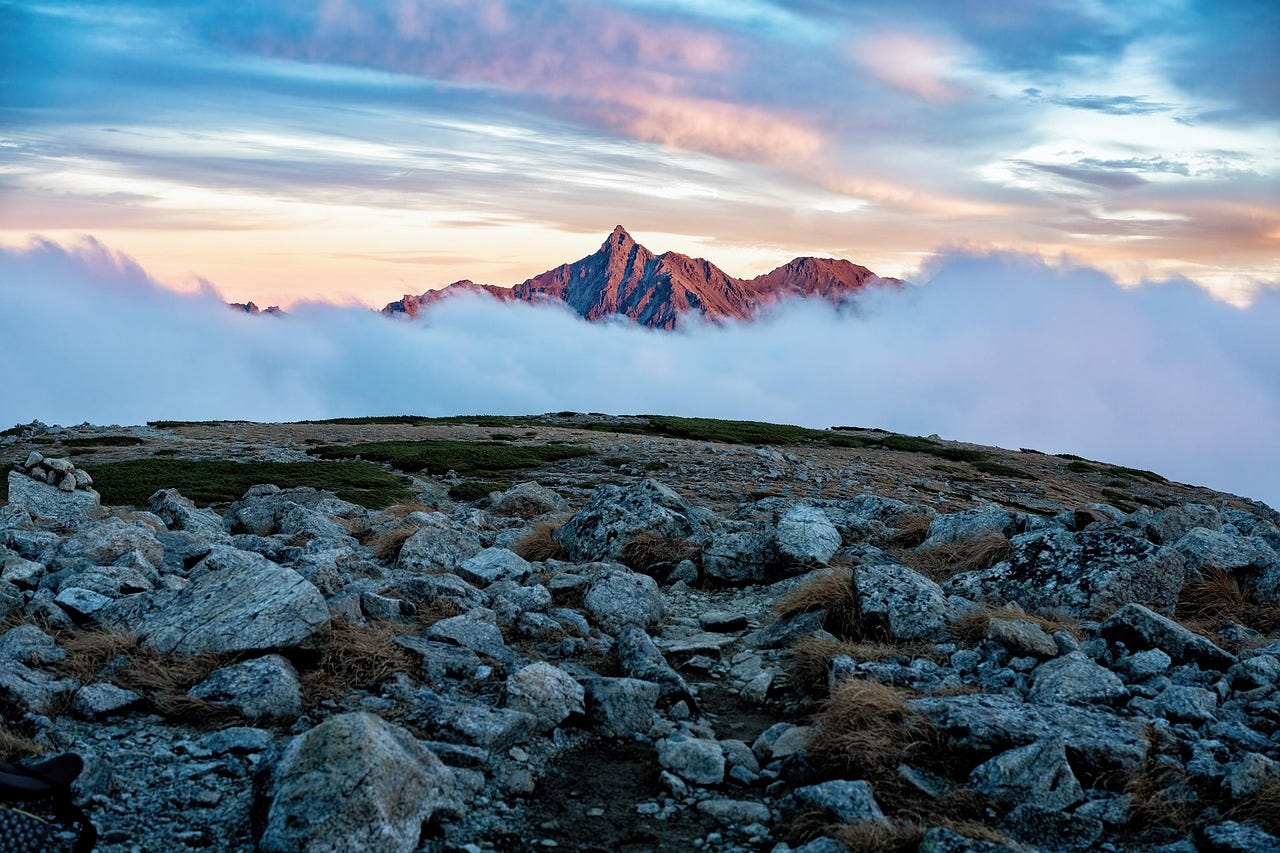
If you can, take five minutes to sit with the image of the mountain—smoke, fire, trembling people, Moses going back and forth. Let yourself feel the weight of it. Then bring whatever keeps you at a distance from God and set it down at the foot of the mountain—not to be consumed by what you cannot survive, but to be carried by the One who already crossed the boundary on your behalf.
If you can’t yet do that—if God feels too large or too distant to approach—write down one word for what is in the way. Just one word. Bring it into the open, even if only before yourself and God. That is enough to begin.
If even that is too much today, receive only this: You have been borne on eagles’ wings. You did not fly here. You were carried. That was true for Israel, and it is true for you. Rest in the carrying. That is enough.
Say this prayer, as much of it as is true for you today: “Father, You are holy—and the gap is real. I cannot close it. But You bore me here on eagles’ wings, and You sent Someone to cross the boundary I couldn’t cross. I come to the foot of the mountain. I bring what I cannot fix. Thank You for the Mediator who absorbed the fire and came back alive. I am invited—not because I am clean enough, but because He is. Help me tremble rightly, and then draw near. Amen.”
That is enough for today.
Do not rush into God’s presence as though it costs nothing. But do not stay back as though you are too broken to come. The boundary has been crossed. You are invited.

The Bible for the Broken is published by Aurion Press LLC. © Aurion Press LLC. All rights reserved.