
Day 108—Offerings and Ark
When God Gives His People a Place to Find Him
However you can engage today, we’re here. Read, listen or both.
The written portion gives an overview, with verses broken down into smaller bites, and journaling/prayer prompts for reflection. In the podcast, Steve Traylor reflects on today’s passage with Scripture reading, a deeper pastoral teaching, and prayer (about 15 minutes). Perfect for morning coffee, commutes, or when your eyes need a rest.
📖 Resources: Printable Bible Book Guides (Genesis & Job) · Hard Questions, Honest Answers
Exodus 25:1-40
Take a slow breath before you begin.
God has finished establishing how Israel is to live. Now He turns to something different: where He intends to live. The command that opens this chapter is not a demand for obedience. It is an invitation to participate in something God wants to build. And the goal of everything that follows—the materials, the dimensions, the gold and acacia wood and hammered cherubim—is captured in a single sentence buried in verse 8: “Let them make me a sanctuary, that I may dwell among them.”
Not among the law. Not in the cloud on the mountaintop. Among them.
If you have ever felt that God was somewhere above you, behind a curtain, inaccessible—if you have prayed and heard nothing back, if you have opened your Bible and found only distance—you are about to read a chapter in which God designs the very architecture of meeting. He draws the blueprint Himself. He names the materials. He specifies the place. He makes the promise.
Today we see that the God of the Bible is not content with being worshipped from a distance. He is a God who moves in.
1. Willing and Welcome
Exodus 25:1-9
Yahweh spoke to Moses, saying, 2 “Speak to the children of Israel, that they take an offering for me. From everyone whose heart makes him willing you shall take my offering. 3 This is the offering which you shall take from them: gold, silver, bronze, 4 blue, purple, scarlet, fine linen, goats’ hair, 5 rams’ skins dyed red, sea cow hides, acacia wood, 6 oil for the light, spices for the anointing oil and for the sweet incense, 7 onyx stones, and stones to be set for the ephod and for the breastplate. 8 Let them make me a sanctuary, that I may dwell among them. 9 According to all that I show you, the pattern of the tabernacle, and the pattern of all of its furniture, even so you shall make it.
God begins with the heart, not the material.
Notice what the instruction does not say. It does not say, “Collect an offering from all the people.” It says to receive offerings from everyone who gives willingly with his heart. The Hebrew emphasizes genuine, spontaneous generosity—not coerced contribution, not religious obligation extracted under social pressure. God wants what is freely given, because forced worship is not worship at all. It is performance.
This is the same God who had just legislated rest, release, and provision for the poor. Now He is asking for building materials—and asking in a way that reveals something about His own character. A God who refuses to coerce the heart even in the building of His own sanctuary is a God who wants relationship, not compliance. The tabernacle could only be built with willing hands because it could only be inhabited by a willing God.
The materials themselves—fifteen categories from gold to gem-set onyx—speak to a project of remarkable beauty and care. God is not asking His people to build Him a bare utility structure. He is asking them to bring the finest things they own, the things plundered from Egypt (Exodus 12:35-36), the things that now represent the riches of their liberation. Their freedom is being shaped into a house of meeting. And notably, it required all of them. The tabernacle was not built by one person in private. Hundreds of people brought what they had—gold and linen and goat hair and oil—and their separate offerings became, together, the place where God would dwell. That pattern still holds. What isolated faith struggles to sustain, the gathered community carries.
Verse 9 introduces a phrase that will echo through the rest of Exodus: according to the pattern. This is not a casual instruction. The earthly tabernacle, as the writer of Hebrews later explains, was a copy and shadow of heavenly realities (Hebrews 8:5). Every dimension mattered. Every material was specified. Getting it right was not about aesthetic precision—it was about faithful correspondence to a reality more true than anything Israel could see.
Journaling/Prayer: What are you withholding from God right now—not out of rebellion, but simply because you feel you have so little left to give?
Depleted people are not disqualified from this passage. Even the smallest willing offering—one honest sentence of prayer, five minutes of attention—is received by a God who asked for willingness, not volume. If you can, bring whatever is genuinely yours to give today. If you cannot even do that, simply notice: you are here. That, too, is something.
2. Throne and Testimony
Exodus 25:10-22
10 “They shall make an ark of acacia wood. Its length shall be two and a half cubits, its width a cubit and a half, and a cubit and a half its height. 11 You shall overlay it with pure gold. You shall overlay it inside and outside, and you shall make a gold molding around it. 12 You shall cast four rings of gold for it, and put them in its four feet. Two rings shall be on the one side of it, and two rings on the other side of it. 13 You shall make poles of acacia wood, and overlay them with gold. 14 You shall put the poles into the rings on the sides of the ark to carry the ark. 15 The poles shall be in the rings of the ark. They shall not be taken from it. 16 You shall put the covenant which I shall give you into the ark. 17 You shall make a mercy seat of pure gold. Two and a half cubits shall be its length, and a cubit and a half its width. 18 You shall make two cherubim of hammered gold. You shall make them at the two ends of the mercy seat. 19 Make one cherub at the one end, and one cherub at the other end. You shall make the cherubim on its two ends of one piece with the mercy seat. 20 The cherubim shall spread out their wings upward, covering the mercy seat with their wings, with their faces toward one another. The faces of the cherubim shall be toward the mercy seat. 21 You shall put the mercy seat on top of the ark, and in the ark you shall put the covenant that I will give you. 22 There I will meet with you, and I will tell you from above the mercy seat, from between the two cherubim which are on the ark of the covenant, all that I command you for the children of Israel.
God begins with the center.
In ancient building projects, you start from the outside and work in. God starts in the Holy of Holies and works outward—because worship is not designed from the perimeter toward the presence. It is designed from the presence outward. The ark is the first thing specified because it is the most important thing: not as a container, but as a throne. Israel’s God is not represented by a carved image. He is present between the cherubim, above the mercy seat, in the space where blood and law and gold converge.
The kapporeth—mercy seat, or better translated “atonement cover”—carries the weight of the entire sacrificial system in its dimensions. Underneath it: the tablets of the covenant, the written law of God. Literally inside the ark, the record of what Israel was obligated to be and repeatedly failed to become. And on top of it: the lid, the covering, the place where the high priest would one day sprinkle blood on the Day of Atonement. The law is held under the mercy. The record of failure sits beneath the place of forgiveness.
The poles in verses 13-15 deserve a moment. They were never to be removed from the rings. God’s presence was not a fixed monument—it was portable, moveable, always ready to go where His people went. For a people in the wilderness, and for every broken person reading this who has been through a season in which everything stable was stripped away, this is not an abstract point. The God who moves with you in the wilderness is the same God who dwells between the cherubim in glory.
And then verse 22—the promise that the whole structure exists to make possible: “There I will meet with you.”
Not “there you may seek me,” with no guarantee. Not “there I might be found if conditions are right.” There I will meet with you. God names the place. God makes the appointment. God shows up. The meeting is initiated and guaranteed from His side, not Israel’s. The people build the structure; God furnishes the presence.
Many interpreters see in the mercy seat a foreshadowing that finds its fullest expression in Romans 3:25, where Paul uses the same Greek word (hilastērion, the Septuagint translation of kapporeth) to describe Christ himself. Propitiation—the satisfying of God's just wrath through an atoning sacrifice—is precisely what the mercy seat pictured: the place where the law's verdict was covered by blood. Paul's use of the word is not accidental. The mercy seat was never only furniture. It was a promise God was already keeping.
Journaling/Prayer: Where do you feel farthest from God right now? Not theologically—experientially. The place that feels like distance, like silence, like absence. Bring that place to this verse.
God did not wait for Israel to find Him. He told them where to come. He still does. The throne of grace—Hebrews calls it that, drawing directly on this imagery—is not behind a veil you need to tear. If you know Christ, the veil is already gone (Matthew 27:51). You are invited in. If that feels empty rather than comforting right now, that is honest, and God can work with honest. Simply say: “I don’t feel it, but I believe it.” That is enough.
3. Bread and Belonging
Exodus 25:23-30
23 “You shall make a table of acacia wood. Its length shall be two cubits, and its width a cubit, and its height one and a half cubits. 24 You shall overlay it with pure gold, and make a gold molding around it. 25 You shall make a rim of a hand width around it. You shall make a golden molding on its rim around it. 26 You shall make four rings of gold for it, and put the rings in the four corners that are on its four feet. 27 The rings shall be close to the rim, for places for the poles to carry the table. 28 You shall make the poles of acacia wood, and overlay them with gold, that the table may be carried with them. 29 You shall make its dishes, its spoons, its ladles, and its bowls with which to pour out offerings. You shall make them of pure gold. 30 You shall set bread of the presence on the table before me always.
Fellowship is not an occasional event.
The bread of the Presence—twelve loaves according to Leviticus 24:5-9, one for each tribe—sat on this table before God continually. Always. The word is emphatic. Not when Israel was performing well. Not when the priests had kept themselves sufficiently holy. Always. The tribes were always before God, always represented in His sight, always held in the place of covenant fellowship.
This is a table, not an altar. Altars are for sacrifice; tables are for presence. The furnishing belongs to the language of shared meals and covenant hospitality. In the ancient world, to eat at someone’s table was to be bound to them in loyalty and safety. The host accepted responsibility for the guest; the guest accepted the relationship on the host’s terms. God was not simply tolerating Israel’s proximity. He was setting a table for them.
The bread of the Presence says that fellowship with God is not earned moment by moment by moral performance. It is established, continuous, and maintained by His own initiative. Israel brought new bread each week; God sustained the relationship daily. Their faithfulness was inconsistent—as ours is. His provision was unbroken.
The poles on this table, too, were designed for movement. Like the ark, the table of fellowship was never meant to be fixed in one place and left there. God’s people would wander. The table would come with them.
Journaling/Prayer: When did you last experience a genuine sense of being welcome before God—not just forgiven, but welcomed, as a guest at a table rather than a suppliant at a courthouse?
That experience may feel distant. Chronic illness, grief, spiritual exhaustion, and long silences from God can make the table feel very far away. You are not required to feel the warmth of it today. But you are allowed to want it again. If you can, tell God honestly: “I want to feel welcome again.” If even that is too much, simply notice: He set the table before you arrived. It is already there.
4. Light and Life
Exodus 25:31-40
31 “You shall make a lamp stand of pure gold. The lamp stand shall be made of hammered work. Its base, its shaft, its cups, its buds, and its flowers shall be of one piece with it. 32 There shall be six branches going out of its sides: three branches of the lamp stand out of its one side, and three branches of the lamp stand out of its other side; 33 three cups made like almond blossoms in one branch, a bud and a flower; and three cups made like almond blossoms in the other branch, a bud and a flower, so for the six branches going out of the lamp stand; 34 and in the lamp stand four cups made like almond blossoms, its buds and its flowers; 35 and a bud under two branches of one piece with it, and a bud under two branches of one piece with it, and a bud under two branches of one piece with it, for the six branches going out of the lamp stand. 36 Their buds and their branches shall be of one piece with it, all of it one beaten work of pure gold. 37 You shall make its lamps seven, and they shall light its lamps to give light to the space in front of it. 38 Its snuffers and its snuff dishes shall be of pure gold. 39 It shall be made of a talent of pure gold, with all these accessories. 40 See that you make them after their pattern, which has been shown to you on the mountain.
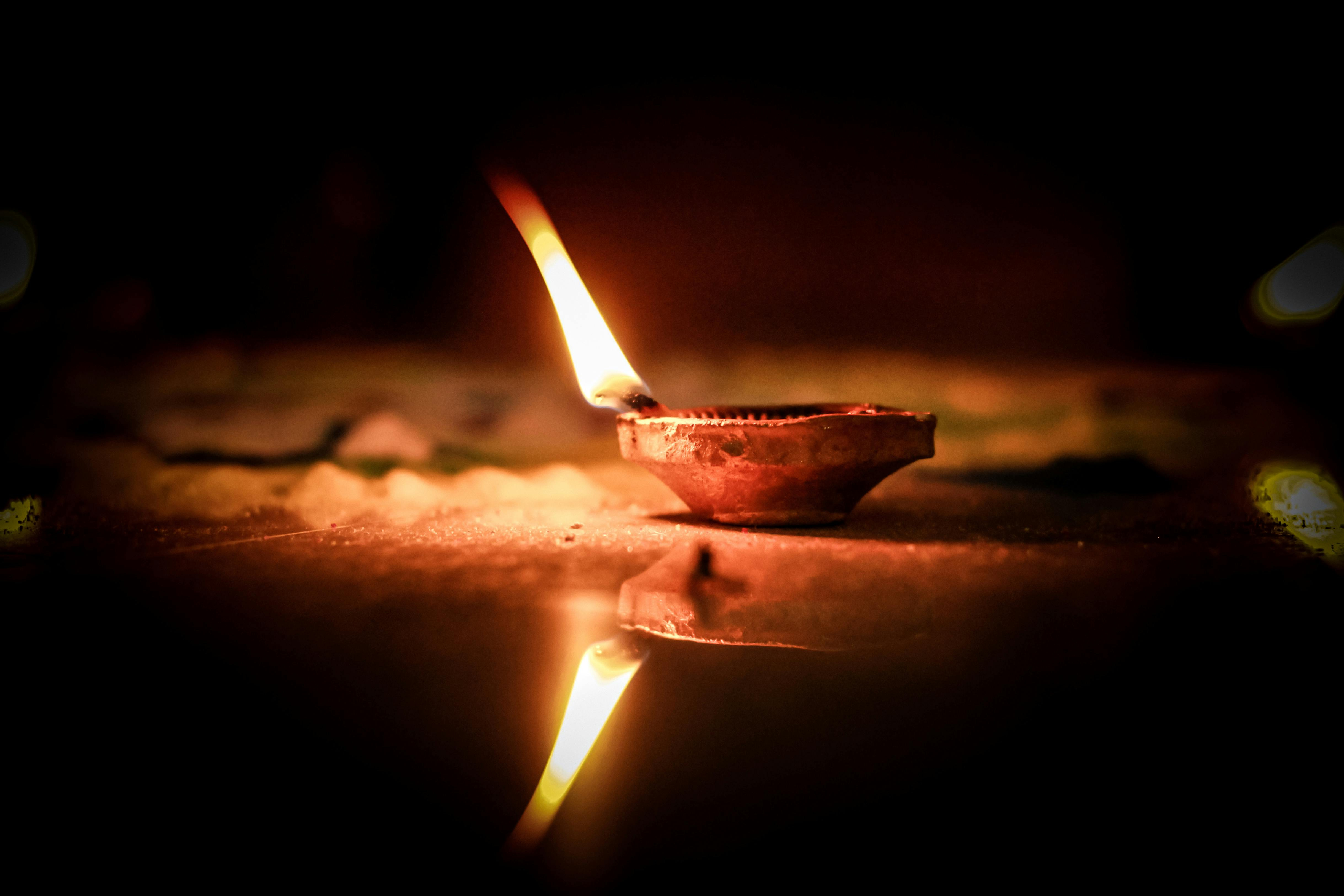
There was no window in the tabernacle. No natural light source reached the Holy Place. The only illumination came from the lampstand—seven lamps, perpetually tended, burning day and night.
The detail most easy to pass over is the most significant: the lampstand was hammered from a single talent of pure gold. Not assembled from pieces. Not welded from components. One continuous, unbroken piece of metal, beaten into shape by hammer and fire. The almond-blossom design carried meaning Israel would have recognized—the almond tree was the first tree to blossom after winter, the first sign that the frozen season was ending and life was returning.
Light, life, and the end of winter’s darkness—all embodied in the same furnishing, hammered out of a single piece of gold. This is not accidental. God is not a God of darkness. The one piece of furniture charged with illuminating the Holy Place was designed to look like spring.
For many in this study, the darkness has not felt optional. Grief does not announce when it will lift. Illness does not negotiate. The long seasons of spiritual silence can feel less like night and more like a permanent change of season. If that is where you are, do not force a resolution today. The lampstand is noted here. The light was always God’s provision, not the priest’s achievement. What he brought was oil. What God provided was the design, the gold, and the promise that the light would not go out.
Journaling/Prayer: Where has the darkness been most persistent for you—in your faith, in your body, in your relationships, in your sense of the future?
The light was always God’s provision, not the priest’s achievement. You are not required to generate your own illumination. You are invited to tend the lamp—to bring the oil, to stay close, to keep showing up—and to trust that the light not extinguished across all of Israel’s wanderings has not been extinguished in your life either. Is there any small act of tending—one prayer, one verse, one moment of stillness—you can offer today?
Action / Attitude for Today
Let this chapter settle on you as an invitation, not a demand.
God is designing a place to live with His people—not above them, not at a safe distance, not in the theological formulas they keep at arm’s length when things get hard. Among them. The curtains and the gold and the poles and the mercy seat are all in service of that single sentence: that I may dwell among them.
If you have energy to act today: identify one specific “pattern” in your life that helps you meet with God—a time, a place, a practice—and tend it deliberately today, not because it earns anything, but because it keeps you near the mercy seat. The lampstand didn’t generate light on its own; it was tended. Faith works similarly.
If you are too depleted for that: simply receive verse 22. “There I will meet with you.” God spoke that over a piece of furniture in the wilderness—and He speaks it over you in yours. You do not have to find your way to Him. He has already told you where He will be. Come with nothing if that is all you have. He is already there.
If even that is too much today—if the language of meeting and presence feels hollow because the silence has been so long: take only this small stone and put it in your pocket. He did not wait to be sought. He drew the blueprint. He named the place. He made the promise. A God who builds His own dwelling place among broken people has not abandoned the ones He is still building toward.
Say this prayer, as much of it as is true for you today: “Lord, I don’t always know where to find You. The distance feels real, even if I know theologically that it isn’t. But You are the One who drew the blueprint for meeting, who designed the place of atonement, who set the table and lit the lamp. I don’t have to find You. You told me where You’d be. Help me trust that today—that the mercy seat is not theoretical, that the table is set, that the light is still burning. I come with whatever I have. It is not enough, and You never asked it to be. Amen.”
The God who moves in with His people has not moved out.

The Bible for the Broken is published by Aurion Press LLC. © Aurion Press LLC. All rights reserved.