
Day 114—Fragrance and Foundation
When God Designs the Space Between Us
However you can engage today, we’re here. Read, listen or both.
The written portion gives an overview, with verses broken down into smaller bites, and journaling/prayer prompts for reflection. In the podcast, Steve Traylor reflects on today’s passage with Scripture reading, a deeper pastoral teaching, and prayer (about 15 minutes). Perfect for morning coffee, commutes, or when your eyes need a rest.
📖 Resources: Printable Bible Book Guides (Genesis & Job) · Hard Questions, Honest Answers
Exodus 30:1-38
Take a breath before you open this chapter.
We are deep inside the tabernacle instructions now—days of altars and curtains and priestly garments and ordination ceremonies. These chapters are written as commands to craftsmen and priests, not as invitations to readers. None of us will ever stand in these rooms or carry these poles or tend these lamps. Reading detailed instructions for a place you can only imagine, for a system you will never operate, can make the material feel distant. If these chapters have felt slow or hard to enter, that is an honest response.
But Exodus 30 holds something worth pausing over. Five separate sets of instructions crowd this single chapter: a small golden altar positioned at the very threshold of God’s presence, a ransom paid for every counted life, a bronze basin for washing before approach, a sacred oil that transforms what it touches, and an incense compound so holy it must never be replicated for ordinary use. They seem like separate items. They are not. Each one answers the same question: How do human beings come near to a holy God without being destroyed by the distance?
The answer God gives is not “try harder” or “come cleaner.” The answer is: I will design the approach. I will prescribe the way in. I will put in place what you cannot provide for yourself.
We have seen this logic throughout the tabernacle instructions—in the priests’ garments, in the mercy seat, in the golden plate that read Holy to the LORD. Exodus 30 continues in the same direction. The tabernacle is not a monument Israel built to honor God from below. It is a system God designed so that Israel could reach Him at all.
Today we see that every element of the approach to God—the smoke that rises, the ransom that is paid, the washing that is required, the oil that sets apart, the incense that must not be mixed with anything common—teaches the same essential truth: nearness to God is not something the human heart can manufacture. It is something God provides.
1. Altar and Ascent
Exodus 30:1-10
“You shall make an altar to burn incense on. You shall make it of acacia wood. 2 Its length shall be a cubit, and its width a cubit. It shall be square, and its height shall be two cubits. Its horns shall be of one piece with it. 3 You shall overlay it with pure gold, its top, its sides around it, and its horns; and you shall make a gold molding around it. 4 You shall make two golden rings for it under its molding; on its two ribs, on its two sides you shall make them; and they shall be for places for poles with which to bear it. 5 You shall make the poles of acacia wood, and overlay them with gold. 6 You shall put it before the veil that is by the ark of the covenant, before the mercy seat that is over the covenant, where I will meet with you. 7 Aaron shall burn incense of sweet spices on it every morning. When he tends the lamps, he shall burn it. 8 When Aaron lights the lamps at evening, he shall burn it, a perpetual incense before Yahweh throughout your generations. 9 You shall offer no strange incense on it, nor burnt offering, nor meal offering; and you shall pour no drink offering on it. 10 Aaron shall make atonement on its horns once in the year; with the blood of the sin offering of atonement once in the year he shall make atonement for it throughout your generations. It is most holy to Yahweh.”
The altar of incense is small—about eighteen inches square and three feet tall, gold-covered, portable, horned at the corners like the altar of burnt offering. But its placement tells you everything about its significance. God places it in the Holy Place, directly in front of the veil that separates the Holy Place from the Most Holy Place where the ark rests. No other piece of furniture is closer to the presence of God without being behind the veil itself.
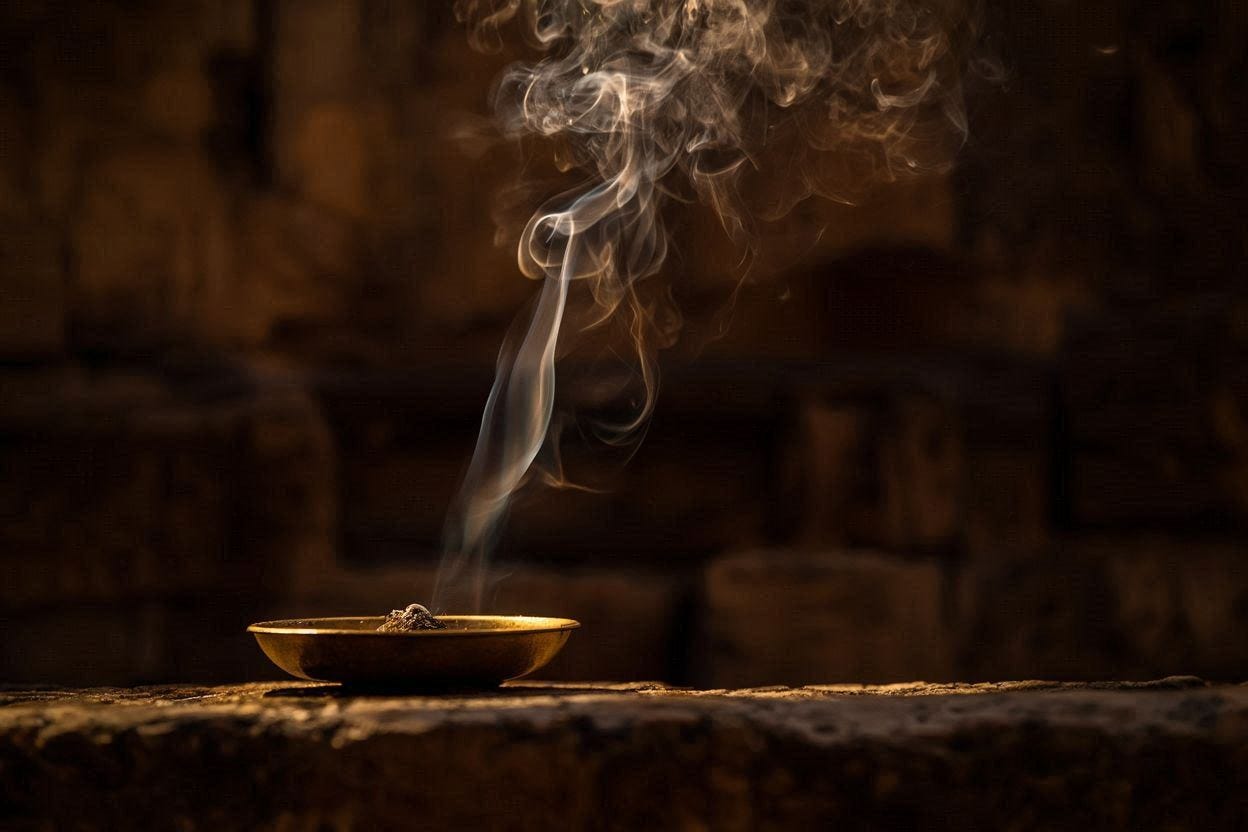
The smoke from this altar was meant to drift toward and through the veil. Many interpreters across church history have seen this as deliberate: the incense was prayer made visible—rising, fragrant, reaching through the curtain into the place where God dwelled.
The pattern is morning and evening, without interruption: perpetual incense before the LORD. Not when the priests found it meaningful—every morning when the lamps were tended, every evening when they were lit. The approach continued whether or not the worshipper felt like approaching.
God designed the worship to continue even when the heart had gone quiet.
One constraint is worth holding: no “strange incense”—nothing substituted, nothing improvised—and no sacrifice offered on this altar. The text distinguishes the altar of incense from the altar of burnt offering in the courtyard. The bronze altar outside is where atonement is made. The golden altar inside is where atonement is remembered and enjoyed. The blood of the Day of Atonement reached even this altar’s horns once a year, but the incense altar itself is not a sacrifice. It is a response. Prayer is not the place where atonement is accomplished—it is how we draw near to the God who accomplished it.
Journaling/Prayer: When you come to God in prayer—however rarely or faithfully—what do you feel? Freedom to approach, or heaviness about whether you’ve earned it?
The priests didn’t approach because they had accumulated enough good days to justify the walk to the altar. They approached because God had designed the approach, lit the fire, and instructed them to come. The incense belonged to the encounter, and the encounter was God’s design, not their achievement. If prayer feels heavy or reluctant right now, you don’t have to resolve that feeling before you come. The altar is already lit.
2. Ransom and Recognition
Exodus 30:11-16
11 Yahweh spoke to Moses, saying, 12 “When you take a census of the children of Israel, according to those who are counted among them, then each man shall give a ransom for his soul to Yahweh when you count them, that there be no plague among them when you count them. 13 They shall give this, everyone who passes over to those who are counted, half a shekel according to the shekel of the sanctuary (the shekel is twenty gerahs); half a shekel for an offering to Yahweh. 14 Everyone who passes over to those who are counted, from twenty years old and upward, shall give the offering to Yahweh. 15 The rich shall not give more, and the poor shall not give less, than the half shekel, when they give the offering of Yahweh, to make atonement for your souls. 16 You shall take the atonement money from the children of Israel, and shall appoint it for the service of the Tent of Meeting; that it may be a memorial for the children of Israel before Yahweh, to make atonement for your souls.”
This instruction may feel like a pivot from the altar—practical, administrative, almost bureaucratic. It is not. It is one of the most sobering theological statements in the chapter.
When God commands a census, He simultaneously commands a ransom. Every head counted must submit a half-shekel—not based on wealth, not based on worth, not based on what a man had contributed to the community. The same from everyone: the prosperous merchant and the laborer who could barely afford it. Half a shekel each. No exceptions in either direction.
The reason is stated plainly: to make atonement for your souls.
To be numbered—to be counted, to be visible before God—is to be seen in your need for ransom. A census wasn’t just a headcount. It was a reckoning. Every name recorded was a life that required a substitute payment to stand before God without plague. There is a logic embedded in the act of numbering itself: to count a people is to claim them, to measure strength, to inventory what you believe belongs to you. The ransom interrupted that logic. It reminded Israel that every life being tallied did not ultimately belong to the census-taker, or to Israel’s military confidence. It belonged to God. The half-shekel said so plainly—and said it at the moment of counting, before any illusion of self-sufficiency could settle.
Every soul counted before God needs a ransom. And the ransom God has set is the same for every one of us.
The egalitarianism here is striking. The rich don’t pay more. The poor don’t pay less. Before the question of atonement, status levels. A wealthy man’s soul requires exactly the same ransom as a man with nothing. Neither can purchase his way to a better arrangement, and neither is too poor to be ransomed. The price is fixed. The access is equal.
Journaling/Prayer: Do you ever feel that your sin—or your status, your record, your history—puts you in a different category than other people before God? That what you’ve done might cost more than the standard ransom?
The half-shekel doesn’t ask how bad you were. It asks only: are you counted among His people? If you are, the ransom is already set. Jesus said He came to give His life “as a ransom for many” (Matthew 20:28). The New Testament writers understood this as the fulfillment of what the census payment was pointing toward—a ransom not in silver, but in blood, and not proportional to the severity of individual sin, but sufficient for all of it.
3. Washing and Welcome
Exodus 30:17-21
17 Yahweh spoke to Moses, saying, 18 “You shall also make a basin of bronze, and its base of bronze, in which to wash. You shall put it between the Tent of Meeting and the altar, and you shall put water in it. 19 Aaron and his sons shall wash their hands and their feet in it. 20 When they go into the Tent of Meeting, they shall wash with water, that they not die; or when they come near to the altar to minister, to burn an offering made by fire to Yahweh. 21 So they shall wash their hands and their feet, that they not die. This shall be a statute forever to them, even to him and to his descendants throughout their generations.”
The language is stark: wash—or die. Wash before entering the tabernacle. Wash before approaching the altar. Not once in a lifetime. Not once per ceremony. Every time, without exception, for every generation that follows.
The bronze basin stood between the altar of sacrifice and the entrance to the Tent of Meeting—between the place where the price was paid and the place where God was approached. The priests had to pass through the washing to reach the worship.
There is a logic to this that goes beyond hygiene. The altar of burnt offering dealt with the guilt of sin—the moral verdict. The laver addressed something else: the contamination of living in a world where sin is everywhere, where ordinary life accumulates what could not be brought near to holiness without cleansing. The priests moved in the world between ceremonies. They ate and worked and walked where things died and decayed and fell short. The washing said: you cannot carry the world with you into this place.
God does not just forgive the record; He cleanses the person. Atonement covers the guilt. Washing prepares the approach.
For broken readers who have lived through things that feel like contamination—grief that feels like it got inside them, trauma that left residue, seasons that stained—there is something here. God did not design the approach to His presence as a test you must pass in your own strength. He provided both the sacrifice and the basin. He is the one who designed the washing. The priests didn’t have to generate their own cleanliness; they simply had to use what God had put there.
Journaling/Prayer: Is there something you feel you need to wash off before you can come close to God—shame, grief, history, a season that feels like it left a mark?
The basin was always full. It was positioned before the entrance, not after it. God put the washing on the way in. He didn’t wait for you to arrive already clean. He designed the cleansing as part of the approach—as evidence that the One you’re coming to is the one who provides what you cannot provide for yourself. If you can’t feel clean today, name it honestly: I know I need what I cannot produce. I’m coming to the one who put the basin there.
4. Anointing and Appointment
Exodus 30:22-33
22 Moreover Yahweh spoke to Moses, saying, 23 “Also take fine spices: of liquid myrrh, five hundred shekels; and of fragrant cinnamon half as much, even two hundred and fifty; and of fragrant cane, two hundred and fifty; 24 and of cassia five hundred, according to the shekel of the sanctuary; and a hin of olive oil. 25 You shall make it into a holy anointing oil, a perfume compounded after the art of the perfumer: it shall be a holy anointing oil. 26 You shall use it to anoint the Tent of Meeting, the ark of the covenant, 27 the table and all its articles, the lamp stand and its accessories, the altar of incense, 28 the altar of burnt offering with all its utensils, and the basin with its base. 29 You shall sanctify them, that they may be most holy. Whatever touches them shall be holy. 30 You shall anoint Aaron and his sons, and sanctify them, that they may minister to me in the priest’s office. 31 You shall speak to the children of Israel, saying, ‘This shall be a holy anointing oil to me throughout your generations. 32 It shall not be poured on man’s flesh, and do not make any like it, according to its composition. It is holy. It shall be holy to you. 33 Whoever compounds any like it, or whoever puts any of it on a stranger, he shall be cut off from his people.’”
The recipe is precise: liquid myrrh, cinnamon, calamus, cassia—measured in shekels—blended with olive oil in the proportions of a perfumer’s craft. The result was not merely fragrant. It was transformative. Whatever this oil touched became holy—set apart, belonging entirely to God.
The tabernacle furnishings were anointed with it: the ark, the table, the lampstand, the altars, the basin. Aaron and his sons were anointed with it. The anointing transferred a status they did not inherently possess. The objects were wood and metal. The priests were mortal men. The oil made them what they could not make themselves: consecrated, set apart, fit for God’s service.
The prohibition is correspondingly total: do not reproduce this formula. Do not pour this oil on anyone outside the priestly calling. To privatize what God designated as sacred—to reduce this compound to something personal, aesthetic, or ordinary—was to be cut off. The oil was not a luxury. It was not a spiritual experience to be marketed or imitated. It was a boundary marker around the holiness of God.
God does not share the means of consecration with those who would make them common.
This sounds severe. But for broken readers, the severity runs in a different direction than they might expect. The prohibition is not against receiving the anointing—it is against pretending to manufacture one’s own. No one can anoint themselves into God’s service. No one can duplicate the oil that transforms an ordinary object into a holy one. The anointing comes from God, and it consecrates what it touches.
Journaling/Prayer: Have you spent energy trying to manufacture your own sense of spiritual acceptability—performing devotion, constructing a version of yourself you think God will find sufficient?
The priests didn’t make the oil. They received the anointing. What transformed them was not their effort but what was poured over them. The New Testament connects this imagery explicitly: the Holy Spirit is the anointing of the new covenant (1 John 2:27), poured out not by human effort but by divine initiative. You cannot anoint yourself. You can receive what God gives.
5. Incense and Intimacy
Exodus 30:34-38
34 Yahweh said to Moses, “Take to yourself sweet spices, gum resin, onycha, and galbanum: sweet spices with pure frankincense. There shall be an equal weight of each. 35 You shall make incense of it, a perfume after the art of the perfumer, seasoned with salt, pure and holy. 36 You shall beat some of it very small, and put some of it before the covenant in the Tent of Meeting, where I will meet with you. It shall be to you most holy. 37 You shall not make this incense, according to its composition, for yourselves: it shall be to you holy for Yahweh. 38 Whoever shall make any like that, to smell of it, he shall be cut off from his people.”
The chapter ends where it began: incense. The composition here is specified at the same level of precision as the anointing oil—stacte, onycha, galbanum, pure frankincense in equal portions, salted, finely ground. And again, the same prohibition: do not reproduce this for personal use. Anyone who makes this incense for themselves, to enjoy the fragrance privately, is cut off.
Why? Because this particular scent belongs to the encounter with God. It was not recreational. It was not decorative. It was not available as a luxury or a symbol of prosperity. It was the fragrance of the place where God said, I will meet with you. To make it for yourself—to surround your ordinary life with the scent of the Most Holy—would be to flatten the distinction between the common and the sacred, to pretend that any room is the room where God meets with His people.
Some things cannot be domesticated without being destroyed.
The incense belongs to the approach. That is where it retains its meaning. And the approach is not the ordinary course of the day—it is the deliberate, designed act of coming near to God through the way He has prescribed.
This is not severity against the broken. It is protection of the holy for the broken. There is something irreplaceable about the designated space where God meets with His people—where the smoke rises toward the veil, where the ransom has been paid, where the hands have been washed, where the anointing oil has run over. To make that anywhere and everywhere is to make it nowhere in particular. God’s presence is not unavailable; it is specifically available in the way He has made it so.
What God has set apart as the place of meeting cannot be replaced by anything we construct for our own comfort. But what He has designed for our approach is enough—fully enough—for everything we bring.
Journaling/Prayer: What does it mean to you that God has designed the approach—not left you to find your own way in, but set up the altar and the basin and the oil and the incense himself?
If you’ve been trying to create your own version of access to God—your own rituals, your own formulas, your own conditions you have to meet before you can approach—consider letting that go. God has already put in place everything needed. The smoke is rising. The ransom is paid. The water is there. The anointing has been poured out in Christ. You don’t need to make your own incense. You just need to come through the way He has opened.
Summary
Exodus 30 is a chapter about the space between human beings and a holy God—and about what God puts there to make the crossing possible.
He places a golden altar at the very threshold of His presence: morning and evening, the smoke rises without interruption, carrying the prayers of people who could not cross the veil themselves. He requires a ransom for every counted life—the same half-shekel from every person, because the need for atonement is universal and the provision is equal. He positions a basin between the sacrifice and the sanctuary: wash before you come near, because even those whose guilt has been covered still carry the residue of the world they live in. He pours a holy oil over what He sets apart—not improvised by human effort, but compounded by divine prescription—and it makes holy whatever it touches. He prescribes an incense that belongs entirely to the encounter with Him, not to be replicated for comfort or pleasure, because the place where God meets with His people is not ordinary, and that extraordinary character must be protected.
Five provisions. One logic: God designs the approach because the approach is beyond us without Him.
The writer of Hebrews saw all of this as prefiguring Christ, who is our altar of intercession, our ransom, our cleansing, our anointing, and the new and living way into the presence of God (Hebrews 9–10). Many interpreters across church history have found the tabernacle pointing toward Him with remarkable precision—not mechanically, as if every object was a code to be cracked, but organically, as the whole system told one story: we cannot reach God on our own terms; He must provide the way.
Come through the way He has provided. It is the only way. It is a sufficient way. And He has made sure it never runs out.
Action / Attitude for Today
If you have been withholding prayer because you don’t feel clean enough, settled enough, or spiritually sufficient for the approach—consider that the incense was burning whether or not the people waiting outside felt ready. The altar was tended every morning and every evening. The smoke rose on behalf of people who were still in their ordinary lives, still carrying their failures, still not entirely sure what they believed.
Come anyway. The approach is God’s design, not your achievement.
If you have wondered whether your sin—the weight of it, the specific kind of it, the accumulated record of it—might require more than the standard ransom: it doesn’t. The half-shekel was the same for every man counted. The ransom Jesus paid is not calibrated to the severity of individual cases. It is sufficient. All of it.
If today you feel the residue of something—grief that got inside, a season that stained, shame that hasn’t lifted—name it honestly to God. The basin was positioned on the way in, not after arrival. He put the washing in the path of the approach. He designed the cleansing as part of the welcome.
Say this prayer, as much of it as is true for you today: “Lord, I keep trying to make my own way in—my own rituals, my own spiritual states, my own conditions before I approach. But You have already put in place everything needed. The ransom is paid. The washing is provided. The anointing has been poured out in Christ. I don’t have to manufacture access to You. I just have to come through the way You’ve opened. I’m coming. Whatever state I’m in. Amen.”
The way into God’s presence was His design, not yours. Everything needed for the approach, He has already provided.

The Bible for the Broken is published by Aurion Press LLC. © Aurion Press LLC. All rights reserved.