
Day 12 – Promise and Presence
Rainbow and Covenant
However you can engage today, we’re here. Read, listen or both.
The written portion gives an overview, with verses broken down into smaller bites, and journaling/prayer prompts for reflection. In the podcast, Steve Traylor reflects on today’s passage with Scripture reading, a deeper pastoral teaching, and prayer (about 15 minutes). Perfect for morning coffee, commutes, or when your eyes need a rest.
Genesis 9:1–29
The flood is over. The family has stepped onto dry ground.
Now God speaks—not with condemnation, but with blessing. Not with silence, but with promise. Not with abandonment, but with covenant.
If you have walked through devastation and emerged wondering what comes next—if you’re standing on the other side of crisis asking, “Can I trust God to stay?”—this day is for you.
Because today we discover: God does not just rescue. He covenants. He binds Himself to His people with promises that will not break.
1. Blessed and Renewed
Genesis 9:1–7
¹ God blessed Noah and his sons, and said to them, “Be fruitful, multiply, and replenish the earth. ² The fear of you and the dread of you will be on every animal of the earth, and on every bird of the sky. Everything that moves along the ground, and all the fish of the sea, are delivered into your hand. ³ Every moving thing that lives will be food for you. As I gave you the green herb, I have given everything to you. ⁴ But flesh with its life, that is, its blood, you shall not eat. ⁵ I will surely require accounting for your life’s blood. At the hand of every animal I will require it. At the hand of man, even at the hand of every man’s brother, I will require the life of man. ⁶ Whoever sheds man’s blood, his blood will be shed by man, for God made man in his own image. ⁷ Be fruitful and multiply. Increase abundantly in the earth, and multiply in it.”
God’s first words after the flood are not “Remember what I destroyed.”
They are: “Be blessed.”
The command echoes creation: “Be fruitful and multiply.” God is resuming what He began in Eden—filling the earth with image-bearers, establishing human stewardship, giving life and purpose.
But notice the differences.
In Eden, there was no fear between humanity and creation. Now there is. The relationship is broken, but not abandoned.
In Eden, humanity ate only plants. Now God permits eating meat—but with limits. Life is sacred. Blood represents life, and life belongs to God.
God reaffirms accountability: whoever takes human life will answer for it. Why? Because humanity bears God’s image. To murder is to assault the image of God Himself.
Even after judgment, God declares: you are made in My image. Your life matters. Your dignity stands.
For those who feel diminished by suffering or trauma—for those who wonder if they still have value after everything that’s been broken:
The flood did not erase God’s image in you.
Your worth is not contingent on circumstances. It is grounded in who made you.
Journaling/Prayer: Where do you feel your dignity has been stripped away by suffering or loss? Where do you need to hear again: “You are made in God’s image. You are blessed”?
If you can’t yet believe it, tell God that. Say: “I don’t feel blessed. I don’t feel valuable.”
And then ask: “Will You remind me who I am?”
He will. Not because you’ve earned it. But because it’s true.
2. Covenant and Sign
Genesis 9:8–17
⁸ God spoke to Noah and to his sons with him, saying, ⁹ “As for me, behold, I establish my covenant with you, and with your offspring after you, ¹⁰ and with every living creature that is with you: the birds, the livestock, and every animal of the earth with you, of all that go out of the ship, even every animal of the earth. ¹¹ I will establish my covenant with you: All flesh will not be cut off any more by the waters of the flood. There will never again be a flood to destroy the earth.” ¹² God said, “This is the token of the covenant which I make between me and you and every living creature that is with you, for perpetual generations: ¹³ I set my rainbow in the cloud, and it will be a sign of the covenant between me and the earth. ¹⁴ When I bring a cloud over the earth, that the rainbow will be seen in the cloud, ¹⁵ I will remember my covenant, which is between me and you and every living creature of all flesh, and the waters will no more become a flood to destroy all flesh. ¹⁶ The rainbow will be in the cloud. I will look at it, that I may remember the everlasting covenant between God and every living creature of all flesh that is on the earth.” ¹⁷ God said to Noah, “This is the token of the covenant which I have established between me and all flesh that is on the earth.”
God makes a covenant.
Notice who receives it: “you and your offspring after you... and with every living creature.” God’s covenant wasn’t just with Noah alone—it was with his entire household, his descendants, all creation. We are covenant people, not isolated individuals. God’s promises hold us collectively, not just personally.
Not a contract. Not a negotiation. A covenant—a binding promise initiated by God, sustained by God, and fulfilled by God.
Notice who establishes it: “I establish my covenant.”
Notice who remembers it: “I will remember my covenant.”
Notice who guarantees it: “I set my rainbow... I will look at it.”
This covenant does not depend on Noah’s faithfulness. It depends on God’s.
When the Bible says God “remembers,” it doesn’t mean He forgot. It means He acts on His prior commitment—He moves in faithfulness to what He has promised.
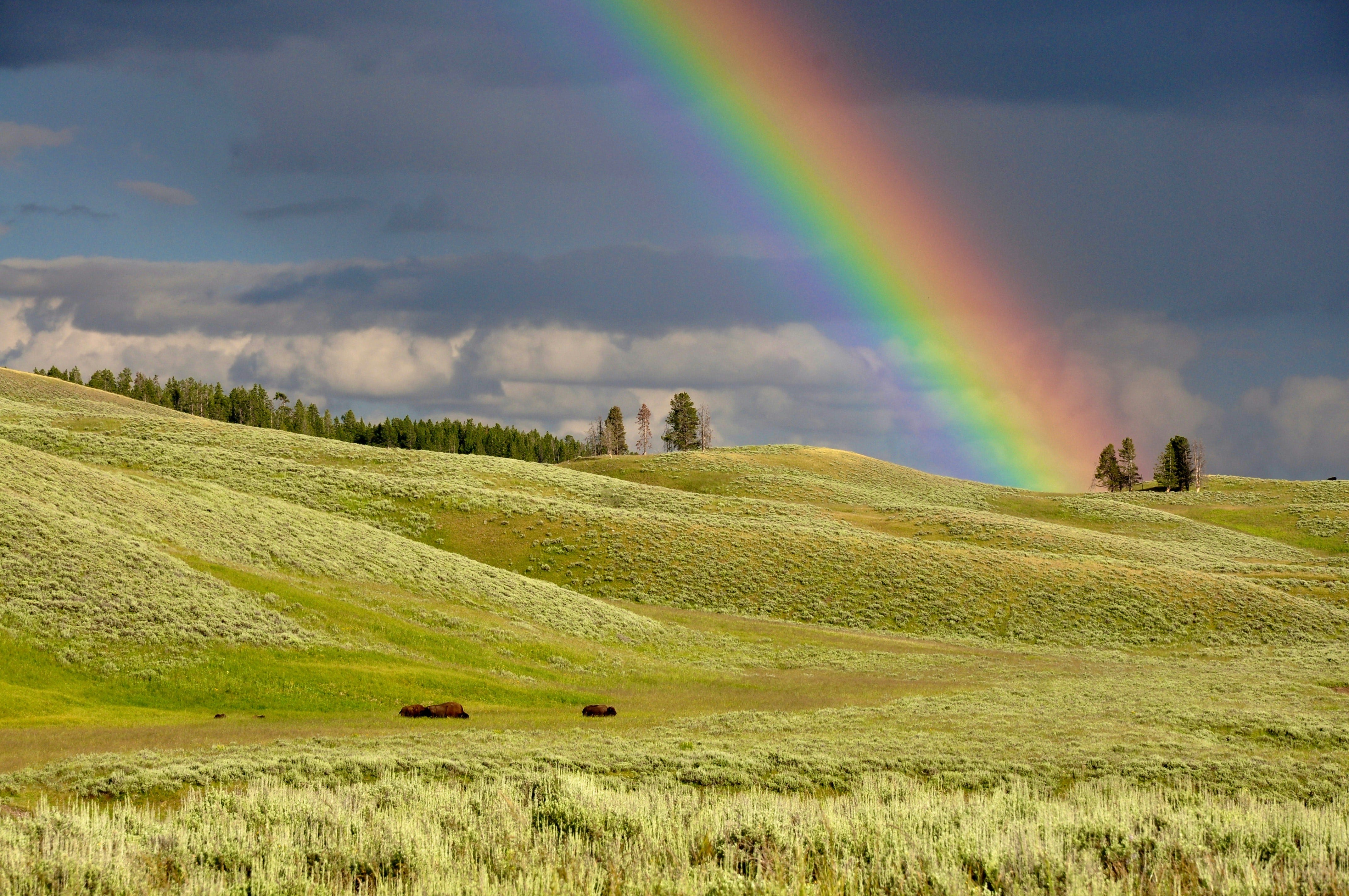
And the sign? A rainbow.
When storm clouds gather and rain falls—when the sky darkens and we fear the worst—the rainbow appears as a reminder: God will not destroy the earth again. The flood is over. The judgment has passed.
“I will look at it, that I may remember.” God binds Himself to this promise.
For those who trust in Christ—for those who have placed their faith in God’s covenant:
The rainbow does not mean there will be no more storms. It means God keeps His covenant promises.
You may face hard things again. You may face trials that feel impossible. In this broken world, suffering is real, and death comes for us all.
But here is the gospel hope: just as God remembered Noah and brought him through the waters of judgment, God remembers all who trust in Christ. He will not abandon His own. He will walk with you through it. And when your earthly life ends, His covenant—sealed in Christ’s blood—carries you safely through death into eternal life.
Noah was saved because he trusted God’s Word and obeyed. The rainbow reminds us that God is faithful to those who are His—not because of our perfect faithfulness, but because of Christ’s.
The waters will not have the final word. His covenant will.
Journaling/Prayer: What “storm clouds” are gathering in your life right now? What makes you afraid that the next crisis will be more than you can bear?
If fear is rising, tell God that. Say: “I’m afraid I can’t handle another hard thing.”
And then ask Him: “Will You show me the rainbow? Will You remind me of Your covenant?”
He will. Maybe not in the way you expect. But He will remind you: the storm will not have the final word.
3. Failure and Shame
Genesis 9:18–23
¹⁸ The sons of Noah who went out from the ship were Shem, Ham, and Japheth. Ham is the father of Canaan. ¹⁹ These three were the sons of Noah, and from these the whole earth was populated. ²⁰ Noah began to be a farmer, and planted a vineyard. ²¹ He drank of the wine and got drunk. He was uncovered within his tent. ²² Ham, the father of Canaan, saw the nakedness of his father, and told his two brothers outside. ²³ Shem and Japheth took a garment, and laid it on both their shoulders, went in backwards, and covered the nakedness of their father. Their faces were backwards, and they didn’t see their father’s nakedness.
And just like that—the hero stumbles.
Noah, the righteous man who walked with God, who survived the flood—plants a vineyard, drinks wine, becomes drunk, and lies naked in his tent.
Scripture is clear: drunkenness is sin. The Bible condemns it consistently (Ephesians 5:18, Proverbs 23:20-21).
Why? Not because God is a killjoy, but because drunkenness is destructive. It removes self-control. It clouds judgment. It replaces Spirit-control with substance-control.
As Calvin observed, “drunkards subvert their own understanding, and so far deprive themselves of reason as to degenerate into beasts.” They deface the image of God—that image of rationality, self-governance, and clear-minded worship.
Even the faithful fall. Even those God has used mightily can stumble. Even survivors of great trials can make foolish choices.
Noah was most vulnerable when the pressure was off. He had remained faithful through centuries of wickedness, but after the storm passed, his guard came down.
But notice—Noah’s sin is compounded by his son Ham’s response.
Ham sees his father’s nakedness and spreads the news. He dishonors him. The text suggests Ham took delight in his father’s shame—trying to make his father “seem vile” to his brothers.
This was not an accidental glimpse. This was deliberate dishonor.
Shem and Japheth respond with dignity. They take a garment, walk backward, and cover their father without looking. They honor him even in his disgrace.
Here’s the pastoral word for those struggling with their own failures:
Your sin is real. Your failure matters. Drunkenness—or whatever your stumbling point is—displeases God and harms you.
God does not forbid drunkenness arbitrarily. He forbids it because He loves you and knows what diminishes your humanity, what clouds the image He placed in you.
But your failure does not disqualify you from God’s covenant.
Noah’s drunkenness did not void the rainbow.
God’s promises do not rest on your perfection. They rest on His faithfulness.
Noah was declared righteous not because he never sinned, but because God showed him grace (Genesis 6:8). That same grace is available to you.
And here’s the word for those hurt by others’ failures—especially leaders, parents, or trusted people who fell:
You can grieve the sin without abandoning the person. You can acknowledge what was broken while still honoring what was good.
Shem and Japheth didn’t pretend Noah hadn’t sinned. But they covered him with compassion and dignity.
Journaling/Prayer: Where have you stumbled after a season of faithfulness? Where do you feel disqualified by your own sin or weakness?
If shame is pressing down on you, tell God that. Say: “I thought I was stronger. I’m ashamed.”
And then hear this: God’s covenant with you does not depend on your strength. It depends on His.
The rainbow still stands. His promises still hold—even when you fall.
If you’ve been wounded by someone else’s failure, tell God that too. Ask Him: “How do I honor them without excusing their sin? How do I walk in both truth and grace?”
He will show you. One step at a time.
4. Curse and Prophecy
Genesis 9:24–29
²⁴ Noah awoke from his wine, and knew what his youngest son had done to him. ²⁵ He said, “Canaan is cursed. He will be a servant of servants to his brothers.” ²⁶ He said, “Blessed be Yahweh, the God of Shem. Let Canaan be his servant. ²⁷ May God enlarge Japheth. Let him dwell in the tents of Shem. Let Canaan be his servant.” ²⁸ Noah lived three hundred fifty years after the flood. ²⁹ All the days of Noah were nine hundred fifty years, and then he died.
Noah wakes. He knows what Ham has done. And he pronounces a curse—not on Ham directly, but on Canaan, Ham’s son.
This is difficult. It raises questions about justice, generational consequences, and God’s sovereignty.
What we know: this curse is prophetic, not arbitrary. It anticipates the conflicts between Israel (descendants of Shem) and Canaan (descendants of Ham). Later Scripture will show the Canaanites’ rebellion against God and their eventual displacement.
But we must be clear: this curse was never about ethnicity or skin color. It was about the moral corruption of Canaanite culture.
And even within that cursed line, God’s grace remained available. Rahab the Canaanite believed and was saved (Joshua 2). She became part of the lineage of Christ (Matthew 1:5). Ruth the Moabite chose the God of Israel and also entered Christ’s genealogy.
Throughout Scripture, individuals from cursed or enemy nations found grace when they turned to God.
No people group—no matter how cursed—is excluded from God’s mercy.
But we also know this: curses are not the final word.
God’s covenant with Noah—the rainbow covenant—still stands. It covers all flesh, even those under curse.
And ultimately, the curse of sin itself will be broken not by human effort but by God’s own intervention through Christ.
For those wrestling with generational sin, family dysfunction, or patterns that feel inescapable:
You are not doomed to repeat the failures of those who came before you.
God’s grace can break cycles. His covenant is stronger than any curse.
Journaling/Prayer: What generational patterns—of sin, dysfunction, or brokenness—do you see in your family or in your own life? What feels inescapable?
If you feel trapped by the past, tell God that. Say: “I’m afraid I’ll never break free.”
And then ask Him: “Will You break what needs to be broken? Will You redeem what feels cursed?”
He can. And He will—not because you’re strong enough to escape, but because His covenant is strong enough to hold you.
Summary
God establishes a covenant with Noah and all creation: never again will a flood destroy the earth.
The rainbow appears as a sign—not just for humanity, but for God Himself. “I will look at it, that I may remember.”
God blesses Noah. God renews the mandate to fill the earth. God reaffirms the sacredness of life and the dignity of His image-bearers.
And then—Noah fails. He drinks too much. He is dishonored. But the covenant stands.
This is the pattern of Scripture: God’s promises do not rest on human faithfulness. They rest on His.
For those standing on the other side of devastation, wondering if they can trust God to stay:
The rainbow still arches across the sky. God has covenanted with you. He will not abandon you.
And even when you fail—even when you stumble shamefully—His promises remain.
Not because you deserve them. But because He is faithful.
Action / Attitude for Today
Today, look for the rainbow.
Not necessarily a literal one. But look for signs of God’s covenant faithfulness in your life:
A moment of unexpected peace
A provision you didn’t orchestrate
A relationship that hasn’t broken despite the strain
The simple fact that you’re still breathing, still here, still held
Choose today to trust God’s covenant promises—not because life is easy, but because God is faithful.
And if you’ve recently failed—if you’re carrying shame from a stumble after a season of strength—do this:
Let someone cover you.
Not in the sense of hiding your sin, but in the sense of receiving grace.
Tell one safe person: “I messed up. I need help.”
And then believe what God says: the covenant still stands. The rainbow is still there. You are still His.
If today you can’t do any of this—if you’re too tired, too ashamed, too numb—then simply notice this:
The rainbow is not dependent on you seeing it.
God’s covenant is not dependent on you feeling it.
It stands. It holds. It will not break.
And one day, when the storm clouds clear, you will see it again.
A Note on Genesis 10: Before moving to Genesis 11 (the Tower of Babel), we encourage you to read Genesis 10 on your own. It’s a genealogical record—the Table of Nations—showing how Noah’s three sons became seventy nations that spread across the earth. While it may seem like just a list of names, it’s actually profound: God promised Noah that his descendants would fill the earth (Genesis 9:1), and Genesis 10 shows that promise being fulfilled. Every name matters. Every lineage is part of God’s sovereign plan. Read it as a testimony to His faithfulness—and as preparation for Genesis 11, where humanity’s rebellion at Babel will scatter them further still.
The Bible for the Broken is published by Aurion Press LLC. © Aurion Press LLC. All rights reserved.