
Day 142—Light and Liberty
When Nothing Goes Dark and No One Stays Lost

However you can engage today, we’re here. Read, listen or both.
The written portion gives an overview, with verses broken down into smaller bites, and journaling/prayer prompts for reflection. In the podcast, Steve Traylor reflects on today’s passage with Scripture reading, a deeper pastoral teaching, and prayer (about 15 minutes). Perfect for morning coffee, commutes, or when your eyes need a rest.
📚 Resource Library:
Printable Bible Book Guides: Discipleship charts for books we’ve completed together
Hard Questions, Honest Answers: Deeper dives on difficult topics that arise along the way

Leviticus 24:1–9; 25:1–12, 23–24, 35–43, 47–55
Look at the lamp first.
Before the laws about land, before the trumpet call of Jubilee, before any of the social architecture God builds in chapter 25, Leviticus 24 opens with a simple command: keep the lamp burning. Pure oil. Pressed olives. Aaron’s responsibility, morning and evening, every day.
The lamp on the golden lampstand in the tabernacle’s Holy Place was the only light inside that tent. The coverings overhead were layered thick enough to block every ray of daylight. Without the lamp, the priests worked in total darkness. Without the lamp, nothing could be seen.
God did not want His tabernacle to go dark.
The word that appears three times in the first four verses is continually—“to make a lamp burn continually,” “Aaron shall keep it in order continually,” “he shall keep the lamps in order continually.” This repetition is deliberate. The lamp was not lit once and left. It required daily attention, daily oil, daily tending. Not because the light was fragile, but because maintaining it was itself the act of worship. And beside the lampstand, week after week, twelve loaves of bread sat on the gold table—one for each tribe of Israel, replaced fresh every Sabbath. The whole congregation brought the flour. Aaron arranged the loaves. The old bread was eaten by the priests in the holy place. The frankincense burned before God as a memorial. The pattern continued without interruption: light and bread, tended and renewed, week after week, month after month, year after year.
Together, these two objects filled the Holy Place with a simple theological statement: God provides for His people, and He does not stop.
Then chapter 25 widens the lens. If the lampstand expressed God’s unbroken provision in the daily rhythms of worship, the Sabbath year and the Year of Jubilee expressed it in the long rhythms of time. Every seventh year, the land rested—no sowing, no reaping, no tending of the vines. Every fiftieth year, on the Day of Atonement, a ram’s horn sounded across the land and liberty was proclaimed throughout Israel. Slaves went free. Land returned to its original families. Debts were released. The economy—not just of money but of belonging and place—reset to the pattern God had established at the beginning.
Today we see two things God has built into the center of Israel’s life together: a light that never goes dark, and a freedom that always returns.
1. Tended and True
Leviticus 24:1–9
Yahweh spoke to Moses, saying, 2 “Command the children of Israel, that they bring to you pure olive oil beaten for the light, to cause a lamp to burn continually. 3 Outside of the veil of the Testimony, in the Tent of Meeting, Aaron shall keep it in order from evening to morning before Yahweh continually. It shall be a statute forever throughout your generations. 4 He shall keep in order the lamps on the pure gold lamp stand before Yahweh continually.
5 “You shall take fine flour, and bake twelve cakes of it: two tenths of an ephah[a] shall be in one cake. 6 You shall set them in two rows, six on a row, on the pure gold table before Yahweh. 7 You shall put pure frankincense on each row, that it may be to the bread for a memorial, even an offering made by fire to Yahweh. 8 Every Sabbath day he shall set it in order before Yahweh continually. It is an everlasting covenant on the behalf of the children of Israel. 9 It shall be for Aaron and his sons. They shall eat it in a holy place; for it is most holy to him of the offerings of Yahweh made by fire by a perpetual statute.”
There is something quietly steadying in this passage—if you let it land. The entire nation contributed to keeping one lamp burning. Each tribe’s existence was represented by one loaf on the gold table. No one was forgotten. No tribe was left out. Every Sabbath the bread was renewed. Every day the lamp was tended. Israel could not see inside the Holy Place—only the priests could enter—but this is what they were doing in there: maintaining the signs of God’s ongoing care, tribe by tribe, day by day.
The light is not yours to keep alive.
If you are in a season where it feels like God has gone quiet, where the silence is less like peace and more like abandonment, where you cannot tell whether anything is still burning on your behalf—this passage is speaking to you directly. The lamp in the tabernacle was not visible to the people, but it was burning nonetheless. Aaron’s faithfulness in the dark tent did not depend on whether Israel could see the light. What God had declared would be maintained was being maintained, whether or not anyone standing outside knew it.
The bread of the presence was called, in Hebrew, “bread of the face”—bread eaten before the face of God. Twelve loaves, resting in the presence of the God who had called twelve tribes and claimed them as His own. Not twelve loaves of perfect obedience. Not twelve loaves of spiritual achievement. Twelve loaves of flour, representing twelve families of people who had built a golden calf in the desert and who would grumble their way through the wilderness—and who were still named, still held, still kept before the face of God.
Journaling/Prayer: Is there a part of your life right now that feels like it’s been left in the dark—a grief that hasn’t lifted, a relationship that seems forgotten, a prayer that keeps going unanswered?
The lamp in the tabernacle was being tended even when no one could see it. The God who required it to burn continually did not establish that requirement and then walk away. What He declares He will maintain, He maintains. You do not have to generate your own light in this season. In Christ, what you cannot see is still burning.
2. Liberty Proclaimed
Leviticus 25:1–12
Yahweh said to Moses on Mount Sinai, 2 “Speak to the children of Israel, and tell them, ‘When you come into the land which I give you, then the land shall keep a Sabbath to Yahweh. 3 You shall sow your field six years, and you shall prune your vineyard six years, and gather in its fruits; 4 but in the seventh year there shall be a Sabbath of solemn rest for the land, a Sabbath to Yahweh. You shall not sow your field or prune your vineyard. 5 What grows of itself in your harvest you shall not reap, and you shall not gather the grapes of your undressed vine. It shall be a year of solemn rest for the land. 6 The Sabbath of the land shall be for food for you; for yourself, for your servant, for your maid, for your hired servant, and for your stranger, who lives as a foreigner with you. 7 For your livestock also, and for the animals that are in your land, shall all its increase be for food.
8 “‘You shall count off seven Sabbaths of years, seven times seven years; and there shall be to you the days of seven Sabbaths of years, even forty-nine years. 9 Then you shall sound the loud trumpet on the tenth day of the seventh month. On the Day of Atonement you shall sound the trumpet throughout all your land. 10 You shall make the fiftieth year holy, and proclaim liberty throughout the land to all its inhabitants. It shall be a jubilee to you; and each of you shall return to his own property, and each of you shall return to his family. 11 That fiftieth year shall be a jubilee to you. In it you shall not sow, neither reap that which grows of itself, nor gather from the undressed vines. 12 For it is a jubilee; it shall be holy to you. You shall eat of its increase out of the field.
Notice when the Jubilee was announced: the tenth day of the seventh month—the Day of Atonement. Not a random date on the calendar. The year of liberty was proclaimed on the day when the high priest entered the Most Holy Place with the blood of the sacrifice, on the day when Israel’s sin was covered and the scapegoat carried their failures into the wilderness. Freedom from debt. Freedom from bondage. Return to belonging. All of it announced at the moment of atonement.
This is not coincidence. Jubilee and atonement belong together because freedom is grounded in forgiveness. You do not earn your way back to your inheritance. You do not accumulate enough spiritual credit to buy your way home. The trumpet that announced Jubilee was blown after the blood had been offered—after the way back to God had been opened. Freedom followed from that, not the other way around. The land Sabbath built the same theology into the agricultural year, requiring Israel to release their grip on the soil every seventh year and trust that God would provide—“I will command my blessing on you in the sixth year, so that it will produce a crop sufficient for three years” (25:21). The provision preceded the obedience. The promise came first.
If you are carrying something you feel you need to earn your way out of—a past failure, a relationship that shattered, a season of faith so thin you can barely call it faith—hear what the Jubilee announced: the terms of release are set by God, not by your performance. The trumpet sounds on the Day of Atonement. Not on the day you finally get it right.
Journaling/Prayer: Is there something you’ve been carrying—a sense of being lost, or dispossessed, or far from where you belong—that you’ve been trying to resolve on your own terms?
The Year of Jubilee was not something Israel achieved. It arrived on a calendar God had set before they entered the land. When Luke 4 records Jesus standing in the synagogue and reading “the year of the Lord’s favor” from Isaiah 61, then saying “Today this Scripture has been fulfilled in your hearing”—He was announcing that the Jubilee everyone had been counting toward had finally come, and that it was Him. You do not have to find your way back. He came to where you were lost.
3. Sojourners and Secured
Leviticus 25:23–24, 35–43, 47–49, 55
23 “‘The land shall not be sold in perpetuity, for the land is mine; for you are strangers and live as foreigners with me. 24 In all the land of your possession you shall grant a redemption for the land.
35 “‘If your brother has become poor, and his hand can’t support himself among you, then you shall uphold him. He shall live with you like an alien and a temporary resident. 36 Take no interest from him or profit; but fear your God, that your brother may live among you. 37 You shall not lend him your money at interest, nor give him your food for profit. 38 I am Yahweh your God, who brought you out of the land of Egypt, to give you the land of Canaan, and to be your God.
39 “‘If your brother has grown poor among you, and sells himself to you, you shall not make him to serve as a slave. 40 As a hired servant, and as a temporary resident, he shall be with you; he shall serve with you until the Year of Jubilee. 41 Then he shall go out from you, he and his children with him, and shall return to his own family, and to the possession of his fathers. 42 For they are my servants, whom I brought out of the land of Egypt. They shall not be sold as slaves. 43 You shall not rule over him with harshness, but shall fear your God.
47 “‘If an alien or temporary resident with you becomes rich, and your brother beside him has grown poor, and sells himself to the stranger or foreigner living among you, or to a member of the stranger’s family, 48 after he is sold he may be redeemed. One of his brothers may redeem him; 49 or his uncle, or his uncle’s son, may redeem him, or any who is a close relative to him of his family may redeem him; or if he has grown rich, he may redeem himself.
55 For to me the children of Israel are servants; they are my servants whom I brought out of the land of Egypt. I am Yahweh your God.
Three times in this chapter God identifies Israel as His servants—people He personally purchased out of slavery in Egypt. This is the ground beneath the entire Jubilee system. An Israelite who fell into debt and sold himself to another could not be owned permanently, because he was already owned—by God. The maximum term of servitude was until Jubilee, and then he went free.
Not because he had paid off his debt. Not because he had earned his release. But because God had already paid for him, and that prior claim could not be overridden by any subsequent transaction.
You are not outside the system.
Verse 23 is the hinge on which all of this turns: “The land shall not be sold in perpetuity, for the land is mine; for you are strangers and sojourners with me.” God does not say you are strangers before me, or strangers in my land, or strangers who must earn permanent residence. He says sojourners with me. The preposition matters. To be a sojourner with God is to be in His company, under His protection, held by the one who owns everything. You cannot be permanently dispossessed if the God you sojourn with owns the land you sojourn on.
If you feel like a stranger in your own life right now—displaced by illness, grief, or loss—this is the word the text speaks: you do not sojourn alone, and you do not sojourn on neutral ground. The God who said “the land is mine” is the God you sojourn with. That is not a threat. It is a protection. His prior claim on you overrides every loss, every transaction, every distance. The kinsman-redeemer who buys back what cannot redeem itself has already come, and He paid a price beyond anything the Jubilee system ever imagined.
Journaling/Prayer: Where do you feel most displaced right now—most like a stranger in a place that should feel like home?
The Jubilee system built into Israel’s law a guarantee that no one stayed permanently lost. Even if a kinsman-redeemer never came, the fiftieth year would. The calendar itself was arranged in the shape of promise: no matter how far from belonging you have traveled, return was built into the system. In Christ, that return has already been secured—not by a calendar, but by a cross.
Summary
Two chapters, one conviction: God builds return into everything He makes.
The lamp burns continually because God will not leave His people in the dark—not in the daily round of priestly duty, not in the long arc of human history. The bread sits week after week before the face of God because twelve tribes are held week after week in the presence of the God who called them. The sabbath year gives the land rest because the one who made the land is the one who provides from it. And the Jubilee—announced on the Day of Atonement, every fiftieth year—proclaims that debt and bondage and displacement are not the final word. They have a release date.
This is not optimism. It is architecture. God has built freedom and return into the structure of time itself—and then, when Jesus stood in the synagogue at Nazareth and announced “the year of the Lord’s favor,” He declared that all of it had been pointing to Him. In Him, the eternal Jubilee had arrived. The permanent lamp of the world had been lit. The bread of the presence was standing in their midst.
The light you cannot see may still be burning. The freedom you cannot feel has already been proclaimed. You are a sojourner—and the one you sojourn with owns everything.
Action/Attitude for Today
What does it look like to live as someone held by the God who built return into His calendar?
If you are barely holding on today—if the darkness feels total and you have nothing left to give—you do not have to sustain your own faith by sheer effort. That was never the assignment. What God has promised to maintain, He maintains. Your only task today is to stay near Him.
If you are in the middle of a long season of waiting—for something to be released, for something lost to be restored, for a change that feels like it will never come—what you are feeling is not evidence that God has forgotten. He is working on a timeline you cannot see yet. What He has promised, He has arranged. Your waiting is not empty. It is the space between the promise and its arrival.
If you are carrying someone else’s lost-ness today—watching a person you love drift further from belonging, further from their inheritance—pray toward your Kinsman-Redeemer. The one who can buy back what has been lost has already paid the price. No one is permanently out of His reach.
Say this prayer, as much of it as is true for you today:
Lord, I do not always know if the lamp is still burning. I cannot always see what You are doing in the dark. But I have read that You declared it would not go out—and that what You declare, You maintain. I want to trust that today. I want to believe that “sojourner with me” means something. That I am not wandering on unclaimed ground. That my losses are held by the Wne who owns everything, and that freedom has already been announced for me in Christ. I come as someone held, not abandoned. I receive that as true, even when it does not feel that way.
You sojourn with God, not merely before Him. His prior claim on you—secured in Christ—means no one and nothing can permanently dispossess you of what He has given.
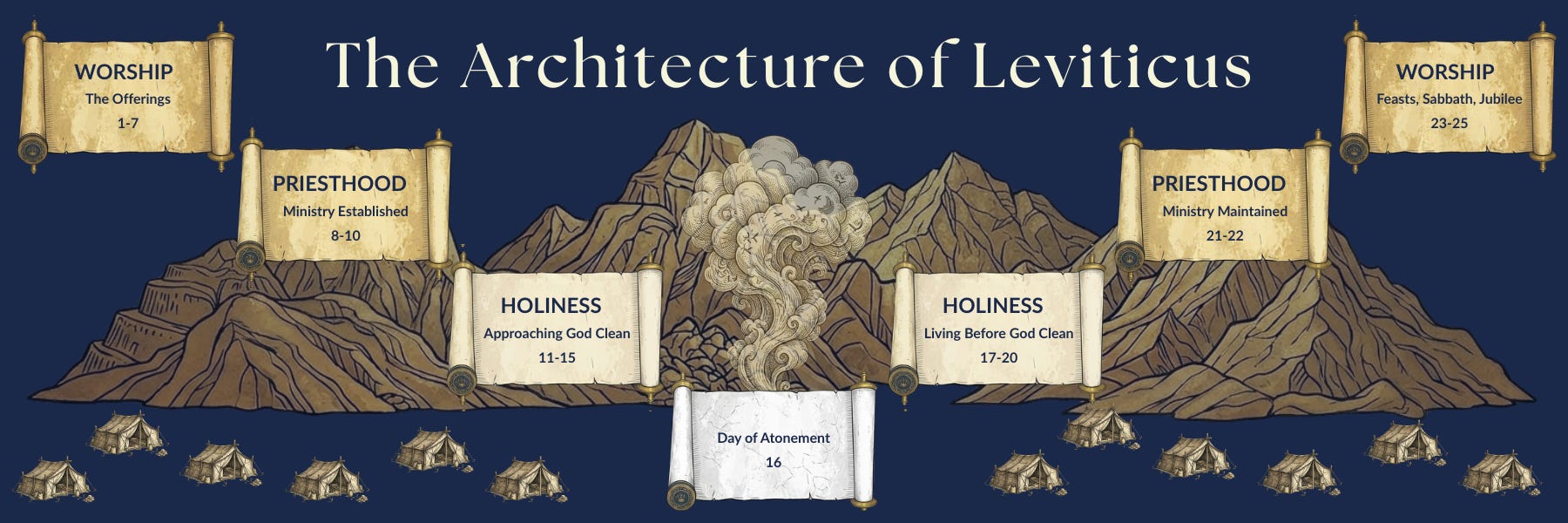
When we began Leviticus, we paused to look at its architecture — a mirrored structure with the Day of Atonement at its center. We did that because the shape is the message. Every offering, every priestly law, every purity code, every feast was arranged to point inward to the one moment when the distance between a holy God and a sinful people was closed. You could have read the chapters and missed it. Having walked the whole structure, you can now see what God designed. It was always about atonement. One day remains in Leviticus—outside “The Architecture of Leviticus.”

The Bible for the Broken is published by Aurion Press LLC. © Aurion Press LLC. All rights reserved.