
Day 144 — At Sinai Review
What the Law Has Done to You

However you can engage today, we’re here. Read, listen or both.
The written portion gives an overview, with verses broken down into smaller bites, and journaling/prayer prompts for reflection. In the podcast, Steve Traylor reflects on today’s passage with Scripture reading, a deeper pastoral teaching, and prayer (about 15 minutes). Perfect for morning coffee, commutes, or when your eyes need a rest.
📚 Resource Library:
Printable Bible Book Guides: Discipleship charts for books we’ve completed together
Hard Questions, Honest Answers: Deeper dives on difficult topics that arise along the way
Free Discipleship Charts — At Sinai
Most people read Leviticus and come away unsure what it means for their lives today. These two charts are designed to change that.
How God Shapes His People at Sinai distills ten principles from Leviticus and the opening chapters of Numbers — truths about access, holiness, guilt, rest, and what it means to have a Mediator standing before God on your behalf.
Bringing It to God turns those same ten principles into honest prayers for where you actually are.
Print them. Keep them. Come back to them.
Download both charts free here.
Sinai Review: Leviticus and Chronological Numbers 6-10 Passages
You finished Sinai.
That is not a small thing to say out loud. Most people who attempt to read the Bible straight through close it somewhere in the first seven chapters of Leviticus. The blood, the regulations, the priestly procedures stacked one on top of another—it defeats more readers than any other section of Scripture. And you are still here.
You stayed.
Whatever brought you through—determination, habit, the stubborn refusal to quit, or simply the grace of God keeping you in motion when you had no energy of your own—take a moment before you read another word and let that land: you now know something about this section that most people never learn. You know it from the inside.
Today there is no new Scripture. Instead, there is a question. You have just spent nineteen days learning how God designed an entire system—detailed, costly, blood-drenched—so that broken, sinful, golden-calf-building people could live near Him without being destroyed by His holiness. What has that done to you? What do you carry now that you didn’t carry when this section began?
Leviticus is not the part of the Bible where God became demanding and distant. It is the part where He solved the problem Exodus ended with. The tabernacle was built. The glory filled it. Moses couldn’t enter. And the question hanging over the camp in the final verses of Exodus was: how? How do people like these live near a God like this? Leviticus is the answer. Not one word of it asks Israel to invent the way of access—only to receive and obey the one God provided.
1. Why All This Blood?
Before we look at what Leviticus built, we need to answer the question you may have been carrying through all nineteen days of it: Why this way? If God created everything—if He set the rules—why did access to a holy God require so much blood? Why couldn’t He have designed something less violent, less visceral, less shocking?
It is the right question. And Leviticus answers it directly.
The answer begins with Leviticus 17:11—the verse that is the theological engine of the entire book: “For the life of the flesh is in the blood, and I have given it for you on the altar to make atonement for your souls, for it is the blood that makes atonement by the life.” Blood is not an arbitrary ritual requirement. Blood is life. And the reason blood is required for atonement is that sin—real sin, cosmic rebellion against the Author of Life—produces death. Not as an imposed penalty, like a fine for a parking violation. As an organic consequence, like moving away from the sun produces cold and darkness. When humanity turns from the Source of Existence, death is what follows. God did not invent that equation. He stated it honestly.
But someone might push further: Why did God design a universe where that equation is true? Did He have no other options? Scripture doesn’t answer this exhaustively—His ways are higher than ours, and the secret things belong to Him (Deuteronomy 29:29). We see only what He has chosen to reveal. But what He has revealed, and what careful theology can reason from it, points in this direction: the framework is not something God invented or could have invented differently as a matter of mere preference. It flows from who He is. God is not subject to an external law that demands blood. Rather, because God is Life itself—the ground of all existence—separation from Him is death, by definition. He couldn’t design it otherwise any more than the sun could design darkness to be something other than the absence of light. And He could not simply waive the consequence without denying His own nature—pretending that what fractures His creation doesn’t matter, that the rebellion of creatures against the Author of Life is a minor inconvenience. That would not be mercy. It would make Him a liar and an unjust judge. God cannot be other than He is. The equation isn’t a rule He imposed. It is a reality that flows from who He is—as best as we, finite creatures, are able to understand it.
This means a bloodless system would not have been more merciful. It would have been a lie—saying sin is trivial, your rebellion easily resolved. Because He is perfectly just, sin had to be answered. Because He is perfectly loving, He refused to let it be answered by the sinner alone. The system He designed placed the weight of death on a substitute—the worshipper’s hands pressed on the animal’s head, the transfer made visibly, the life given in place of the life that was owed. The blood on the altar was not primitive religion. It was the most honest accounting of what sin costs that human eyes could be shown.
And it was always pointing forward. The animal on the altar could absorb the penalty but could not remove the debt permanently—which is why the Day of Atonement came every year, and every year again. The repetition was not failure. It was the system’s own honest signal: this is not the final answer. Something greater is still coming.
The cross was not a New Testament invention. It was the fulfillment of what every altar at Sinai had been saying since the first sacrifice fell. When the writer of Hebrews says “without the shedding of blood there is no forgiveness” (9:22), he is not inventing a new theology. He is reading Leviticus correctly. And when Jesus said at the Last Supper “this is my blood of the covenant, poured out for many for the forgiveness of sins,” He was announcing that the preview had become the reality—once, finally, completely, never to be repeated.
Journaling/Prayer: Did the blood of Leviticus feel shocking to you—and has understanding why it was required changed anything?
The blood was not God being harsh. It was God being honest about what sin costs—and then paying it Himself.
2. The Architecture of Holiness
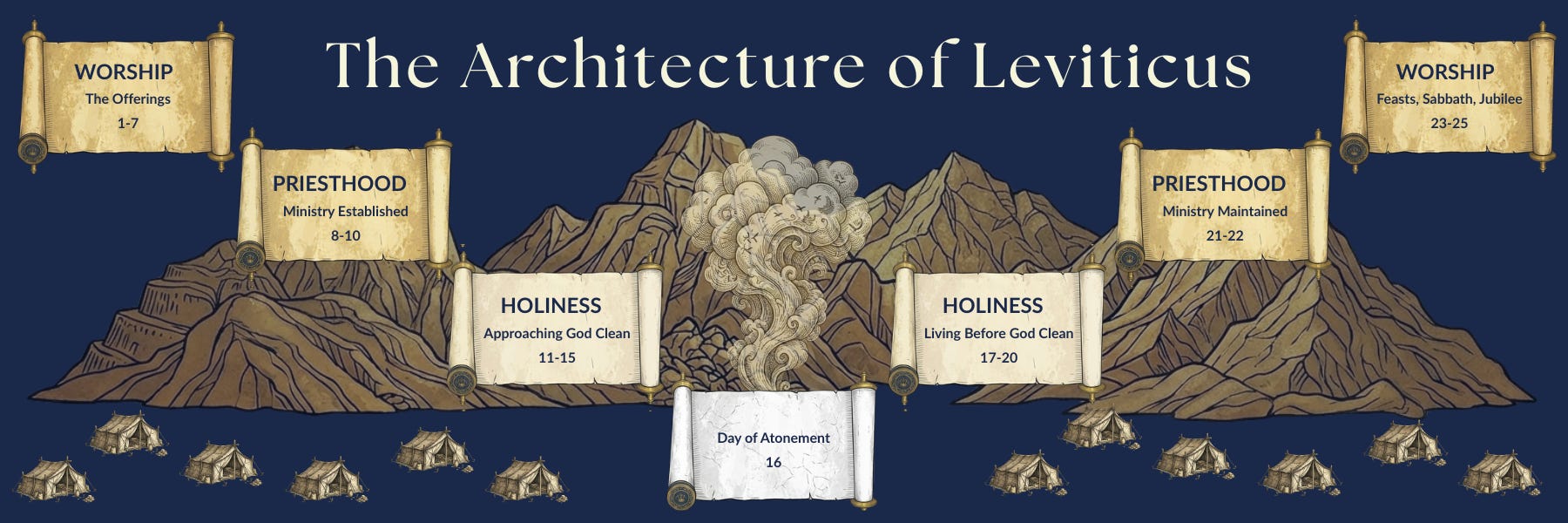
Look at the Architecture of Leviticus chart once more before you read this section.
What you will see is a book built like a cathedral. On the far left: Worship—the offerings, chapters 1 through 7. Then: Priesthood established, chapters 8 through 10. Then: Holiness in approaching God, chapters 11 through 15. And at the center, by itself, on its own scroll, in white rather than gold: the Day of Atonement. Chapter 16. Then the structure mirrors itself exactly: Holiness in daily life, chapters 17 through 20. Priesthood maintained, chapters 21 through 22. Worship—feasts, Sabbath, Jubilee—chapters 23 through 25. And framing the whole: the covenant declaration of Leviticus 26 and 27.
This is not accidental. Leviticus is a chiasm—a literary structure that places its most important content at the center and builds symmetrically outward in both directions. The center of Leviticus is not a law. It is not a regulation. It is a day: the one day of the year when the high priest entered behind the veil with blood, and everything Israel had accumulated—every sin, every failure, every breach of the covenant—was addressed at once.
Everything in Leviticus is built around that center.
The offerings in chapters 1 through 7 prepare the people to bring what the system requires.
The ordination in chapters 8 through 10 prepares the priest who will carry it into the holy place.
The purity laws in chapters 11 through 15 identify what stands between a person and that center—what must be addressed before anyone can approach.
And the feasts and holiness codes on the far side show what life looks like when the atonement has done its work: people who have been forgiven, living differently because of it.
The Hebrew word at the center of Leviticus is qodesh—holy, appearing more than eighty times in twenty-seven chapters. Holiness is genuinely dangerous to the unclean—Nadab and Abihu are in this book, consumed by fire for offering unauthorized worship on the day the tabernacle system was inaugurated. If you have wondered why that judgment fell on them and not on everyone who has ever been casual about the holy—you are asking exactly the right question.
The answer is that these severe, immediate judgments cluster at covenant threshold moments: the inauguration of the tabernacle here, the entrance into Canaan with Achan, the birth of the church with Ananias and Sapphira. They are not arbitrary. They are inaugural—God establishing the weight and terms of a new covenant reality at its founding, with the clarity that the moment demands. The community must understand what they are entering before they enter it. Once the lesson is given at the threshold, God’s patience extends into the long middle of the story—not because His holiness has diminished, but because the warning has already been given and the community is expected to hold it. The severity of these moments is not evidence of an unpredictable God. It is evidence of a God who takes the founding of His covenant community with absolute seriousness.
But the first word God speaks in Leviticus is a summons: “The LORD called to Moses and spoke to him from the tent of meeting.” He called. He initiated. Holiness is the fire that, when approached rightly, draws near—and the entire system exists because God refused to let His holiness be the final word on whether the broken could come.
Journaling/Prayer: Does holiness feel like distance or like nearness to you right now—and why?
You don’t have to be holy enough to come. You come through the One who is.
3. The Promise Israel Never Kept
Among all the laws God gave at Sinai, two were built on an extraordinary faith: the sabbath year and the Year of Jubilee.
Every seventh year, the land was to rest. No sowing. No harvesting. Whatever grew on its own belonged to the poor and the animals. Every fiftieth year—after seven sevens—the trumpet would sound on the Day of Atonement, and everything lost would be returned. Debts cleared. Land restored. Slaves freed. The word God used was deror—liberty. “Proclaim liberty throughout the land to all its inhabitants” (Leviticus 25:10). The Hebrew calendar had freedom built into its architecture.
These were not minor laws. They required Israel to trust God with their survival—to let the fields lie fallow, to release what they had accumulated, to believe He would provide what the seventh year could not produce.
Scripture never records Israel faithfully observing a Jubilee. Not once in the entire history of the monarchy does the text describe the trumpet sounding, the land reverting, the slaves going free as commanded. The sabbatical years went largely unkept as well. The silence of the record strongly suggests how rarely—if ever—this was practiced.
This is not a minor footnote. Second Chronicles 36:21 states explicitly that the seventy years of Babylonian exile were calculated by God to give the land the Sabbaths it had not received—”until the land had made up for its Sabbaths.” Leviticus 26:34–35 had warned of exactly this. God held the math. Every missed sabbath was counted.
What Israel never gave, God would eventually take—and what Israel never proclaimed, Christ would come to announce.
When Jesus opened the scroll at Nazareth, He did not arrive at the end of a nation that had faithfully kept Jubilee for centuries. He arrived at the end of a people whose record was marked more by silence than by trumpets—and He said: Today. The year of the Lord’s favor does not depend on Israel’s faithfulness to the calendar. It depends on the faithfulness of the One Israel’s calendar was always pointing toward. Many interpreters across church history have understood that moment as the Jubilee announcement the land had been waiting for—proclaimed once, in a body that would die and rise again, and holding still.
For the reader who has lost something and does not know how to get it back—who carries the weight of what was taken, the years that went missing, the life that feels foreclosed—hear this: the Jubilee that was never kept on earth has been proclaimed from heaven. By Someone with the authority to mean it.
Journaling/Prayer: Is there something in your life that feels permanently lost—something you’ve stopped expecting to be restored?
No loss is final in God’s economy. The trumpet has sounded. It will not sound again—because it does not need to.
What Sinai Has Built in You
You walked through a section most people never finish. You read the blessing, the Jubilee laws, the census lists, the Nazirite vows. You kept reading anyway.
What was actually happening in those nineteen days: you were being shown the weight of holiness and the cost of access—so that when you arrive at the cross, you will know what it cost. The “once for all” of Hebrews 10 does not land with full force until you have watched the annual repetition of the Day of Atonement and understood why it had to keep happening. The high priest entering behind the veil every year is what makes it stunning when Jesus enters the true sanctuary once and does not come back out—because the work was finished.
Not one word asks Israel to create the way of access. Every word asks them to trust and obey the one God already made.
You stayed through Sinai. That matters more than you know.
Action/Attitude for Today
If you are barely functioning and these weeks at Sinai were mostly survival—you read the words even when they didn’t connect, you stayed when you wanted to stop—that is enough. God works in what you give Him, even when what you give Him is “I read it and I don’t know what to do with it.” Stay.
If you have more capacity today, take a few minutes with this question: Which moment from Sinai stayed with you? Was it the fire that consumed the first offering and showed the people that God had accepted their worship? Was it Nadab and Abihu—and the sober reminder that proximity to holiness is not a casual thing? Was it “love your neighbor as yourself”—buried in the middle of a holiness code, as though God couldn’t talk about ritual without talking about relationships? Was it the Aaronic blessing, with God’s face turning toward you, lifted, shining? Name the moment. Hold it. That is your Sinai.
If one image from this section has settled into you—the scapegoat walking into the wilderness carrying everything, the priest standing between the living and the dead, the Jubilee trumpet that was supposed to sound on the Day of Atonement, the cloud lifting and the whole camp moving at once—let that be what you carry forward. You don’t need to have synthesized nineteen days into a systematic theology. You need one image that is true.
Say this prayer, as much of it as is true for you today:
“Father, I walked through Sinai. I didn’t understand all of it. Some days I barely understood any of it. But I saw something—I saw that You built the system, You provided the sacrifice, You designed the access. You put Your presence at the center of the camp and made it possible for broken people to live near You without being destroyed. That is the God I’m following. Not a God who stands at a distance setting standards I can’t reach—but a God who came close and made a way. Lead me into the wilderness. I’ll follow the cloud. Amen.”
God cleared the path. He supplied the offering. He placed His presence at the center. None of that was your job—and none of it depends on your strength now.
What Comes Next
In the days between Leviticus and Israel’s departure from Sinai, God counted His people—603,550 fighting men, arranged around the tabernacle with precise intentionality. Judah to the east. Reuben to the south. Ephraim to the west. Dan to the north. And at the center of everything: the tabernacle. Not at the edge of the camp, accessible to those willing to seek it at the margins. At the center—the organizing principle of the whole community, the holy God in the middle of His people.
Then the cloud lifted (Numbers 10:11), and Israel moved. After nearly a year at Sinai—receiving the law, building the tabernacle, learning what it meant to live near a holy God—they were finally ready to go.
Tomorrow that journey begins. It is not easy. But they carry into it everything Sinai built—and so do you.

The Bible for the Broken is published by Aurion Press LLC. © Aurion Press LLC. All rights reserved.