
Day 177—The River Stops
When God Goes First
However you can engage today, we’re here. Read, listen or both.
The written portion gives an overview, with verses broken down into smaller bites, and journaling/prayer prompts for reflection. In the podcast, Steve Traylor reflects on today’s passage with Scripture reading, a deeper pastoral teaching, and prayer (about 15 minutes). Perfect for morning coffee, commutes, or when your eyes need a rest.
📚 Resource Library:
Printable Bible Book Guides: Discipleship charts for books we’ve completed together
Hard Questions, Honest Answers: Deeper dives on difficult topics that arise along the way
JOSHUA RESOURCE: A map of the Joshua campaigns and a reference outline is available here.
Joshua 3
Read slowly today. This is one of those passages worth sitting with before you move on.
Forty years of wilderness. A generation of funerals. The bones of everyone who refused to trust God buried somewhere in the sand. And now—finally—the people are on the eastern bank of the Jordan, looking across at the land they were supposed to enter before most of them were born.
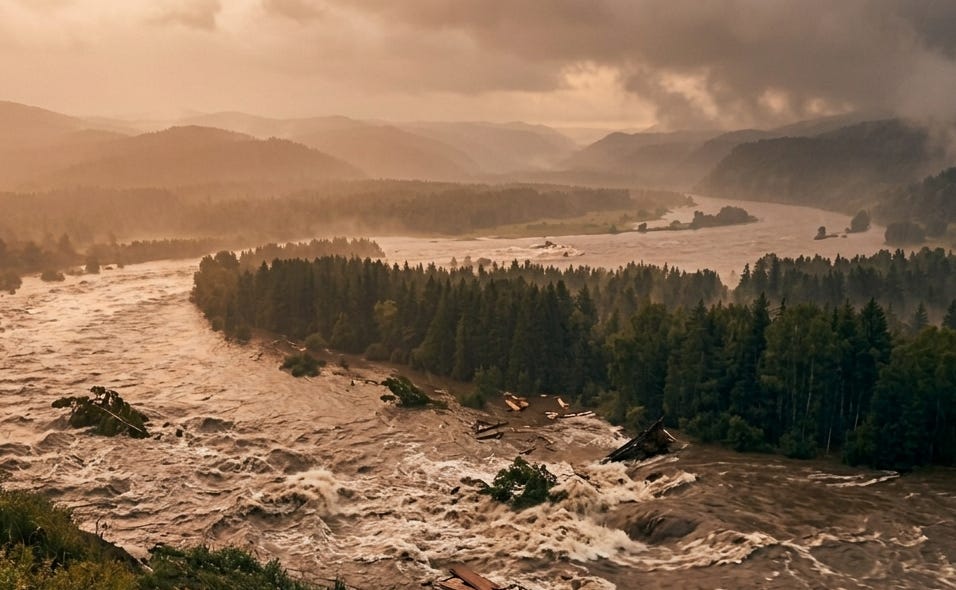
The river is at flood stage. The text is precise about this detail: harvest season, the Jordan overflowing every bank, running wide and fast and deep. This is not the best possible moment to attempt a crossing. It is, by ordinary calculation, one of the worst.
And God says: go.
Not when the water recedes. Not when conditions improve. Not when Israel has spent forty more years proving themselves worthy. The priests are to walk to the edge of the flood-swollen river and put their feet in.
And then something extraordinary happens—not before their feet touch the water, but when they do.
Today we see that God does not wait for favorable conditions to act on behalf of His people. Here, He chooses the flood season deliberately, so that when the river stops, there is no natural explanation left standing.
1. Sanctified and Still
Joshua 3:1-8
Joshua got up early in the morning; and they moved from Shittim and came to the Jordan, he and all the children of Israel. They camped there before they crossed over. 2 After three days, the officers went through the middle of the camp; 3 and they commanded the people, saying, “When you see the ark of Yahweh your God’s covenant, and the Levitical priests bearing it, then leave your place and follow it. 4 Yet there shall be a space between you and it of about two thousand cubits by measure—don’t come closer to it—that you may know the way by which you must go; for you have not passed this way before.”
5 Joshua said to the people, “Sanctify yourselves; for tomorrow Yahweh will do wonders among you.”
6 Joshua spoke to the priests, saying, “Take up the ark of the covenant, and cross over before the people.” They took up the ark of the covenant, and went before the people.
7 Yahweh said to Joshua, “Today I will begin to magnify you in the sight of all Israel, that they may know that as I was with Moses, so I will be with you. 8 You shall command the priests who bear the ark of the covenant, saying, ‘When you come to the brink of the waters of the Jordan, you shall stand still in the Jordan.’”
Three days of waiting at the river’s edge. The text doesn’t tell us what those days felt like—but we can imagine. The sound of water. The sight of the far bank. Two million people who have never been this way before, waiting for something they cannot yet see.
Joshua’s command to the people before anything happens: sanctify yourselves. Not “prepare your crossing strategy.” Not “scout for the shallowest ford.” Set yourselves apart. Get ready to receive what God is going to do.
The two-thousand-cubit gap between the people and the ark—roughly a half mile—was not cruelty. It was clarity. They could not get close to the holiness leading them. But they could keep their eyes on it. The ark went first, and they would know where to follow because they were watching the right thing.
God’s stated reason for the miracle is tucked into verse 7, easy to skip past: “Today I will begin to exalt you in the sight of all Israel.” The crossing was not only about geography. It was a public confirmation—the living God vouching for His new leader, so Israel would know the same presence that carried Moses through forty years would carry Joshua into the land. The miracle served the mission. And the mission required a leader the people could trust.
Journaling/Prayer: Is there someone in your life you’re having trouble following because you can’t yet see proof that God is with them—or a situation you’re reluctant to trust because you’ve never been this way before?
The people had never been this way before either. That was the whole point. They followed the ark anyway—keeping their eyes on the presence of God rather than the unfamiliarity of the terrain. What would it mean today to follow where the ark is going, even if the ground ahead looks nothing like where you’ve been?
2. Living and Leading
Joshua 3:9-13
9 Joshua said to the children of Israel, “Come here, and hear the words of Yahweh your God.” 10 Joshua said, “By this you shall know that the living God is among you, and that he will without fail drive the Canaanite, the Hittite, the Hivite, the Perizzite, the Girgashite, the Amorite, and the Jebusite out from before you. 11 Behold, the ark of the covenant of the Lord of all the earth passes over before you into the Jordan. 12 Now therefore take twelve men out of the tribes of Israel, for every tribe a man. 13 It shall be that when the soles of the feet of the priests who bear the ark of Yahweh, the Lord of all the earth, rest in the waters of the Jordan, that the waters of the Jordan will be cut off. The waters that come down from above shall stand in one heap.”
Joshua tells the people what is about to happen before it happens. Not as a hedge—as a witness. “By this you shall know that the living God is among you.” The miracle is coming, but it is not primarily about the crossing. It is about the knowing.
The title used for God twice in these five verses is worth stopping on: the Lord of all the earth. Not the God of Israel only. Not the deity of one nation claiming a small territory. The Lord of all the earth was going into the Jordan ahead of them—and what the Lord of all the earth chooses to stop, stops.
Seven nations are named in verse 10. The list is not rhetorical filler. These were real peoples with real armies, real cities, real history in the land. And the living God names every one of them and says: I will without fail drive them out. The promise is not vague. It is specific enough to be falsifiable—and specific enough to trust.
The sign God announces in verse 13 is precise: the moment the priests’ feet rest in the Jordan, the water upstream will be cut off and pile up in a heap. No gradual recession. No change in weather. A heap—at the moment of priestly contact.
God did not promise the water would stop before they stepped in. He promised it would stop when they did. The step was required. The water stopping was His.
Journaling/Prayer: Is there something God seems to be calling you toward that you’re waiting to move on until the conditions look more favorable?
The priests couldn’t see the water stopping from where they stood. They could only hear the promise. If you’re waiting for visible proof before you take a step God is calling you to take—that may be the wrong order. Not every step belongs to you. But the one in front of you might.
3. Feet and Flood
Joshua 3:14-16
14 When the people moved from their tents to pass over the Jordan, the priests who bore the ark of the covenant being before the people, 15 and when those who bore the ark had come to the Jordan, and the feet of the priests who bore the ark had dipped in the edge of the water (for the Jordan overflows all its banks all the time of harvest), 16 the waters which came down from above stood, and rose up in one heap a great way off, at Adam, the city that is beside Zarethan; and those that went down toward the sea of the Arabah, even the Salt Sea, were wholly cut off. Then the people passed over near Jericho.
The text is almost clinical in its precision. The feet of the priests dipped in the edge of the water—and the river stopped. Not when they arrived at the bank. Not when Joshua gave the order. When their feet touched.
The water upstream piled up at a town called Adam, near Zarethan. Adam is approximately sixteen miles north of the crossing point. The text names the location. This is not mythology; this is reported geography. The water stood in a heap sixteen miles away while the riverbed south of Adam ran dry from bank to bank.
The timing could not be coincidental. The Jordan was at its seasonal maximum—full banks, fast current, flood season. If God had chosen the dry season, skeptics might attribute the crossing to a natural ford. He chose the flood season so the only available explanation was the one the text provides: the Lord of all the earth stopped the water.
Many interpreters across church history have noted the echo of the Red Sea here—Psalm 114 joins the two crossings in a single breath of praise, as if they are bookends of the same redemptive act: Why was it, sea, that you fled? Why, Jordan, did you turn back (verse 5)? The same God who divided the sea divided the river. The wilderness was always meant to end at this bank.
Journaling/Prayer: When God has come through for you before—even once, even in a small way—have you let that memory do its proper work? Have you let it carry weight in what you’re facing now?
The people crossing the Jordan that day had heard the Red Sea story their whole lives. This moment was designed to remind them that the God of that story was still the God of this one. What you’ve heard about Him—and what He has done—is evidence. It is permitted to lean on it.
4. Standing and Sure
Joshua 3:17
17 The priests who bore the ark of Yahweh’s covenant stood firm on dry ground in the middle of the Jordan; and all Israel crossed over on dry ground, until all the nation had passed completely over the Jordan.
One verse. Seventeen words in English. And it contains an image worth sitting with for a long time.
The priests did not carry the ark to the far bank and wait there. They did not set the ark down and step back. They stood—in the middle of the Jordan, on ground that had been a riverbed moments before—and they did not move until every last person had crossed. Until all the nation had passed completely over.
The flood was held back. The priests bore the weight of the ark—the weight of God’s covenant presence—and they planted their feet and stood firm while two million people walked past them to the other side.
The holiness of God held back what would have drowned everyone else, and it did not move until the last person was safe.
There is no record that the priests were afraid. There is no record of what it felt like to stand in a dry riverbed with walls of water held upstream by nothing visible. There is only the statement: they stood firm. And they kept standing until the crossing was complete.
The chapter’s central image is here, in this verse: the ark—the symbol of God’s covenant presence—entered the flood before a single Israelite crossed. The danger was entered first by the presence of God. The people crossed safely because God went into the impossible place before them, and did not leave it until they were all through.
For those whose role right now feels like standing still while others move forward—holding something in place that you can’t see the purpose of, waiting in a position that makes no sense by ordinary logic—this verse is for you. Sometimes the calling is not to cross. It is to stand firm in the hard place until the people God entrusts to your faithfulness get safely to the other side.
Journaling/Prayer: Do you feel more like one of the crossing people right now, or more like one of the standing priests—holding something in place while everyone else seems to be moving?
Both roles are in this passage. Both are necessary. Both are ordered by God. If you are standing still in a hard place today, you are not forgotten—you may be the reason someone else gets across. Ask God to show you whose crossing your steadiness is serving.
Summary
Joshua 3 is not primarily a story about a river.
It is a story about a God who goes first—into the flood, into the impossible, into the place no one else would stand—so that His people can cross on dry ground. The ark went before. The priests stood in the riverbed. The water piled up sixteen miles north. And two million people walked across on ground that should have been underwater.
The Lord of all the earth did this. Not the God of one small nation making a local claim. The Lord who holds every water, every nation, every outcome—He stopped the Jordan at flood stage to confirm one thing: the living God is among you.
For those who belong to Him through Christ, this is not merely ancient history. It reveals the character of the God who still goes before His people and faithfully keeps His promises. He does not assign His people an impossible crossing and then watch from the bank. He enters the danger first. Many interpreters across church history have seen in the ark entering the flood before the people a picture that finds its fullest weight in Christ—who entered death before His people did, and did not come out until the way through was secure. The symbol pointed forward to the substance. God made a way where there was no way, and the One who went first into the impossible place was not a priest carrying a box. It was the Lord of all the earth Himself.
Action / Attitude for Today
If you’re standing at a flood-stage river today—facing something that looks impossible by every ordinary measure—notice what the text does not say. It does not say the water stopped before the priests arrived. It does not say God removed the obstacle before He asked them to move. The step came first. The stopping came when their feet touched.
This is not a formula. It is not “if you just take the first step, God will always part the river.” It is something more honest: God knew what He was going to do before the priests moved, and He designed the moment so that the step and the miracle would be joined. So that there would be no question about who stopped the water.
If you’re in the middle of a crossing right now—one foot on dry ground, one foot still in the Jordan—remember the priests who stood firm. They couldn’t see sixteen miles upstream. They couldn’t see the heap of water. They could only stand where they had been placed and trust that what God said He would do, He was doing.
If you can’t manage either of those today—if the river just looks like a river and God just feels absent—then take only this:
Say this prayer, as much of it as is true for you today: “Lord, I cannot always see what You are doing. But You are the Lord of all the earth, and You went into the impossible place before Your people did. Help me trust You where I cannot see. And where my faith is weak, hold me fast until You bring me through. Amen.”
The Lord of all the earth entered the Jordan before you. He made a way where there was no way—and He still goes before His people.

The Bible for the Broken is published by Aurion Press LLC. © Aurion Press LLC. All rights reserved.