
Day 178—Twelve Stones
When God Builds a Memory
However you can engage today, we’re here. Read, listen or both.
The written portion gives an overview, with verses broken down into smaller bites, and journaling/prayer prompts for reflection. In the podcast, Steve Traylor reflects on today’s passage with Scripture reading, a deeper pastoral teaching, and prayer (about 15 minutes). Perfect for morning coffee, commutes, or when your eyes need a rest.
📚 Resource Library:
Printable Bible Book Guides: Discipleship charts for books we’ve completed together
Hard Questions, Honest Answers: Deeper dives on difficult topics that arise along the way
JOSHUA RESOURCE: A map of the Joshua campaigns and a reference outline is available here.
Joshua 4
Take a moment before you begin.
Yesterday the Jordan stopped. The priests stood in the riverbed. The water piled upstream. Two million people crossed on dry ground. It was the kind of moment that changes everything—the kind you would think no one could ever forget.
God knew better.
Before the priests’ feet had even lifted from the mud, He was already making provision for the forgetting. Not because Israel was uniquely faithless. Because human memory is short. Because what overwhelms us today can become a vague impression by next year and a story we’re no longer sure actually happened by the year after that.
So before the crossing was even complete, God commanded: go back into the river and get twelve stones.
Today we see that God does not simply do great things—He builds the structures that help His people remember them.
1. Stones and Shoulders
Joshua 4:1-8
When all the nation had completely crossed over the Jordan, Yahweh spoke to Joshua, saying, 2 “Take twelve men out of the people, a man out of every tribe, 3 and command them, saying, ‘Take from out of the middle of the Jordan, out of the place where the priests’ feet stood firm, twelve stones, carry them over with you, and lay them down in the place where you’ll camp tonight.’”
4 Then Joshua called the twelve men whom he had prepared of the children of Israel, a man out of every tribe. 5 Joshua said to them, “Cross before the ark of Yahweh your God into the middle of the Jordan, and each of you pick up a stone and put it on your shoulder, according to the number of the tribes of the children of Israel; 6 that this may be a sign among you, that when your children ask in the future, saying, ‘What do you mean by these stones?’ 7 then you shall tell them, ‘Because the waters of the Jordan were cut off before the ark of Yahweh’s covenant. When it crossed over the Jordan, the waters of the Jordan were cut off. These stones shall be for a memorial to the children of Israel forever.’”
8 The children of Israel did as Joshua commanded, and took up twelve stones out of the middle of the Jordan, as Yahweh spoke to Joshua, according to the number of the tribes of the children of Israel. They carried them over with them to the place where they camped, and laid them down there.
Notice the posture: each of you pick up a stone on his shoulder.
Not a handful. Not a pebble slipped into a pocket. A stone large enough to be carried on a man’s shoulder—large enough to be seen, to require effort, to be unmistakably intentional. Twelve men, one from every tribe, went back into the riverbed while the priests still stood. They bent down in the place where the priests' feet had been planted—where the ark had been held aloft as all Israel passed by. They lifted.
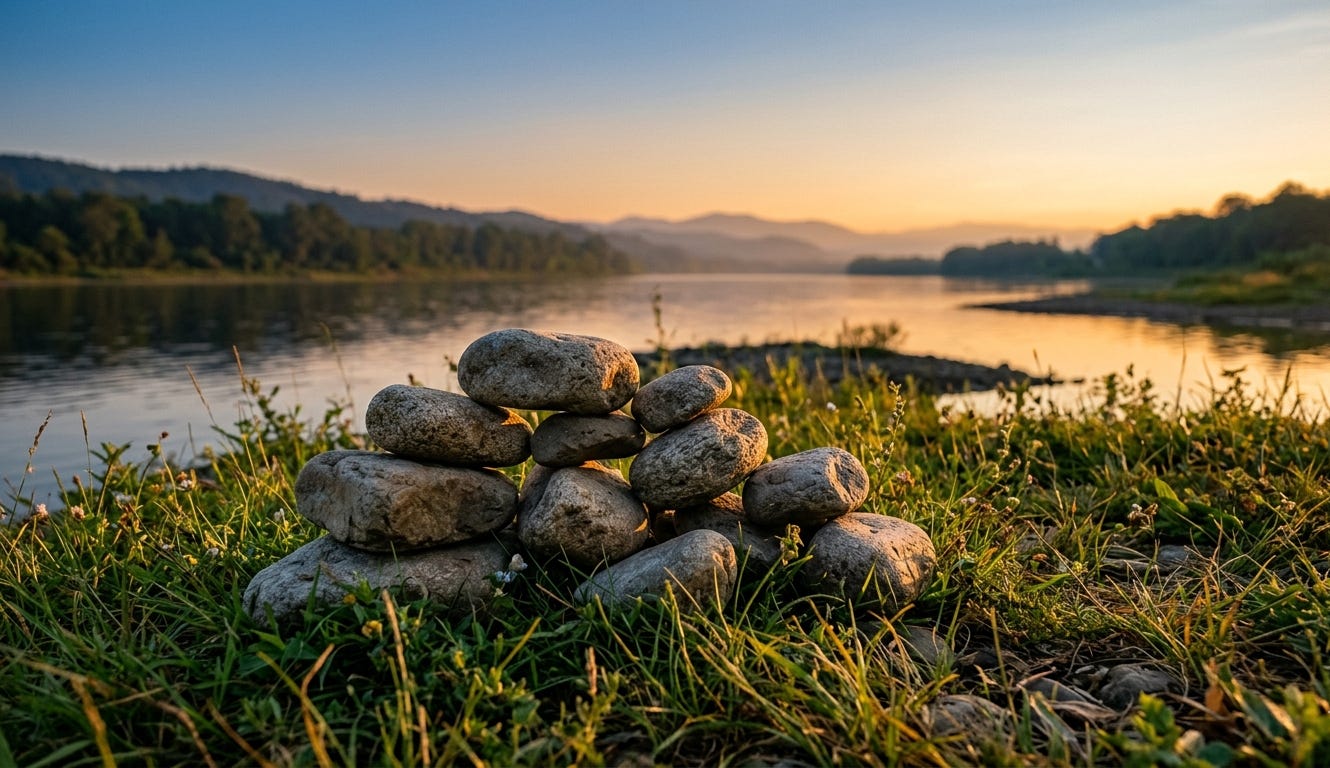
The monument they were building would not be a carved pillar or a constructed altar. It would be a heap of rough river stones—which meant a child who stumbled across it one day would know immediately that it was assembled, not natural. Stones don’t stack themselves.
God designed the memorial so that its strangeness would generate the question.
The question is the point: What do you mean by these stones? The monument was not meant to be self-explanatory. It was meant to prompt a conversation—to give fathers and mothers a moment to say: sit down. Let me tell you what God did.
Journaling/Prayer: Is there something God has done for you—even something old and distant—that has never been put into words for someone else?
God often strengthens our own remembrance when we speak His faithfulness aloud. The twelve men did not carry eloquent speeches. They carried stones. You do not have to have a polished testimony—just a true one.
2. Witness and Water
Joshua 4:9-13
9 Joshua set up twelve stones in the middle of the Jordan, in the place where the feet of the priests who bore the ark of the covenant stood; and they are there to this day. 10 For the priests who bore the ark stood in the middle of the Jordan until everything was finished that Yahweh commanded Joshua to speak to the people, according to all that Moses commanded Joshua; and the people hurried and passed over. 11 When all the people had completely crossed over, Yahweh’s ark crossed over with the priests in the presence of the people.
12 The children of Reuben, and the children of Gad, and the half-tribe of Manasseh crossed over armed before the children of Israel, as Moses spoke to them. 13 About forty thousand men, ready and armed for war, passed over before Yahweh to battle, to the plains of Jericho.
Verse 9 is easy to read past, and worth stopping for.
In addition to the twelve stones carried to the campsite, Joshua set up another twelve in the middle of the Jordan—in the very spot where the priests had stood. Not on the bank where people could see them. In the riverbed, where the water would return and cover them.
The text does not explain why Joshua erected this second set of stones. What is clear is that God considered the location itself significant enough to be marked—the precise place where His ark had stood while His people crossed. Beyond that, Scripture does not tell us. But what is also clear is that these stones would vanish from human sight the moment the water returned. No child would ever ask about them. No parent would ever point to them and explain.
Some of what God does is witnessed by no one but Him.
The tribes who had already received their inheritance east of the Jordan—Reuben, Gad, half of Manasseh—crossed over armed, fulfilling their promise to Moses. They had land. They had homes. They crossed anyway, to fight for brothers they could have left behind. Forty thousand men, prepared for war, passed before the LORD toward a battle that wasn’t theirs to win alone.
The crossing was complete. The priests were still in the river. And the water waited.
Journaling/Prayer: Have you done something faithful that no one witnessed—something you kept, or gave up, or endured, that no monument marks?
God keeps records that human memory cannot. Joshua set stones where no human eye would see them again, and the text reports their location as though it matters—because to God, it does. Your faithfulness in unseen places is not invisible to Him.
3. Rising and Returning
Joshua 4:14-19
14 On that day, Yahweh magnified Joshua in the sight of all Israel; and they feared him, as they feared Moses, all the days of his life.
15 Yahweh spoke to Joshua, saying, 16 “Command the priests who bear the ark of the covenant, that they come up out of the Jordan.”
17 Joshua therefore commanded the priests, saying, “Come up out of the Jordan!” 18 When the priests who bore the ark of Yahweh’s covenant had come up out of the middle of the Jordan, and the soles of the priests’ feet had been lifted up to the dry ground, the waters of the Jordan returned to their place, and went over all its banks, as before. 19 The people came up out of the Jordan on the tenth day of the first month, and encamped in Gilgal, on the east border of Jericho.
The water waited for the priests.
Not until Joshua commanded them to move. Not until the people had crossed and the stones had been placed and everything God had commanded through Moses had been carried out. The priests stood in the riverbed—holding the ark, holding back the Jordan—until the word came. Then their feet lifted. Then the water returned.
There is something here about the patience of those who hold the presence of God in difficult places. They do not move until they are told. They do not abandon the post because the waiting is long or the work looks finished to everyone else.
The text records that on that day, Yahweh magnified Joshua in the sight of all Israel. His authority was not established by his own speeches or strategies. God established it—through the crossing, through the obedience of the priests, through the moment when everyone saw that what Joshua commanded, God honored.
And the date: the tenth day of the first month. The same day, according to Exodus 12, that the Passover lambs were to be selected and brought into the household. Whether the text intends this connection or the timing was providential, many readers across the centuries have noted it—Israel entering the land on the anniversary of the night their liberation began.
Journaling/Prayer: Is there a place in your life right now where you are still standing in the riverbed—holding something, waiting for the word to move?
The priests were not failing. They were faithful. The water returned the moment they stepped out, not a moment before. There is a kind of obedience that looks like inaction from the outside and is, in fact, exactly what God requires.
4. Memory and Mission
Joshua 4:20-24
20 Joshua set up those twelve stones, which they took out of the Jordan, in Gilgal. 21 He spoke to the children of Israel, saying, “When your children ask their fathers in time to come, saying, ‘What do these stones mean?’ 22 Then you shall let your children know, saying, ‘Israel came over this Jordan on dry land. 23 For Yahweh your God dried up the waters of the Jordan from before you until you had crossed over, as Yahweh your God did to the Red Sea, which he dried up from before us, until we had crossed over, 24 that all the peoples of the earth may know that Yahweh’s hand is mighty, and that you may fear Yahweh your God forever.’”
The twelve stones are set up in Gilgal, and Joshua speaks their meaning directly.
The answer has two audiences and two purposes. First, the nations: that all the peoples of the earth may know the hand of Yahweh, that it is mighty. The stones were not just a private monument for Israel’s spiritual memory. They were testimony—a declaration available to every traveler, every enemy, every Canaanite who looked at that heap of river rocks and had to ask: where did those come from?
Second, Israel itself: that you may fear Yahweh your God forever. The word “fear” here is not terror. It is the awe-soaked reverence that comes from standing in the presence of something that is genuinely larger than you—from knowing, at a level below argument, that God is real and His power is not theoretical. The stones were meant to keep producing that knowledge in every generation that asked about them.
The monument was not about the past. It was about the future—the children who had not yet been born who would one day stand in front of those stones and need to know Who their God is.
Joshua’s explanation connects the Jordan crossing directly to the Red Sea: as Yahweh your God did to the Red Sea. Forty years earlier. A different generation. The same God. The stones said: what He did before, He did again. He is the same yesterday, today, and forever—not as a slogan, but as a lived pattern inscribed in stone.
For those who belong to Him today, the pattern continues. The God who parted the Sea and stopped the Jordan has not changed. His arm is not shortened. His faithfulness does not diminish with the passing of generations. The greatest memorial God has given His people is not a pile of stones but the death and resurrection of Christ—events we are repeatedly called to remember and proclaim. What He has done for His people in Christ is the same testimony, set not in Gilgal but in an empty tomb, and meant to be spoken out loud to the next person who asks.
Journaling/Prayer: Who in your life needs to hear what God has done for you—even imperfectly, even haltingly?
Israel was commanded to answer when their children asked. We are not Israel, and these stones are not ours to point to—but the pattern holds for all who belong to God: faith passed forward is faith that lives. You do not need an eloquent answer. You need a true one. The twelve men did not deliver speeches. They carried stones and set them down.
Summary
Israel is on the western bank. The river is flowing. The stones are piled in Gilgal.
Forty years in the wilderness, and now the first night in the land—and what God commanded before the crossing was complete was not a battle plan or a victory celebration. It was a memorial. Twelve stones from the riverbed, carried on the shoulders of twelve ordinary men, stacked in a field where children would someday stumble across them and ask.
God does not only rescue His people. He builds the structures that help them remember they were rescued.
The stones at Gilgal declared two things simultaneously: to the nations, the LORD is mighty; to Israel, fear Him forever. Both declarations were made not with eloquence but with river rocks—crude, heavy, unmistakable.
There is also a set of stones no one will ever see again, buried in the riverbed where the water returned. The text records them without explanation—Joshua set them up where the priests had stood, and then the water came back. Whatever their purpose, God considered that place worth marking. What is buried there is not forgotten by the One who commanded it.
The God who keeps that record keeps yours.
Action / Attitude for Today
If you have been carrying something God did—a moment of rescue, a season of grace, a provision you could not have manufactured—and it has never left your own memory, consider today whether it is time to put it into words for someone else.
It does not have to be formal. It does not have to be polished. The twelve men just bent down and picked up a rock.
If you are in a season where God’s past faithfulness feels distant or unreachable—where the crossing feels like someone else’s story—then stand at the stones and let the question work on you: What do these stones mean? The answer is not yours to manufacture. It was spoken before you were born, and it is still true: the waters were cut off. He did it. He is the same God.
If you cannot reach either of those places today—if memory and testimony both feel beyond you—then take only this:
There are stones in a riverbed that no one can see. God put them there. He keeps records in places human eyes cannot reach—and yours is among them.
Say this prayer, as much of it as is true for you today: “Lord, I forget too quickly. The crossing recedes and I live as though it didn’t happen. Remind me today of what You have done—in the long story of Your people, and in the smaller story of my own life. Help me carry one stone. Help me say one thing true. And where I cannot yet, let it be enough for now that You remember. Amen.”
What God has done for His people does not disappear when we forget it. The stones are still there.

The Bible for the Broken is published by Aurion Press LLC. © Aurion Press LLC. All rights reserved.