
Day 196—The Pattern Begins
What Happens When a Generation Forgets
However you can engage today, we’re here. Read, listen or both.
The written portion gives an overview, with verses broken down into smaller bites, and journaling/prayer prompts for reflection. In the podcast, Steve Traylor reflects on today’s passage with Scripture reading, a deeper pastoral teaching, and prayer (about 15 minutes). Perfect for morning coffee, commutes, or when your eyes need a rest.
📚 Resource Library:
Printable Bible Book Guides: Discipleship charts for books we’ve completed together
Hard Questions, Honest Answers: Deeper dives on difficult topics that arise along the way
Judges 1–2
Take a moment before you open Judges.
You have just finished Joshua. You have watched water pile up upstream, walls fall at a shout, and a woman named Rahab hang a scarlet cord from her window and live. You have heard Joshua say, “Not one word of all the good promises that the LORD had made to the house of Israel had failed; all came to pass.” You have watched three old servants of God buried in the land they waited forty years to enter.
And then you turn the page.
What you find in Judges is not a different God. It is the same God—faithful, patient, slow to anger. But it is a very different Israel. The generation that crossed the Jordan is giving way to a generation that never crossed anything. They received the land as inheritance, not as miracle. Many heard the stories but never embraced the God behind them for themselves.
Judges is honest about what happens next. It is not a pleasant book. It is a necessary one.
The book of Judges exists to make one thing viscerally clear: human beings, left to their own spiritual drift, will always choose comfort over obedience—and the consequences accumulate. The cycles within Judges worsen as the book progresses. The author also appends two additional stories at the end—not in chronological order, but placed there deliberately to show the full extent of what life looks like when God is refused as King. By the time you reach those final chapters, you will need to look away. The author intends that. The book's own repeated refrain—“In those days there was no king in Israel; everyone did what was right in his own eyes”—is not an argument for the monarchy. It is an indictment of what human beings do with freedom when they have forgotten God. Judges is not building toward a political solution. It is exposing a spiritual condition that no judge, and eventually no king, would be able to fix.
Before we go further, a word about what comes after Judges. The book does not end the Bible’s story. Tucked immediately after Judges is one of the most quietly beautiful narratives, not only in all of Scripture but in all of literature—a story of a foreign woman, a faithful man, and a God who is doing something in the background that no one in Judges can see yet. Stay with us. What comes after the darkness is worth waiting for.
Today we see that the pattern of Israel’s unfaithfulness began not with dramatic apostasy but with small compromises—and that God’s response to that unfaithfulness was not silence but confrontation, not abandonment but consequence, and not the end of His covenant but the beginning of a long, painful mercy.
1. Partial and Pressing
Judges 1:1-36
After the death of Joshua, the children of Israel asked of Yahweh, saying, “Who should go up for us first against the Canaanites, to fight against them?”
2 Yahweh said, “Judah shall go up. Behold, I have delivered the land into his hand.”
3 Judah said to Simeon his brother, “Come up with me into my lot, that we may fight against the Canaanites; and I likewise will go with you into your lot.” So Simeon went with him. 4 Judah went up, and Yahweh delivered the Canaanites and the Perizzites into their hand. They struck ten thousand men in Bezek. 5 They found Adoni-Bezek in Bezek, and they fought against him. They struck the Canaanites and the Perizzites. 6 But Adoni-Bezek fled. They pursued him, caught him, and cut off his thumbs and his big toes. 7 Adoni-Bezek said, “Seventy kings, having their thumbs and their big toes cut off, scavenged under my table. As I have done, so God has done to me.” They brought him to Jerusalem, and he died there. 8 The children of Judah fought against Jerusalem, took it, struck it with the edge of the sword, and set the city on fire.
9 After that, the children of Judah went down to fight against the Canaanites who lived in the hill country, and in the South, and in the lowland. 10 Judah went against the Canaanites who lived in Hebron. (The name of Hebron before that was Kiriath Arba.) They struck Sheshai, Ahiman, and Talmai.
11 From there he went against the inhabitants of Debir. (The name of Debir before that was Kiriath Sepher.) 12 Caleb said, “I will give Achsah my daughter as wife to the man who strikes Kiriath Sepher, and takes it.” 13 Othniel the son of Kenaz, Caleb’s younger brother, took it, so he gave him Achsah his daughter as his wife.
14 When she came, she got him to ask her father for a field. She got off her donkey; and Caleb said to her, “What would you like?”
15 She said to him, “Give me a blessing; because you have set me in the land of the South, give me also springs of water.” Then Caleb gave her the upper springs and the lower springs. 16 The children of the Kenite, Moses’ brother-in-law, went up out of the city of palm trees with the children of Judah into the wilderness of Judah, which is in the south of Arad; and they went and lived with the people. 17 Judah went with Simeon his brother, and they struck the Canaanites who inhabited Zephath, and utterly destroyed it. The name of the city was called Hormah. 18 Also Judah took Gaza with its border, and Ashkelon with its border, and Ekron with its border. 19 Yahweh was with Judah, and drove out the inhabitants of the hill country; for he could not drive out the inhabitants of the valley, because they had chariots of iron. 20 They gave Hebron to Caleb, as Moses had said, and he drove the three sons of Anak out of there. 21 The children of Benjamin didn’t drive out the Jebusites who inhabited Jerusalem, but the Jebusites dwell with the children of Benjamin in Jerusalem to this day.
22 The house of Joseph also went up against Bethel, and Yahweh was with them. 23 The house of Joseph sent to spy out Bethel. (The name of the city before that was Luz.) 24 The watchers saw a man come out of the city, and they said to him, “Please show us the entrance into the city, and we will deal kindly with you.” 25 He showed them the entrance into the city, and they struck the city with the edge of the sword; but they let the man and all his family go. 26 The man went into the land of the Hittites, built a city, and called its name Luz, which is its name to this day.
27 Manasseh didn’t drive out the inhabitants of Beth Shean and its towns, nor Taanach and its towns, nor the inhabitants of Dor and its towns, nor the inhabitants of Ibleam and its towns, nor the inhabitants of Megiddo and its towns; but the Canaanites would dwell in that land. 28 When Israel had grown strong, they put the Canaanites to forced labor, and didn’t utterly drive them out. 29 Ephraim didn’t drive out the Canaanites who lived in Gezer, but the Canaanites lived in Gezer among them. 30 Zebulun didn’t drive out the inhabitants of Kitron, nor the inhabitants of Nahalol; but the Canaanites lived among them, and became subject to forced labor. 31 Asher didn’t drive out the inhabitants of Acco, nor the inhabitants of Sidon, nor of Ahlab, nor of Achzib, nor of Helbah, nor of Aphik, nor of Rehob; 32 but the Asherites lived among the Canaanites, the inhabitants of the land, for they didn’t drive them out. 33 Naphtali didn’t drive out the inhabitants of Beth Shemesh, nor the inhabitants of Beth Anath; but he lived among the Canaanites, the inhabitants of the land. Nevertheless the inhabitants of Beth Shemesh and of Beth Anath became subject to forced labor. 34 The Amorites forced the children of Dan into the hill country, for they would not allow them to come down to the valley; 35 but the Amorites would dwell in Mount Heres, in Aijalon, and in Shaalbim. Yet the hand of the house of Joseph prevailed, so that they became subject to forced labor. 36 The border of the Amorites was from the ascent of Akrabbim, from the rock, and upward.
The book opens well. Israel seeks God before battle. God answers, directing the tribe of Judah—one of the twelve tribes of Israel, descended from Jacob’s son Judah—to go first. Judah moves with tribal cooperation, bringing Simeon with them. In the early verses of chapter 1, there is genuine faith and genuine success—Judah takes the hill country, drives out significant Canaanite opposition, and fulfills the portion of the commission belonging to them.
But the chapter is not uniformly triumphant. Verse after verse introduces a variation on one phrase: did not drive out. Manasseh did not drive out. Ephraim did not drive out. Zebulun, Asher, Naphtali—partial success, Canaanites remaining, coexistence chosen or forced. Dan is eventually pressed back entirely into the hill country.
There is one story in the middle of the chapter that deserves to be read carefully. Adoni-bezek, a Canaanite king, is captured by Judah. His thumbs and big toes are cut off—a brutal practice, but one common in ancient Near Eastern warfare that prevented a captured king from wielding a weapon or holding his footing in battle. Adoni-bezek’s own response is striking: “Seventy kings, having their thumbs and their big toes cut off, scavenged under my table. As I have done, so God has done to me…” (1:7) He recognizes the justice in what has been done to him. He is not protesting. He is confessing.
The warfare of Judges 1 continues the unfinished conquest, but unlike the victories in Joshua, it is marked by compromise, inconsistency, and incomplete obedience. The problem of Judges 1 is not that Israel fought—it is that they stopped.
Journaling/Prayer: Is there an area of your spiritual life where you started well but have settled into coexistence with something you know should not be there?
Incomplete obedience is still incomplete. The Canaanites left in the land were not a minor inconvenience—they were, as God would soon say, thorns and snares. What we tolerate in the short term tends to grow. If you can name the thing, you don’t have to fix it today. But it helps to see it clearly.
2. Bokim and Breaking
Judges 2:1-5
Yahweh’s angel came up from Gilgal to Bochim. He said, “I brought you out of Egypt, and have brought you to the land which I swore to give your fathers. I said, ‘I will never break my covenant with you. 2 You shall make no covenant with the inhabitants of this land. You shall break down their altars.’ But you have not listened to my voice. Why have you done this? 3 Therefore I also said, ‘I will not drive them out from before you; but they shall be in your sides, and their gods will be a snare to you.’”
4 When Yahweh’s angel spoke these words to all the children of Israel, the people lifted up their voice and wept. 5 They called the name of that place Bochim, and they sacrificed there to Yahweh.
The angel of the LORD travels from Gilgal—the place of consecration before the conquest began—to a place that will be called Bochim, which means “the weepers.” Many interpreters across church history have understood this figure to be the preincarnate Christ—the second person of the Trinity appearing before the Incarnation, as He has done at other pivotal moments in Israel's story. Whatever one concludes, He speaks with full divine authority, in the first person, claiming the acts of covenant faithfulness as His own: I brought you up. I swore to your fathers. I said I would never break my covenant.
And then: But you have not listened to my voice.
There is no outburst of rage in the announcement—only the sober grief and consequence of a covenant God addressing a people who have not listened. God does not say He is ending the covenant. He says He is allowing the incomplete obedience to stand as its own correction: the peoples Israel chose not to drive out will now remain as thorns and snares, exactly as He warned from the beginning (Exodus 23:33; Numbers 33:55).
The people weep. But notice what follows: they sacrifice at Bochim and then the narrative moves on. Tears without repentance are not repentance. Feeling the weight of disobedience and changing the pattern of disobedience are two different things. Judges will return to this distinction again and again.
Journaling/Prayer: Have you ever wept over something and then returned to it anyway—not because you didn’t mean the tears, but because the pattern was too deep to break on grief alone?
You are not alone in that. The Israelites wept at Bochim with genuine sorrow and still walked back into the same patterns. Grief is the beginning of repentance, not the whole of it. If you find yourself crying over the same ground repeatedly, that is not a sign you are beyond help—it may be a sign you need more than your own sorrow to change. That help exists. It is not shamed by your return.
3. Forgotten and Failing
Judges 2:6-15
6 Now when Joshua had sent the people away, the children of Israel each went to his inheritance to possess the land. 7 The people served Yahweh all the days of Joshua, and all the days of the elders who outlived Joshua, who had seen all the great work of Yahweh that he had worked for Israel. 8 Joshua the son of Nun, the servant of Yahweh, died, being one hundred ten years old. 9 They buried him in the border of his inheritance in Timnath Heres, in the hill country of Ephraim, on the north of the mountain of Gaash. 10 After all that generation were gathered to their fathers, another generation arose after them who didn’t know Yahweh, nor the work which he had done for Israel. 11 The children of Israel did that which was evil in Yahweh’s sight, and served the Baals. 12 They abandoned Yahweh, the God of their fathers, who brought them out of the land of Egypt, and followed other gods, of the gods of the peoples who were around them, and bowed themselves down to them; and they provoked Yahweh to anger. 13 They abandoned Yahweh, and served Baal and the Ashtaroth. 14 Yahweh’s anger burned against Israel, and he delivered them into the hands of raiders who plundered them. He sold them into the hands of their enemies all around, so that they could no longer stand before their enemies. 15 Wherever they went out, Yahweh’s hand was against them for evil, as Yahweh had spoken, and as Yahweh had sworn to them; and they were very distressed.
Verse 10 is the hinge on which the entire book swings.
There arose another generation who did not know the LORD.
This is not a statement about theological ignorance. The next generation had heard the stories of the Exodus, the wilderness, the Jordan crossing. They knew the stories, but they did not know the LORD in the covenantal sense that marked the generation before them—the intimacy born of witnessed faithfulness and personal surrender to the God who had acted.
And so verses 11–15 unfold with terrible momentum: Israel abandons the LORD, serves the Baals and Ashtaroth, provokes God to anger, is handed over to plunderers, is sold into the hands of surrounding enemies, suffers continually. The text says God’s hand was against them for harm, just as He had warned and just as He had sworn—and they were in severe distress.
Faith is not automatically transmitted from one generation to the next. Every person must come to know God for themselves—not through the faith of their parents, not through the inherited confidence of those who saw the miracles, but through their own encounter with the living God. The tragedy of Judges 2:10 is that a generation stood at the edge of everything God had done—and did not know Him.
Journaling/Prayer: Is your faith your own—or is it still mostly borrowed from someone else’s encounter with God?
There is no shame in starting from borrowed faith. Most of us began there. But at some point the borrowed must become personal, or it will not hold under the weight of what life brings. If your faith still belongs mostly to someone else, you can begin the work of owning it today—not by achieving certainty, but by bringing whatever you honestly have to God—questions, doubt, half-belief—and speaking to Him from there.
4. Cycle and Covenant
Judges 2:16-23
16 Yahweh raised up judges, who saved them out of the hand of those who plundered them. 17 Yet they didn’t listen to their judges; for they prostituted themselves to other gods, and bowed themselves down to them. They quickly turned away from the way in which their fathers walked, obeying Yahweh’s commandments. They didn’t do so. 18 When Yahweh raised up judges for them, then Yahweh was with the judge, and saved them out of the hand of their enemies all the days of the judge; for it grieved Yahweh because of their groaning by reason of those who oppressed them and troubled them. 19 But when the judge was dead, they turned back, and dealt more corruptly than their fathers in following other gods to serve them and to bow down to them. They didn’t cease what they were doing, or give up their stubborn ways. 20 Yahweh’s anger burned against Israel; and he said, “Because this nation transgressed my covenant which I commanded their fathers, and has not listened to my voice, 21 I also will no longer drive out any of the nations that Joshua left when he died from before them; 22 that by them I may test Israel, to see if they will keep Yahweh’s way to walk therein, as their fathers kept it, or not.” 23 So Yahweh left those nations, without driving them out hastily. He didn’t deliver them into Joshua’s hand.
Here is the pattern that will govern the next twelve chapters. Read it carefully, because once you understand it, the rest of Judges makes a different kind of sense.
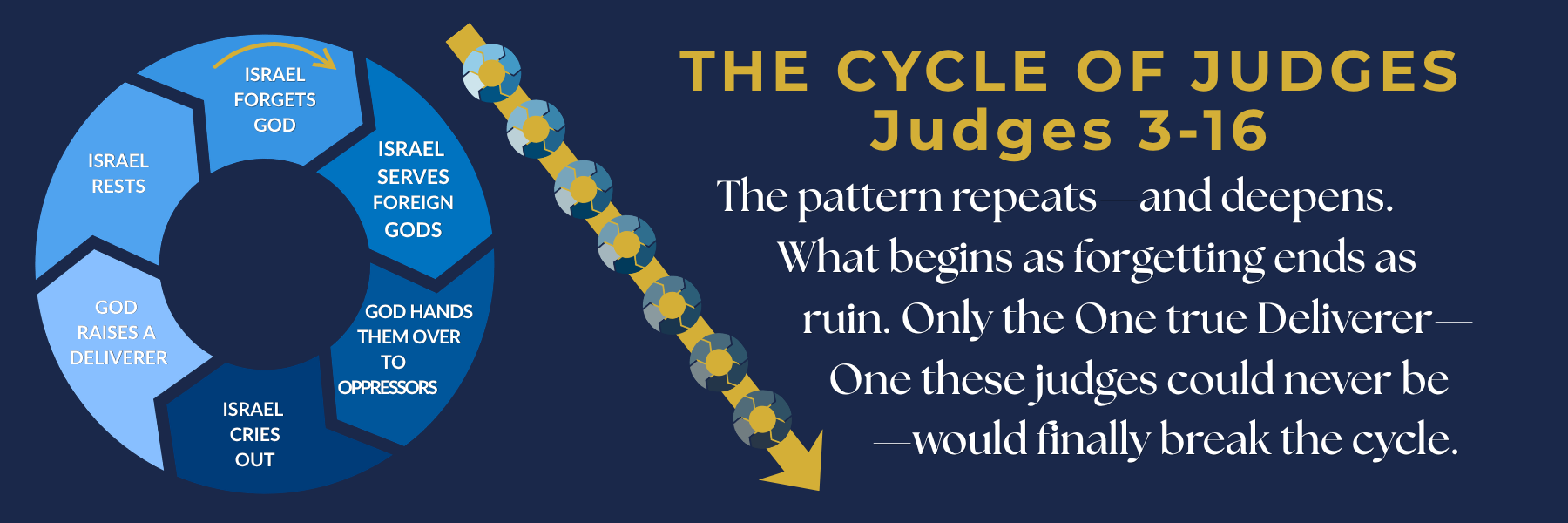
Israel rests and forgets God. Israel serves foreign gods. God hands them over to oppressors. The oppression becomes unbearable. Israel cries out. God, moved to pity by their groaning—not by their virtue, not by their faithfulness, not by anything they have earned—raises up a deliverer. Israel experiences rest. The deliverer dies. Israel turns back to the same patterns, worse than before. The cycle begins again.
Notice what drives God’s response in verse 18: not Israel’s righteousness, but their groaning. God is not responding to Israel’s merit. He is responding out of covenant compassion to their suffering. This is not a book about people who deserved rescue. It is a book about a God who rescues the undeserving because His covenant mercy is not contingent on human faithfulness.
God’s faithfulness to His people in Judges is not based on their performance. It is based on His character. For those who belong to Him through Christ, that same truth holds. The covenant does not ultimately rest on your ability to sustain it—it rests on His faithfulness to keep His promises. And He keeps them.
This is the book’s warning: delayed obedience is not neutral. Every accommodation to sin makes the next departure easier. But the cycle is also the book’s strange mercy: even in the worst descents, God is still listening for the cry.
Journaling/Prayer: Have you found yourself in a repeating pattern—returning to the same failure, the same distance from God, the same groaning?
The cycle in Judges is not evidence that God gives up on repeating failures. Verse 18 makes clear He remains moved by groaning. But it is honest that each return to the pattern tends to go deeper. If you are in a cycle you want to break, the answer is not more willpower—it is a different kind of help than Israel found in the judges. The judges could deliver from oppressors. They could not change the heart. What Israel needed, and what those in Christ have received, is the transformation the judges could never provide.
Summary
Judges 1 shows us what happens when obedience is 90 percent complete: the remaining 10 percent becomes exactly the problem God said it would.
Judges 2 shows us what happens one generation later: the children of the people who crossed the Jordan and watched the walls fall have become people who do not know the LORD.
The judges could deliver Israel from oppressors. What they could not do was deliver Israel from the deeper problem within. The enemy outside the land was never the greatest threat. The wandering heart was.
Between those two realities, God speaks from Gilgal to Bochim, names the covenant He has kept, names the covenant Israel has broken, announces the consequence He warned about from the beginning—and then, when the people cry out under that consequence, raises up deliverers. Again and again. With unearned patience. With covenant faithfulness that exceeds Israel’s covenant faithfulness at every turn.
The book of Judges is not primarily about human failure. It is about divine persistence. The cycle will grow darker. The stories will grow harder. But the God who raises judges from the most unlikely people—and who is, from the very first chapter, working something in the background that no one in Judges can see—is the same God who, in the fullness of time, would send the Deliverer the judges all pointed toward but none of them could be.
Action / Attitude for Today
If you are somewhere in the middle of a repeating pattern today—if you have been at Bochim before, wept there, and found yourself back—do not let the recognition become condemnation. The fact that you can see the pattern is the beginning of something.
God in Judges responds to groaning. He does not wait for the Israelites to get their theology right before He moves. He hears the cry. That means you can begin with the cry, even if you have nothing else to offer.
If you are not in a cycle but are simply entering Judges and feeling the weight of what it contains—trust that the God who preserved one family’s faithfulness in the ruins of this era has not changed. What comes after Judges is worth reading. What comes after Judges points to something worth staking your life on.
If both of those are too far away right now and all you can do is acknowledge that the pattern in this chapter looks uncomfortably familiar—then take only this: God’s covenant does not ultimately rest on your ability to sustain it. It rests on His faithfulness to keep His promises. Say this, as much of it as is true today: “Lord, I recognize the pattern. I have been here before—crying out, meaning it, returning anyway. I don’t have the resources to break this alone. I am groaning. I am asking You to move. Not because I have earned it, but because Christ has opened the way for sinners like me to come. Hear my cry and do what I cannot do for myself.”
The cycle is real. God’s persistence is more real. And the Deliverer the judges could never be has already come.

The Bible for the Broken is published by Aurion Press LLC. © Aurion Press LLC. All rights reserved.