
Day 197—The First Judges
What God Does When His People Cry Out

However you can engage today, we’re here. Read, listen or both.
The written portion gives an overview, with verses broken down into smaller bites, and journaling/prayer prompts for reflection. In the podcast, Steve Traylor reflects on today’s passage with Scripture reading, a deeper pastoral teaching, and prayer (about 15 minutes). Perfect for morning coffee, commutes, or when your eyes need a rest.
📚 Resource Library:
Printable Bible Book Guides: Discipleship charts for books we’ve completed together
Hard Questions, Honest Answers: Deeper dives on difficult topics that arise along the way
Judges 3
You may feel, some days, that you have been here before.
The same failure. The same slow drift. The same moment of recognizing how far you’ve wandered and turning back. If that cycle is familiar—if you know what it is to fall and be lifted, fall and be lifted, and wonder whether God will tire of the pattern before you do—then Judges is a book written in your language.
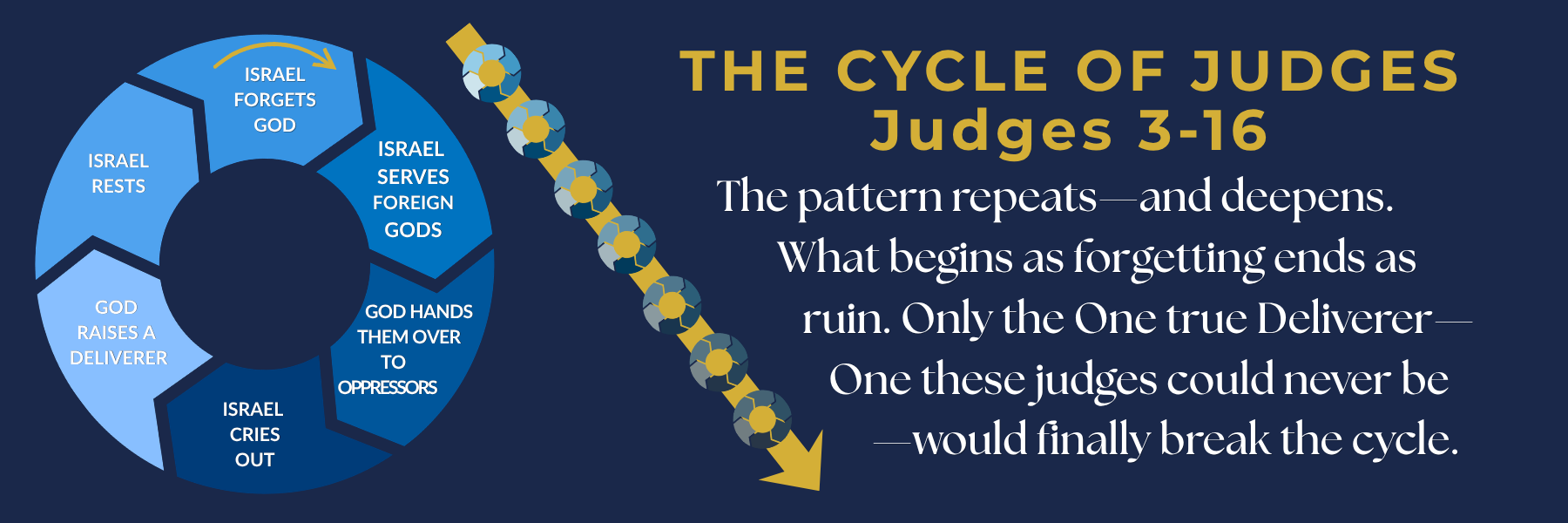
Yesterday we saw the framework: Israel’s cycle of forgetting, suffering, crying out, and being delivered. Today we watch it run for the first time in full. Judges 3 introduces three men who will serve as the opening acts of a long, complicated story. The first is almost too clean to believe. The second is surprising in the best way. The third gets one verse and doesn’t need more than that.
The chapter opens with something worth pausing on. The nations left in the land after Israel’s incomplete conquest were not an oversight. They were not a sign that God had failed to deliver what He promised. They were left, the text says, “to test Israel by them, to know whether Israel would obey the commandments of the LORD” (3:4). The land itself was a proving ground. The presence of difficulty was not evidence of divine absence—it was the structure within which faithfulness could be shaped and demonstrated.
Israel failed the test. They did not drive out the nations; they married into them. Their sons and daughters were given to the surrounding peoples. Their hearts followed their households, and their gods followed their hearts. What God forbade, Israel slowly embraced—and the embrace cost them exactly what God had warned it would.
Today we see that when God’s people forget Him, He gives them over to the consequences of what they chose—and when they turn back and cry out, He responds with mercy.
1. Othniel: The Pattern and the Promise
Judges 3:1-11
Now these are the nations which Yahweh left, to test Israel by them, even as many as had not known all the wars of Canaan; 2 only that the generations of the children of Israel might know, to teach them war, at least those who knew nothing of it before: 3 the five lords of the Philistines, all the Canaanites, the Sidonians, and the Hivites who lived on Mount Lebanon, from Mount Baal Hermon to the entrance of Hamath. 4 They were left to test Israel by them, to know whether they would listen to Yahweh’s commandments, which he commanded their fathers by Moses. 5 The children of Israel lived among the Canaanites, the Hittites, the Amorites, the Perizzites, the Hivites, and the Jebusites. 6 They took their daughters to be their wives, and gave their own daughters to their sons and served their gods. 7 The children of Israel did that which was evil in Yahweh’s sight, and forgot Yahweh their God, and served the Baals and the Asheroth. 8 Therefore Yahweh’s anger burned against Israel, and he sold them into the hand of Cushan Rishathaim king of Mesopotamia; and the children of Israel served Cushan Rishathaim eight years. 9 When the children of Israel cried to Yahweh, Yahweh raised up a savior to the children of Israel, who saved them, even Othniel the son of Kenaz, Caleb’s younger brother. 10 Yahweh’s Spirit came on him, and he judged Israel; and he went out to war, and Yahweh delivered Cushan Rishathaim king of Mesopotamia into his hand. His hand prevailed against Cushan Rishathaim. 11 The land had rest forty years, then Othniel the son of Kenaz died.
One complete cycle. The first time through, the author keeps it almost clinical—sin, consequence, cry, deliverer, rest—because he wants you to see the pattern before it gets complicated.
Othniel is Caleb’s nephew, the same man who won Achsah in marriage by taking the city of Debir in Joshua 15. He comes from faithful stock and acts like it. The Spirit of the LORD comes on him—and that is the hinge of the whole account. Othniel’s success was not ultimately a product of his heritage, his courage, or his military skill. The Spirit came upon him, and that made all the difference. He goes to war, and God delivers the enemy into his hand. The oppressor’s name—Cushan Rishathaim, which roughly means “Cushan of Double Wickedness”—may have been a mocking nickname the Israelites pinned on him. However the name came to him, the man it belonged to held Israel in bondage for eight years and was gone in the space of one verse. What seemed immovable when God was being ignored became manageable the moment Israel cried out.
Forty years of rest. Then Othniel died—and the cycle began again.
This is not a promise that your personal suffering will resolve the moment you pray. Othniel’s story is Israel’s national covenant history, not a template for individual outcomes. But it does reveal something reliable about the character of the God those individuals served: He is never indifferent to the cries of His people.
Journaling/Prayer: Is there something you’ve been holding back from God—a failure, a return to an old pattern, a slow drift you’re only now recognizing—because you’re not sure He will respond?
Othniel’s story shows a God who heard genuine repentance and moved. The same God hears yours. You don’t have to have it all worked out before you turn back.
2. Ehud: The Unexpected Instrument
Judges 3:12-30
12 The children of Israel again did that which was evil in Yahweh’s sight, and Yahweh strengthened Eglon the king of Moab against Israel, because they had done that which was evil in Yahweh’s sight. 13 He gathered the children of Ammon and Amalek to himself; and he went and struck Israel, and they possessed the city of palm trees. 14 The children of Israel served Eglon the king of Moab eighteen years. 15 But when the children of Israel cried to Yahweh, Yahweh raised up a savior for them: Ehud the son of Gera, the Benjamite, a left-handed man. The children of Israel sent tribute by him to Eglon the king of Moab. 16 Ehud made himself a sword which had two edges, a cubit in length; and he wore it under his clothing on his right thigh. 17 He offered the tribute to Eglon king of Moab. Now Eglon was a very fat man.
The cycle runs again, longer this time—eighteen years of bondage instead of eight. Sin always promises accommodation and eventually produces bondage; the cost of each return takes longer to pay. But the pattern holds: they cried out, and God raised up a deliverer.
This deliverer is not what anyone would have designed on purpose. Ehud is from the tribe of Benjamin—the name means “son of the right hand”—and he is left-handed. In the ancient world, this was an oddity, sometimes considered a disadvantage. He is sent with tribute money to Eglon, king of Moab, described in terms that are almost deliberately unflattering: the man was very fat. The text is not embarrassed about that detail. What follows suggests why it mattered.
18 When Ehud had finished offering the tribute, he sent away the people who carried the tribute. 19 But he himself turned back from the stone idols that were by Gilgal, and said, “I have a secret message for you, O king.”
The king said, “Keep silence!” All who stood by him left him.
20 Ehud came to him; and he was sitting by himself alone in the cool upper room. Ehud said, “I have a message from God to you.” He arose out of his seat. 21 Ehud put out his left hand, and took the sword from his right thigh, and thrust it into his body. 22 The handle also went in after the blade; and the fat closed on the blade, for he didn’t draw the sword out of his body; and it came out behind. 23 Then Ehud went out onto the porch, and shut the doors of the upper room on him, and locked them. 24 After he had gone, his servants came and saw that the doors of the upper room were locked. They said, “Surely he is covering his feet in the upper room.” 25 They waited until they were ashamed; and behold, he didn’t open the doors of the upper room. Therefore they took the key and opened them, and behold, their lord had fallen down dead on the floor.
The text does not look away. The detail is almost darkly deadpan—the handle going in after the blade, the doors locked behind Ehud as he walks out, the servants waiting respectfully outside because they assumed their king was relieving himself (“covering his feet" was a Hebrew idiom for that), unaware he was already gone. Scripture includes this account not to celebrate the violence but to record the strangeness of how God works.
26 Ehud escaped while they waited, passed beyond the stone idols, and escaped to Seirah. 27 When he had come, he blew a trumpet in the hill country of Ephraim; and the children of Israel went down with him from the hill country, and he led them.
28 He said to them, “Follow me; for Yahweh has delivered your enemies the Moabites into your hand.” They followed him, and took the fords of the Jordan against the Moabites, and didn’t allow any man to pass over. 29 They struck at that time about ten thousand men of Moab, every strong man and every man of valor. No man escaped. 30 So Moab was subdued that day under the hand of Israel. Then the land had rest eighty years.
Eighty years of rest—the longest in the book so far. Ehud called the people to follow, and they did. The victory was decisive.
God is not limited to conventional instruments or impressive credentials. He used a man whose apparent disadvantage became the advantage no one guarded against. If you feel like the wrong person for whatever you’re facing—too ordinary, too overlooked, too obviously flawed to be useful—pause with Ehud for a moment.
Journaling/Prayer: Is there something in your life right now that you’ve been dismissing as a disadvantage—a limitation, an unexpected circumstance, a way you don’t fit the obvious mold?
God is not working around your limitations. He may be working through exactly those. You don’t have to be the obvious choice. You just have to be available.
3. Shamgar: One Verse, One Ox Goad
Judges 3:31
31 After him was Shamgar the son of Anath, who struck six hundred men of the Philistines with an ox goad. He also saved Israel.
That is all. One verse. One man, one improvised tool, six hundred enemies, and four words of verdict at the end: He also saved Israel.
An ox goad was a long wooden pole sharpened at one end, used to prod cattle. It was not a weapon. It was farm equipment. The Song of Deborah (Judges 5:6) notes that in this era the main roads were abandoned—travelers moved through back paths because the highways were controlled by raiders. Many interpreters read this alongside Shamgar’s account to suggest that Israel had been effectively disarmed, leaving ordinary farm tools as the only implements at hand. What Shamgar did with it strains imagination—six hundred men is not a small skirmish—and the text tells you almost nothing about how it happened or who Shamgar was before this moment. He appears, he acts, and the text moves on.
Sometimes the whole record of what someone did for God fits in a single verse. Shamgar’s name appears in the Song of Deborah (Judges 5:6) as a reference point for a dark time before Deborah arose, which suggests his moment of deliverance took place in genuine crisis. We don’t know his tribe, his training, or his theology. We know he had an ox goad and he used it.
If you feel like your contribution to anything that matters is too small, too ordinary, too poorly equipped—Shamgar got one verse and his name endures. God does not require impressive resources. He requires willingness to use what is in your hand.
Journaling/Prayer: What ordinary thing is already in your hands that you’ve been waiting to have replaced by something better before you act?
Shamgar didn’t have a sword. He acted with what he had, in the moment he was given. The deliverance was real. So was the ox goad.
Summary
Judges 3 gives us the cycle running in its clearest form and then complicates it beautifully. Othniel is the template—obedient, Spirit-empowered, effective, clean. Ehud is the surprise—unconventional, cunning, using his perceived weakness as cover for the one thing no one expected. Shamgar is the footnote that refuses to be insignificant.
What holds all three together is not their qualifications. It is the pattern of the God who raised them. Every time Israel cried out, God moved. Not always in the way they expected. Not always with the person they would have chosen. But consistently, without exception in this chapter, the cry was heard and the deliverer came.
That is not a guarantee about your personal timeline. These were men working within Israel’s national covenant history at a particular moment in redemptive history. But the God they served is unchanged—the same One who responds to the cry of His people now through the great Deliverer all the judges foreshadowed but could not themselves be. What no judge could accomplish permanently—the full, final rescue of God’s people from the bondage of sin—has been accomplished in One who carried no sword and held no ox goad, but who bore on His own body what no king of Moab could have inflicted.
Israel failed again and again. God answered again and again. The cycle reveals both the tragedy of human hearts and the persistence of divine mercy. The Judge of all the earth did not grow weary of hearing their cries. Neither has He grown weary now.
Action / Attitude for Today
If you are in a season of returning—recognizing a drift, naming a failure, turning back again and wondering how many times God will bother—receive the pattern of this chapter as a pastoral word. He raised up a deliverer every single time they cried out. Not once did He say, “You’ve done this too many times.” This pattern repeated itself for centuries throughout the period of the judges, and not once did God fail to respond.
Turn back. Name where you are. Cry out, even if it’s only a few words. “Lord, I’ve drifted again. I don’t have much to offer. Come and help me.” That is enough.
If you are in a season of waiting—wondering why your cry hasn’t yet produced the deliverance you expected—hold Ehud. God did not send Israel the deliverer they would have imagined. He sent them the one who would actually work. Trust that what He is doing in your situation may not match your design, and trust the Designer anyway.
If you have almost nothing left to work with—if your resources feel like an ox goad when you needed a sword—then Shamgar is yours today. “Lord, I have almost nothing. Here is what I have. Use it.”
Whatever you bring, whatever you are, whatever limitation you carry into this day—He has worked with less, and He is not finished.

The Bible for the Broken is published by Aurion Press LLC. © Aurion Press LLC. All rights reserved.