
Day 198—Deborah and Barak
When God Leads Through the Unlikely

However you can engage today, we’re here. Read, listen or both.
The written portion gives an overview, with verses broken down into smaller bites, and journaling/prayer prompts for reflection. In the podcast, Steve Traylor reflects on today’s passage with Scripture reading, a deeper pastoral teaching, and prayer (about 15 minutes). Perfect for morning coffee, commutes, or when your eyes need a rest.
📚 Resource Library:
Printable Bible Book Guides: Discipleship charts for books we’ve completed together
Hard Questions, Honest Answers: Deeper dives on difficult topics that arise along the way
Judges 4
Three people carry this chapter.
One is a prophetess sitting under a palm tree, judging a nation with quiet authority. One is a general who refuses to go to war without her. And one is a woman no one anticipated—not Deborah, not Barak, not Sisera.
Judges tends to give us deeply flawed deliverers—men whose courage or obedience unravels by the end of the chapter, or by the end of the book. Among the judges, Deborah stands out as one of the most consistently faithful figures in the book. Her chapter is a moment of brightness in an otherwise darkening book.
But the chapter is not ultimately about Deborah. It is about where the honor goes.
Barak, the general, is given a straightforward divine command: Go. The Lord has given Sisera into your hand. He adds a condition: I will go only if you go with me. Deborah’s response is not condemnation. It is a quiet redirect: the honor of this victory will go to a woman. Not to Barak. And not even to Deborah.
The honor goes to Jael. A woman with a tent peg and a hammer, who was no one’s idea of a deliverer.
Today we see that God’s deliverance does not require the strongest candidate, the most willing warrior, or the most obvious instrument—it requires only His word going out and the right person being awake when it counts.
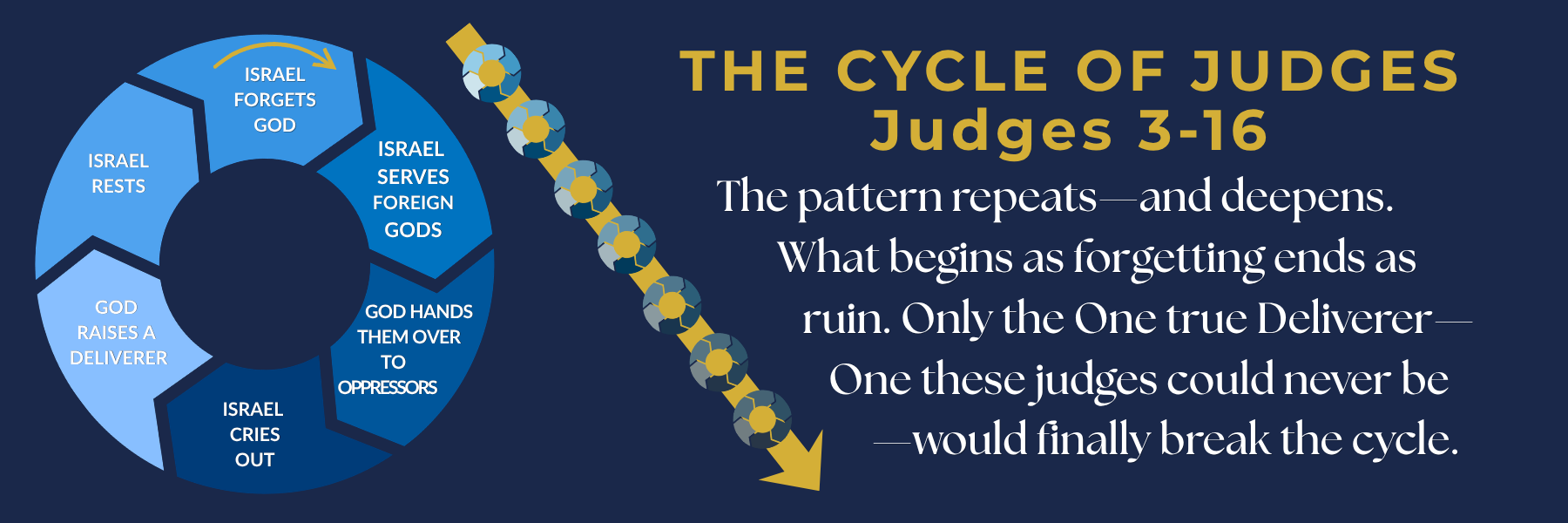
1. Judged and Guided
Judges 4:1–7
The children of Israel again did that which was evil in Yahweh’s sight, when Ehud was dead. 2 Yahweh sold them into the hand of Jabin king of Canaan, who reigned in Hazor; the captain of whose army was Sisera, who lived in Harosheth of the Gentiles. 3 The children of Israel cried to Yahweh, for he had nine hundred chariots of iron; and he mightily oppressed the children of Israel for twenty years.
The cycle has already been named—in Day 196, reading Judges 2, you saw the pattern laid out plainly. Here it runs again: Israel abandons God, God allows an oppressor, oppression produces crying out, God responds. Twenty years of iron chariots. Twenty years of broken roads and villages too afraid to come out in the open (Judges 5:6 tells us travelers took to back paths). The cry came eventually—because suffering often breaks through what comfort could not.
When God seems distant, it is often because He is waiting for the cry. Not because He enjoys the waiting, but because He will not be taken for granted.
4 Now Deborah, a prophetess, the wife of Lappidoth, judged Israel at that time. 5 She lived under Deborah’s palm tree between Ramah and Bethel in the hill country of Ephraim; and the children of Israel came up to her for judgment.
The text introduces Deborah without apology or explanation. She is a prophetess. She is judging Israel. People come to her. The palm tree beneath which she sits becomes so associated with her that it takes her name. There is no suggestion in the text that this is unusual, remarkable, or in need of justification—it is simply stated.
The prophetic gift in early Israel required no formal appointment. God spoke through a person, the word proved true, and the community recognized it. That is what had happened with Deborah. She was already there, already known, already trusted—and Israel came.
Among the judges, Deborah stands out as uniquely consistent in her faithfulness. Whatever we make of her role, the text holds her up as a standard the men who follow her will not reach.
6 She sent and called Barak the son of Abinoam out of Kedesh Naphtali, and said to him, “Hasn’t Yahweh, the God of Israel, commanded, ‘Go and lead the way to Mount Tabor, and take with you ten thousand men of the children of Naphtali and of the children of Zebulun? 7 I will draw to you, to the river Kishon, Sisera, the captain of Jabin’s army, with his chariots and his multitude; and I will deliver him into your hand.’”
The word is clear: go up, deploy, I will deliver him into your hand. God has already committed to the outcome. Deborah is simply conveying what has already been decided.
Journaling/Prayer: Is there something God has made clear to you—a direction, a step, a word—that you’ve been holding at arm’s length because you couldn’t see how it would work out?
You are not expected to see the whole picture. Barak could not see how ten thousand foot soldiers were going to defeat nine hundred iron chariots on flat ground. He only had a promise. Sometimes that is all there is—and it turns out to be enough.
2. Barak and Belief
Judges 4:8–16
8 Barak said to her, “If you will go with me, then I will go; but if you will not go with me, I will not go.”
9 She said, “I will surely go with you. Nevertheless, the journey that you take won’t be for your honor; for Yahweh will sell Sisera into a woman’s hand.” Deborah arose, and went with Barak to Kedesh.
Barak’s condition is worth sitting with before judging it. He does not say he doubts God. He says he needs Deborah with him. The writer of Hebrews—centuries later—places Barak in the great list of faith (Hebrews 11:32). This is not a portrait of a faithless coward. It is a portrait of a man whose faith was real but also human—who needed a person to stand beside him before he could take the step.
Deborah does not shame him. She agrees to go. Then she names what will be lost by the condition: not the victory, only the honor. The victory belongs to God regardless of what Barak does. What Barak’s hesitation costs him is the story he could have had.
10 Barak called Zebulun and Naphtali together to Kedesh. Ten thousand men followed him; and Deborah went up with him. 11 Now Heber the Kenite had separated himself from the Kenites, even from the children of Hobab, Moses’ brother-in-law, and had pitched his tent as far as the oak in Zaanannim, which is by Kedesh. 12 They told Sisera that Barak the son of Abinoam had gone up to Mount Tabor. 13 Sisera gathered together all his chariots, even nine hundred chariots of iron, and all the people who were with him, from Harosheth of the Gentiles, to the river Kishon.
The armies converge. Sisera brings everything he has—nine hundred iron chariots, his full force. From a military standpoint, Israel has no business winning this battle. That is precisely the point.
14 Deborah said to Barak, “Go; for this is the day in which Yahweh has delivered Sisera into your hand. Hasn’t Yahweh gone out before you?” So Barak went down from Mount Tabor, and ten thousand men after him.
“Hasn’t Yahweh gone out before you?”—the question is both declaration and summons. The LORD has already moved. The moment is now. Whatever Barak is feeling, Deborah does not ask him to stop feeling it. She asks him to move anyway.
15 Yahweh confused Sisera, all his chariots, and all his army, with the edge of the sword before Barak. Sisera abandoned his chariot and fled away on his feet. 16 But Barak pursued the chariots and the army to Harosheth of the Gentiles; and all the army of Sisera fell by the edge of the sword. There was not a man left.
Judges 5:21 will tell us that the river Kishon swept the army away—a flood that turned nine hundred iron chariots from weapons into anchors. God did not send a stronger army. He sent rain. The chariots that were Sisera’s greatest advantage became the thing that destroyed him.
What the enemy uses to oppress does not frighten the God who controls the weather.
Journaling/Prayer: What feels like an overwhelming disadvantage in your life right now—something the other side has that you don’t?
Sisera’s nine hundred iron chariots sank in six inches of water. What looks like the thing that makes you certain to lose may be exactly what God uses to make the outcome unmistakable. You don’t have to match the power against you. You have to stay close to the One who does.
3. Tent and Triumph
Judges 4:17–22
17 However Sisera fled away on his feet to the tent of Jael the wife of Heber the Kenite; for there was peace between Jabin the king of Hazor and the house of Heber the Kenite. 18 Jael went out to meet Sisera, and said to him, “Turn in, my lord, turn in to me; don’t be afraid.” He came in to her into the tent, and she covered him with a rug.
Sisera has calculated correctly that Heber’s household is allied with Jabin. He runs to a friendly tent. He is given hospitality—a skin of milk, a blanket, rest. He commands Jael to guard the entrance and deny his presence to anyone who asks. He falls asleep.
What he has not calculated is that Jael is not Heber. She has made her own decision.
19 He said to her, “Please give me a little water to drink; for I am thirsty.”
She opened a container of milk, and gave him a drink, and covered him.
20 He said to her, “Stand in the door of the tent, and if any man comes and inquires of you, and says, ‘Is there any man here?’ you shall say, ‘No.’”
21 Then Jael, Heber’s wife, took a tent peg, and took a hammer in her hand, and went softly to him, and struck the pin into his temples, and it pierced through into the ground, for he was in a deep sleep; so he fainted and died.
The text does not soften it.
Jael’s actions are morally complex and unsettling to modern readers. She gains Sisera’s confidence, gives him shelter, and then kills him while he sleeps. Yet Deborah’s song tomorrow will call her “most blessed among women” (Judges 5:24)—the highest honor given to any woman in that era of Scripture. The text’s emphasis is not on inviting us to imitate Jael’s methods. It is on showing God’s complete overthrow of Israel’s oppressor through an instrument no one anticipated. God is not limited to morally uncomplicated instruments. He has used murderers, foreigners, prostitutes, and the left-handed and overlooked throughout this story. Jael joins that company.
The honor Deborah said would go to a woman has gone to Jael—not to Deborah. Even Deborah was not the point. The point was that Barak’s conditional hesitation had redirected the story, and God completed His purpose anyway through someone no one expected.
22 Behold, as Barak pursued Sisera, Jael came out to meet him, and said to him, “Come, and I will show you the man whom you seek.” He came to her; and behold, Sisera lay dead, and the tent peg was in his temples.
Journaling/Prayer: Has God ever used someone completely unexpected—or some completely unexpected circumstance—to deliver you from something you had no way out of yourself?
He does that. He is not bound by the roster you would have assembled. The people and moments He uses to rescue are rarely the ones we were watching. Stay awake to what He might be doing in the ordinary corner of the story you’re in.
4. Subdued and Strengthened
Judges 4:23–24
23 So God subdued Jabin the king of Canaan before the children of Israel on that day. 24 The hand of the children of Israel prevailed more and more against Jabin the king of Canaan, until they had destroyed Jabin king of Canaan.
Two quiet verses close the chapter. Not a triumph song—that comes tomorrow in Judges 5. Just a statement of fact: God subdued. Israel prevailed. Jabin was destroyed.
The oppression that had lasted twenty years ended. Not because Israel assembled an overwhelming military force. Not because Barak finally found his courage on his own. Because God went out before them—and because Deborah spoke, and Barak moved anyway, and Jael was awake when a sleeping general came to her door.
God builds His deliverance out of ordinary faithfulness, reluctant obedience, and people the story had not yet named.
This is not a pattern limited to Judges. Many readers of this passage across the centuries have seen in the judges—imperfect deliverers called to rescue a people who did not deserve it—a shadow of a greater Deliverer to come: one whose victory would not depend on anyone else’s courage, whose honor would not be transferred, and whose deliverance would be final. We do not press the comparison beyond what the text invites. But the pattern is worth noticing.
Action / Attitude for Today
If you are waiting for the right conditions before you take a step God has made clear—if you’re Barak, asking for one more thing to be in place before you move—take whatever step you can. The honor of the moment is not guaranteed by waiting. And the victory belongs to God regardless.
If you feel like the overlooked person in the story—not the general, not the prophetess, just someone in a tent with tools at hand—stay awake. Jael was not on anyone’s battlefield. She was in her home, with the things women kept in tents. And God used her.
If you can’t find yourself in either of those places today—if Judges feels too foreign and too violent and too far from where you are—then take only this:
God is not stopped by the wrong conditions, the wrong people, or the wrong circumstances. He goes out before His people, and what He has decided to do gets done. You are in the care of One who controls the weather and redirects the honor and uses the tent peg as well as the sword.
Lord, I keep waiting until I feel ready. I keep asking for someone else to come with me, or for the odds to change, or for a sign that it will work. Give me the courage Barak almost had. And if I am not the obvious person for what needs to happen—if I am the one no one thought to put in the story—let me be awake and willing when my moment comes. Amen.
The God who routed nine hundred iron chariots with a river has not run out of ways to do what He has decided to do. He does not ask you to carry the outcome. He only asks you to take the step He has put in front of you.

The Bible for the Broken is published by Aurion Press LLC. © Aurion Press LLC. All rights reserved.