
Day 201—Gideon's Decline
When the Wrong Seed Gets Planted After the Right Victory

However you can engage today, we’re here. Read, listen or both.
The written portion gives an overview, with verses broken down into smaller bites, and journaling/prayer prompts for reflection. In the podcast, Steve Traylor reflects on today’s passage with Scripture reading, a deeper pastoral teaching, and prayer (about 15 minutes). Perfect for morning coffee, commutes, or when your eyes need a rest.
📚 Resource Library:
Printable Bible Book Guides: Discipleship charts for books we’ve completed together
Hard Questions, Honest Answers: Deeper dives on difficult topics that arise along the way
Judges 8
Don’t stop at yesterday’s victory.
Yesterday you watched 300 men with torches and clay jars route the Midianite army. The victory was absurd by any military accounting—which was the point. God reduced the army until no human explanation could take credit. “Lest Israel boast over me, saying, ‘My own hand has saved me’” (7:2).
It is one of the great moments in the book of Judges. Gideon—a man who started by hiding in a winepress and asking God for signs twice—led an outnumbered, outarmed, improbably confident band of men into one of the most famous victories in Israel’s history.
And then came the morning after.
This is the shape of Judges 8. It begins well enough: Gideon handles a difficult confrontation with wisdom, pursues the Midianite kings until the mission is complete, and declines the offer of a crown with words that are, on the surface, exactly right. “I will not rule over you,” he says. “The LORD will rule over you.” Everything appears to be in order.
But something else is also happening in this chapter—quietly, almost beneath the surface at first. Gold is accumulating in Gideon’s hands. He is moving from city to city exercising an authority that begins to resemble that of a king, punishing those who refused him and rewarding those who helped him. And then, in a few spare verses, the account pivots—and we see what the accumulating gold and the centralizing power and the spoken-but-not-lived theology have been building toward: an ephod made in Ophrah, set up in Gideon’s home city, and worshipped by all Israel.
Today we see that it is possible to end a battle on the right side and still lose the war—because the real battlefield was never the Jezreel valley.
1. Wise Words, Wounded Pride
Judges 8:1–9
The men of Ephraim said to him, “Why have you treated us this way, that you didn’t call us when you went to fight with Midian?” They rebuked him sharply. 2 He said to them, “What have I now done in comparison with you? Isn’t the gleaning of the grapes of Ephraim better than the vintage of Abiezer? 3 God has delivered into your hand the princes of Midian, Oreb and Zeeb! What was I able to do in comparison with you?” Then their anger was abated toward him when he had said that.
4 Gideon came to the Jordan and passed over, he and the three hundred men who were with him, faint, yet pursuing. 5 He said to the men of Succoth, “Please give loaves of bread to the people who follow me; for they are faint, and I am pursuing after Zebah and Zalmunna, the kings of Midian.”
6 The princes of Succoth said, “Are the hands of Zebah and Zalmunna now in your hand, that we should give bread to your army?”
7 Gideon said, “Therefore when Yahweh has delivered Zebah and Zalmunna into my hand, then I will tear your flesh with the thorns of the wilderness and with briers.”
8 He went up there to Penuel, and spoke to them in the same way; and the men of Penuel answered him as the men of Succoth had answered. 9 He spoke also to the men of Penuel, saying, “When I come again in peace, I will break down this tower.”
Two confrontations open the chapter, and they are very different from each other.
The first is with the tribe of Ephraim. They are angry because Gideon launched the battle against Midian without calling them. This is a tribal honor dispute—Ephraim was the largest and most prominent tribe in the region, and being excluded felt like a public slight. Their argument to Gideon is essentially: we were not given a role in the main battle, only in the mopping up. Gideon’s reply deflects with a compliment: the Ephraimites captured and killed the two Midianite commanders, Oreb and Zeeb, at the Jordan—a far greater prize, he says, than what his own clan accomplished in the opening assault. Whether or not this is literally true, it is diplomatic. It works. Ephraim’s anger cools.
So far, so good.
The second confrontation is with two Israelite cities—Succoth and Penuel—whose response to Gideon’s request for bread is colder and more calculating. His 300 men are exhausted but still in pursuit of the Midianite kings. He asks for provisions. Both cities refuse, essentially arguing: you haven’t won yet; why should we commit to your side? It is a failure of covenant loyalty to their own brothers. Gideon’s response is swift and unambiguous: when I return, you will answer for this.
The refusal of Succoth and Penuel was a serious covenant failure. Whether Gideon’s response reflected righteous justice, personal vengeance, or some mixture of both has long been debated. But the manner of it—“when I come again”—already begins to sound more like the language of a ruler than the humble servant we met in the winepress.
The first seeds of what will come are always present in the small things we do not examine.
Journaling/Prayer: Is there a place in your life where you’ve handled one thing wisely and then immediately acted out of ego or self-interest in the very next breath—and not noticed the difference?
Gideon himself may not have noticed. Most decline is not a single dramatic turn; it is a direction settled into gradually, across a hundred small moments where no one is checking. The God who called Gideon from the winepress knew what was in him—and used him anyway. His faithfulness to us is not contingent on our perfect consistency.
2. Mission Completed, Memory Kept
Judges 8:10–21
The men of Ephraim said to him, “Why have you treated us this way, that you didn’t call us when you went to fight with Midian?” They rebuked him sharply. 2 He said to them, “What have I now done in comparison with you? Isn’t the gleaning of the grapes of Ephraim better than the vintage of Abiezer? 3 God has delivered into your hand the princes of Midian, Oreb and Zeeb! What was I able to do in comparison with you?” Then their anger was abated toward him when he had said that.
4 Gideon came to the Jordan and passed over, he and the three hundred men who were with him, faint, yet pursuing. 5 He said to the men of Succoth, “Please give loaves of bread to the people who follow me; for they are faint, and I am pursuing after Zebah and Zalmunna, the kings of Midian.”
6 The princes of Succoth said, “Are the hands of Zebah and Zalmunna now in your hand, that we should give bread to your army?”
7 Gideon said, “Therefore when Yahweh has delivered Zebah and Zalmunna into my hand, then I will tear your flesh with the thorns of the wilderness and with briers.”
8 He went up there to Penuel, and spoke to them in the same way; and the men of Penuel answered him as the men of Succoth had answered. 9 He spoke also to the men of Penuel, saying, “When I come again in peace, I will break down this tower.”
The military victory is complete. The kings are captured, the army is routed. It is worth pausing on the scale: 120,000 men had already fallen; 15,000 remained. The God who started with 300 torches has dismantled one of the most formidable forces in the region.
But the details of the return are worth watching. Gideon carries out his threats to Succoth and Penuel exactly as promised. The punishment of those who failed to help may be just—but the comprehensive methodical nature of it reads less like a judge restoring order and more like a ruler settling scores. Their betrayal has remained with him.
The execution of the two kings is personal—they killed his brothers at Tabor. The vendetta is understandable. It is also the last fully narrative moment before the chapter turns.
What Gideon does next will cost him everything he does not yet know he is risking.
Journaling/Prayer: Have you ever carried a list of wrongs for so long that completing the justice felt less like relief and more like the beginning of something else—something harder to name?
Gideon’s grief over his brothers at Tabor is real. Grief is not the problem. What happens to us in the long aftermath of grief—the ways it hardens into patterns of control and accumulation—is worth examining before God, quietly and honestly.
3. Right Words, Wrong Life
Judges 8:22–27
22 Then the men of Israel said to Gideon, “Rule over us, both you, your son, and your son’s son also; for you have saved us out of the hand of Midian.”
23 Gideon said to them, “I will not rule over you, neither shall my son rule over you. Yahweh shall rule over you.” 24 Gideon said to them, “I do have a request: that you would each give me the earrings of his plunder.” (For they had golden earrings, because they were Ishmaelites.)
25 They answered, “We will willingly give them.” They spread a garment, and every man threw the earrings of his plunder into it. 26 The weight of the golden earrings that he requested was one thousand and seven hundred shekels of gold, in addition to the crescents, and the pendants, and the purple clothing that was on the kings of Midian, and in addition to the chains that were about their camels’ necks. 27 Gideon made an ephod out of it, and put it in Ophrah, his city. Then all Israel played the prostitute with it there; and it became a snare to Gideon and to his house.
This is the turning point. Read it carefully.
The words are correct: “I will not rule over you. The LORD will rule over you.” That is exactly the right theology. It is the answer Israel needed to hear. Whether Gideon was sincere or already compromised, the narrative immediately exposes a contradiction between his confession and his conduct.
In the very next breath, he asks for gold.
The ephod he makes is not straightforwardly an idol—an ephod was a garment associated with the high priest, and a gold version may have been intended as an oracle object, a way of seeking God’s direction (the Urim and Thummim, used by the priest to discern God’s will, were housed in the high priest’s breastpiece, which was fastened to the ephod). Gideon may have had some genuinely religious intention. But here is the problem: God had already provided a specific, designated way for Israel to seek His guidance. There were priests. There was a tabernacle at Shiloh. There was an established system of worship and inquiry. Gideon was not a priest. He had no authorization to create a religious object or establish a worship site. And the fact that all Israel immediately gathered around his ephod and “whored after it” reveals something devastating about the spiritual condition of the nation: they had forgotten, or never fully learned, what God had actually commanded. Whatever Gideon’s intention, the result was catastrophic. Israel gathered around the ephod rather than the worship God had appointed, and what may have begun as a religious symbol became an instrument of idolatry.
The location chosen is its own indictment. The ephod is set up in Ophrah—the very city where Gideon had, at God’s direct command, torn down his father’s altar to Baal. He had destroyed one alternative worship site in that city. Now he has built another. The gold that came in after the victory made visible something that had been present and unexamined for some time.
It is possible to say the truest thing about God and simultaneously be building something that will lead people away from Him.
Journaling/Prayer: Is there anything you are building, accumulating, or establishing right now that has good intentions on the surface but might be serving a different purpose underneath?
This is not a comfortable question. It was not comfortable for Gideon either—or rather, it never became uncomfortable for him, which is the problem. The text does not show us a moment of realization. The snare closed quietly, over time, in a city that had once been a place of obedience.
4. Forty Years and Forgotten
Judges 8:28–35
28 So Midian was subdued before the children of Israel, and they lifted up their heads no more. The land had rest forty years in the days of Gideon.
29 Jerubbaal the son of Joash went and lived in his own house. 30 Gideon had seventy sons conceived from his body, for he had many wives. 31 His concubine who was in Shechem also bore him a son, and he named him Abimelech. 32 Gideon the son of Joash died in a good old age, and was buried in the tomb of Joash his father, in Ophrah of the Abiezrites.
33 As soon as Gideon was dead, the children of Israel turned again and played the prostitute following the Baals, and made Baal Berith their god. 34 The children of Israel didn’t remember Yahweh their God, who had delivered them out of the hand of all their enemies on every side; 35 neither did they show kindness to the house of Jerubbaal, that is, Gideon, according to all the goodness which he had shown to Israel.
The chapter ends with what looks, briefly, like a peaceful summary. Forty years of rest. Gideon lived in his own house. He died in a good old age.
But look more closely.
The man who said “I will not rule over you” accumulated seventy sons from many wives—the household of a king. He named one of those sons Abimelech: “my father is king.” That name is not accidental. Names in this world carried weight and meaning. Gideon gave his son a name that said, plainly, what his words had refused to say. The contradiction is in the text, and the text does not soften it.
In Gideon’s story, what he said he was and what he named his son were not the same confession.
And then Gideon died, and the people of Israel forgot the LORD immediately. Not gradually—“as soon as Gideon died.” The forty years of rest had not been forty years of faithfulness; they had been forty years of surface quiet held together by one man’s presence, atop an ephod everyone was already worshipping. The moment he was gone, there was nothing beneath the surface to hold.
The pattern has accelerated. In the opening cycles of Judges, Israel’s apostasy followed a generation after the judge’s death. Here it follows the judge himself within the chapter. Tomorrow we meet Abimelech, and the spiral tightens further.
Outward rest is not the same thing as spiritual health.
Journaling/Prayer: Is there something in your life that appears peaceful on the outside but is resting on a foundation you know is not solid? What would it look like to address the foundation rather than just maintaining the quiet?
The people of Israel could not see what they were standing on during the forty years. They may not have wanted to look. Sometimes the hardest thing about a fragile peace is that it feels indistinguishable from a genuine one—until it doesn’t.
Summary
Gideon began hiding in a winepress and ended his life as the father of seventy sons by many wives, the builder of what became an idolatrous ephod, and the man who named his son “my father is king” while insisting he would never be king.
This is not a sudden fall. It is the long, quiet drift of a man who handled extreme pressure better than he handled ordinary success—who could trust God with 300 men and clay jars but could not trust Him with gold earrings and wounded tribal pride. The victory at Midian was real. The decline was also real. Both things are in the text because both things were true.
Hebrews 11 lists Gideon among the faithful. He is not erased from the record of faith because of what Judges 8 shows us. But neither is Judges 8 softened because of Hebrews 11. God uses broken people, and those same broken people are capable of breaking things in return. The grace that includes Gideon in the hall of faith is the same grace that names the snare he built. Neither is minimized.
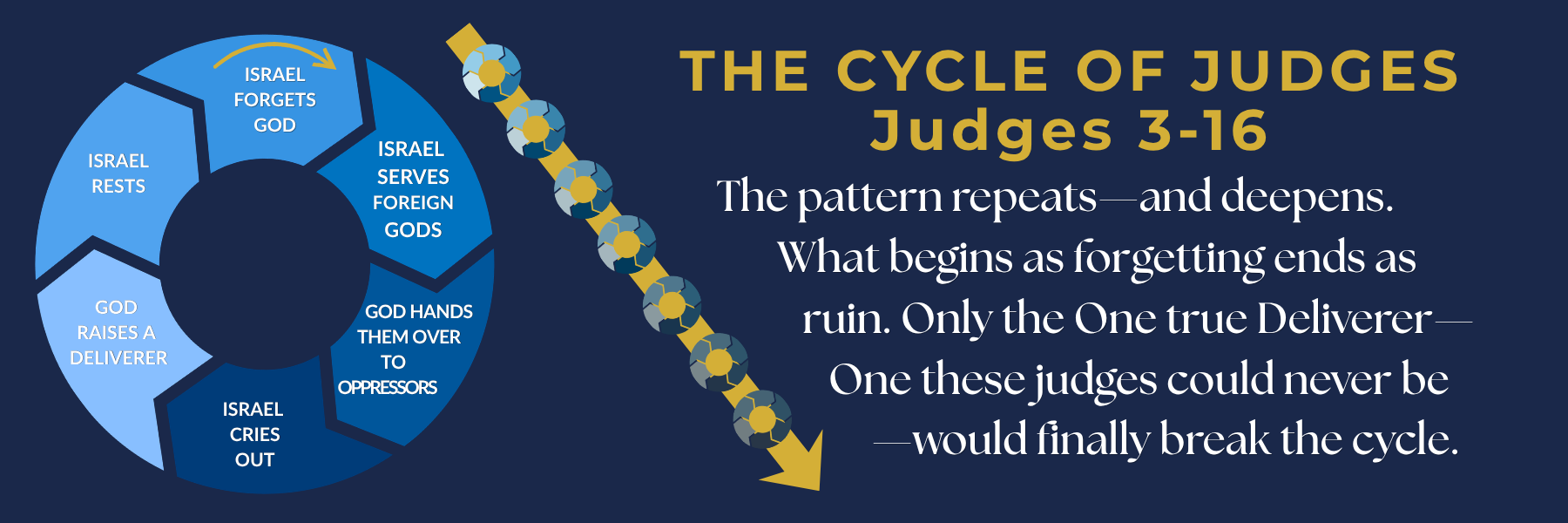
This is the pattern of Judges: every deliverance is real, and every deliverer is falling. The book is building an ache—a longing for someone who will not end like this. Not a judge who declines the crown while living like a king. Someone who actually is what He says He is. Judges keeps teaching the same lesson: God’s people do not merely need better leaders. They need a better Deliverer.
Action / Attitude for Today
Gideon’s decline was not visible on the day it began. It probably wasn’t visible to him at all. The gold came in gradually. The power settled quietly. The son was given a name that told the truth his father wouldn’t say aloud.
If you are in a season of success right now—even small, ordinary success after a long hard stretch—bring it to God deliberately. Not to be suspicious of it, but to be honest about what it might be doing to you. Success is a spiritual test as surely as suffering is, and it is the test fewer people see coming.
If you are in a season of suffering and this passage feels distant—too much prosperity, too much decline to map onto your own exhausted life—then take only this: Scripture includes both Judges 8 and Hebrews 11. The record of his faith was not closed by the record of his failure. The same is true for those who are in Christ. Your lapses, your drift, your failures to examine what’s accumulating—none of them disqualify you from the grace that held Gideon all the way to a good old age, even as he was getting things wrong.
If you can’t reach either of those today—if the chapter just feels dark and you feel dark and that’s all—then sit with verse 34 for a moment: “the people of Israel did not remember the LORD their God, who had delivered them from the hand of all their enemies on every side.” The problem was forgetting. The cure is not effort; it is the act of remembering—even one specific thing God has done for you that is still true today.
Say this prayer, as much of it as is true for you today: “Lord, I don’t always notice what I’m accumulating. I don’t always hear the distance between what I say and what I do. I say I trust You, and then I collect insurance. I say You are enough, and then I build something to feel more secure. Show me what I am actually building—and give me the courage to look at the foundation, not just the quiet. You held Gideon. You hold me. That has to be enough. Amen.”
God does not stop being faithful when we stop noticing. But we are the ones who pay the price of the forgetting.

The Bible for the Broken is published by Aurion Press LLC. © Aurion Press LLC. All rights reserved.