
Day 203—Jephthah's Vow
What a Rash Promise Can Cost

However you can engage today, we’re here. Read, listen or both.
The written portion gives an overview, with verses broken down into smaller bites, and journaling/prayer prompts for reflection. In the podcast, Steve Traylor reflects on today’s passage with Scripture reading, a deeper pastoral teaching, and prayer (about 15 minutes). Perfect for morning coffee, commutes, or when your eyes need a rest.
📚 Resource Library:
Printable Bible Book Guides: Discipleship charts for books we’ve completed together
Hard Questions, Honest Answers: Deeper dives on difficult topics that arise along the way
Judges 10-12
What you’re about to encounter is not a comfortable text.
It is the story of a man rejected by his own family, called by God anyway, empowered by the Spirit to do what no one else could—and then undone not by his enemies, but by his own words.
Jephthah is one of the most complicated figures in all of Judges. He is a man of genuine faith and genuine tragedy. He is listed in Hebrews 11 alongside Gideon and Samson and David. He is also the man who made a vow he should never have made, and whose daughter bore the cost of it.
This is a story about what God does with the people no one wanted—and what happens when people who have been hurt try to bargain with God from a place of fear instead of faith.
Today we see that God’s choice of Jephthah was never in doubt. His vow was never required.
1. Outcast and Offered
Judges 10:1–18; 11:1–29
Judges 10:1–5 and 12:8–15 list what scholars call the “minor judges”—Tola, Jair, Ibzan, Elon, and Abdon among them. We always try to cover every verse assigned to a day, and these are no exception: they are there, and they are Scripture. But the text itself gives us little to work with. Most of these entries are simply a name, a number of years served, some family details, and a burial location. There is no narrative, no conflict, no crisis recorded—just faithfulness measured in years. As you read through them, notice what has become familiar: the pattern of leaders rising, serving their generation, and passing on. God preserved the names even when He preserved no story. These men held the line in their time. That matters. But the narrative weight of these three chapters belongs to Jephthah—and that is where we spend our time today.
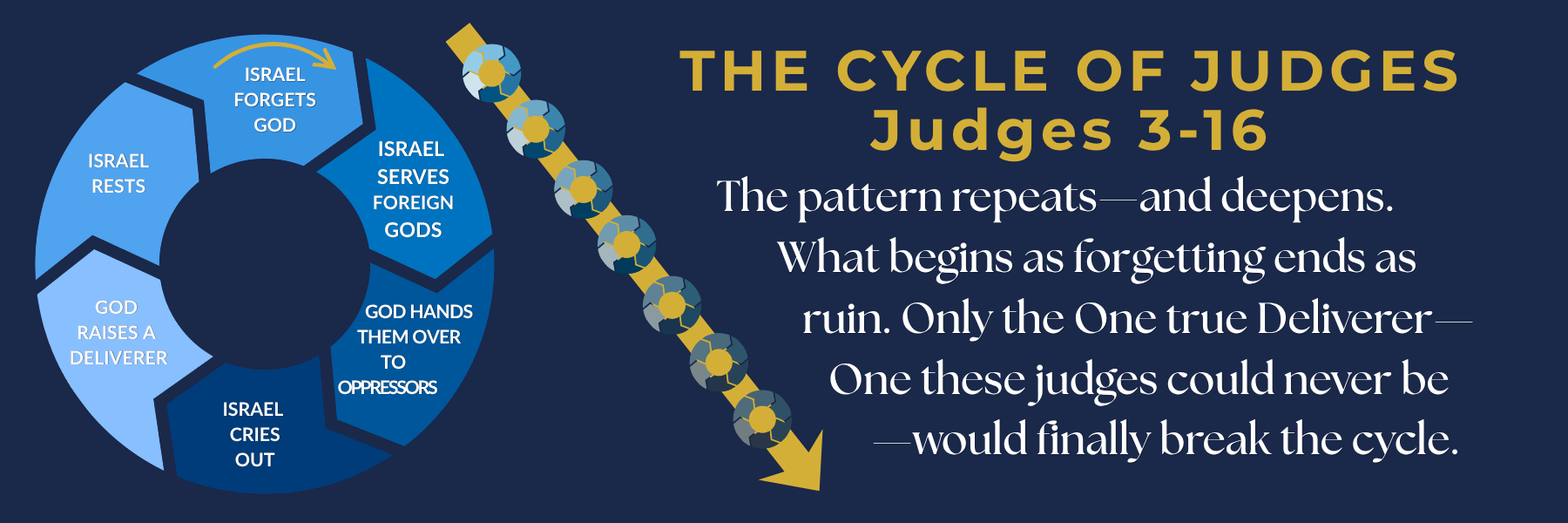
In chapter 10, the cycle resumes—and this time the text slows down.
6 The children of Israel again did that which was evil in Yahweh’s sight, and served the Baals, the Ashtaroth, the gods of Syria, the gods of Sidon, the gods of Moab, the gods of the children of Ammon, and the gods of the Philistines. They abandoned Yahweh, and didn’t serve him. 7 Yahweh’s anger burned against Israel, and he sold them into the hand of the Philistines and into the hand of the children of Ammon.
What follows is unusual. Israel cries out. God responds—but not the way He has before.
11 Yahweh said to the children of Israel, “Didn’t I save you from the Egyptians, and from the Amorites, from the children of Ammon, and from the Philistines? 12 The Sidonians also, and the Amalekites, and the Maonites, oppressed you; and you cried to me, and I saved you out of their hand. 13 Yet you have forsaken me and served other gods. Therefore I will save you no more. 14 Go and cry to the gods which you have chosen. Let them save you in the time of your distress!”
God names what He has done. He names what they have done. He tells them to go to their other gods.
It sounds like rejection—but it is not. It is God pressing His finger on the wound rather than quietly applying a bandage again. God’s refusal to rescue on demand is not abandonment. It is fatherly discipline that aims at repentance.
Israel does something they have not done before. They put away their foreign gods—before they know if God will help them. That small shift matters.
15 The children of Israel said to Yahweh, “We have sinned! Do to us whatever seems good to you; only deliver us, please, today.” 16 They put away the foreign gods from among them and served Yahweh; and his soul was grieved for the misery of Israel.
“His soul was grieved for the misery of Israel.” Even in wrath, He cannot stop caring.
One honest question deserves a direct answer before we move on. God said He would deliver them no more—and then He did. Does that mean His word failed?
Look at what changed between verse 13 and verse 16. Israel had cried out before—many times. What they had never done before was put away their foreign gods before knowing whether God would rescue them. Every previous repentance was crisis-driven: we are suffering, save us. This time they said: do to us whatever seems good to you—only please deliver us. That is a different posture. That is not bargaining. That is surrender.
God Himself stated the operating principle behind this in Jeremiah 18:7–8: “If at any time I declare concerning a nation that I will pluck up and break down and destroy it, and if that nation turns from its evil, I will relent of the disaster that I intended to do to it.” This is not a loophole discovered after the fact. It is God’s own stated character—that His warnings aim at repentance, and when repentance is genuine, He responds to it. The threat in verse 13 was entirely real. So was the change in verse 15. And so was His grief in verse 16. His word did not fail. It produced exactly what it was meant to produce.
Into this moment, Jephthah arrives—and the way the text introduces him tells you everything.
11 Now Jephthah the Gileadite was a mighty man of valor. He was the son of a prostitute. Gilead became the father of Jephthah. 2 Gilead’s wife bore him sons. When his wife’s sons grew up, they drove Jephthah out and said to him, “You will not inherit in our father’s house, for you are the son of another woman.”
Illegitimate. Disinherited. Driven out by the half-brothers who shared his father. He fled to the land of Tob and gathered around him men the text calls “worthless”—the only companions available to a man with no belonging and no future.
Then the elders of Gilead came asking. They needed a military leader. They wanted Jephthah.
God’s use of people the world has discarded is not an exception in Scripture. It is a pattern.
Jephthah negotiated—not out of pride but out of hard-learned self-protection. If you bring me back and if God gives me victory, then I will be your head. The elders agreed. And then a remarkable thing happened.
Before he swung a sword, Jephthah sent a written message to the king of Ammon—a sophisticated, historically informed argument grounded in Israel’s covenant history and God’s prior victories (11:12–28). The text notes that the king of Ammon did not listen. Then:
29 Then Yahweh’s Spirit came on Jephthah, and he passed over Gilead and Manasseh, and passed over Mizpah of Gilead, and from Mizpah of Gilead he passed over to the children of Ammon.
The Spirit came. What followed was not Jephthah’s military brilliance. It was God.
Journaling/Prayer: Have you ever felt like someone the world has no room for—whose background, circumstances, or failures seem to disqualify you from anything God might do?
Jephthah’s illegitimacy did not disqualify him from being empowered by the Spirit. What his brothers rejected, God used. If you cannot feel that today, let it stay on the page until you can.
2. Vow and Verdict
Judges 11:30–40
Between verse 29 and the crossing to battle, Jephthah made a vow.
30 Jephthah vowed a vow to Yahweh, and said, “If you will indeed deliver the children of Ammon into my hand, 31 then it shall be, that whatever comes out of the doors of my house to meet me when I return in peace from the children of Ammon, it shall be Yahweh’s, and I will offer it up for a burnt offering.”
This was unnecessary. The Spirit had already come. The battle was already God’s.
The vow was a bargain—the kind made from fear rather than faith, from a man who had spent his life earning his place rather than receiving it. Even empowered by the Spirit, Jephthah appears to speak from an old wound rather than resting in God’s promise. If you give me this, I will give you that.
God did not require it. God did not ask for it. God had already chosen to act. The vow was Jephthah’s addition—and Jephthah’s alone to carry.
Israel subdued Ammon. Twenty cities. A great blow. The victory was complete.
34 Jephthah came to Mizpah to his house; and behold, his daughter came out to meet him with tambourines and with dances. She was his only child. Besides her he had neither son nor daughter. 35 When he saw her, he tore his clothes, and said, “Alas, my daughter! You have brought me very low, and you are one of those who trouble me; for I have opened my mouth to Yahweh, and I can’t go back.”
His daughter came out dancing. His only child.
What follows is one of the most debated passages in the Old Testament. Faithful interpreters have long disagreed over whether Jephthah literally sacrificed his daughter or devoted her to lifelong virginity in tabernacle service. The text contains features that have led careful scholars to both conclusions, though many believe its language most naturally points to an actual sacrifice—the repeated use of “burnt offering,” the unqualified phrase “he did to her as he had vowed,” and the unrelieved grief of the narrative all carry weight in that direction. Those who hold the dedication view point to her mourning her virginity rather than her death, to the prohibition against human sacrifice in Leviticus 20, and to Jephthah’s presence in Hebrews 11 among the heroes of faith.
Both positions are held by careful, faithful interpreters. The text does not resolve the question beyond dispute.
But the law of Moses had already addressed this situation. Leviticus 5:4 specifically covers rash oaths—words spoken without thinking—and prescribes a sin offering and confession as the remedy. Numbers 30 provides a mechanism for release from vows made rashly. And Genesis 22 had already established beyond question that God does not want human sacrifice—He stopped Abraham and provided a substitute Himself. Leviticus 20 prohibits it explicitly.
Whatever Jephthah did, he was going to violate something. But the law gave him a hierarchy—and an exit. An innocent life outweighs a rash vow. God had already said so. The path of confession, offering, and release was available to him. The tragedy is not that Jephthah had no way out. The tragedy is that he apparently did not take the one God had already provided. Whether pride, public honor, or the weight of his own word held him—the text does not say. But the law does not leave him without options. It never did.
What is not ambiguous is this: Jephthah made a rash vow in the heat of the moment, before a battle God had already committed to win, and that vow—whatever its fulfillment—cost him the future he had just bled for.
His daughter’s response is the quietest thing in the whole account:
36 She said to him, “My father, you have opened your mouth to Yahweh; do to me according to that which has proceeded out of your mouth, because Yahweh has taken vengeance for you on your enemies, even on the children of Ammon.”
She did not blame him. She asked for two months to go to the mountains with her friends to weep for what she would never have—and she went. And she came back.
The text gives her no name. It gives her full dignity. Her faithfulness in the face of her father’s failure is one of the most quietly devastating moments in the book. She is not a plot device. She is a person who bore the cost of words someone else spoke.
Journaling/Prayer: Is there something you have committed to—in desperation, in a moment of fear—that has cost more than you expected?
The lesson of Jephthah’s vow is not primarily about keeping promises at all costs. It is about not making promises from a place of fear—trying to control God with our offerings instead of trusting what He has already committed to do. Bring that to God honestly. He already knew when the words left your mouth.
3. Pride and the Password
Judges 12:1–7
Victory over Ammon lasted long enough to generate its first argument.
12 The men of Ephraim were gathered together, and passed northward; and they said to Jephthah, “Why did you pass over to fight against the children of Ammon, and didn’t call us to go with you? We will burn your house around you with fire!”
Ephraim had done this before—with Gideon after Midian (8:1). Gideon had deflected it with humility. Jephthah was not Gideon.
Watch Ephraim as you keep reading in the years ahead. This is not the tribe’s last appearance as the one demanding recognition and resisting being led by others. Ephraim becomes the dominant tribe of the northern kingdom, and centuries later it is an Ephraimite, Jeroboam, who leads ten tribes away when the kingdom splits after Solomon. The wounded pride on display here is worth remembering when that story comes.
He pointed out that he had called them, and they hadn’t come. The argument escalated into war. Jephthah gathered the men of Gilead and fought Ephraim—and then came the detail that has passed into the English language.
5 The Gileadites took the fords of the Jordan against the Ephraimites. Whenever a fugitive of Ephraim said, “Let me go over,” the men of Gilead said to him, “Are you an Ephraimite?” If he said, “No;” 6 then they said to him, “Now say ‘Shibboleth;’” and he said “Sibboleth”; for he couldn’t manage to pronounce it correctly, then they seized him and killed him at the fords of the Jordan. At that time, forty-two thousand of Ephraim fell.
A single syllable. An accent difference. Forty-two thousand dead. The Ephraimite dialect simply lacked the “sh” sound—what the Gileadites pronounced shibboleth, Ephraimites pronounced sibboleth, a real linguistic divide between two branches of the same people that became, in this moment, a death sentence.
This is what the Judges cycle looks like at its worst: Israel no longer needs foreign enemies to destroy itself. The fragmentation that began as a spiritual failure has become a military one. The people of God are killing each other over a word.
Jephthah judged Israel six years. He died. And the text moves on—more minor judges, more names, more years. The spiral continues. The pattern holds. Nothing has changed.
Journaling/Prayer: Has pride or wounded honor ever cost you more than the original offense warranted?
Ephraim’s complaint may have had a kernel of legitimate grievance. But it was answered with a threat to burn down Jephthah’s house. Pride turned a possible conversation into a war. What we insist on claiming—credit, recognition, our share of the victory—can cost us far more than the thing we were claiming.
4. Outcast and Ordinary
Judges 10:6–18 (revisited) and the arc of Jephthah
Step back and take in what these chapters hold.
God was moved by Israel’s genuine repentance—even after refusing to rescue them on schedule. The same God who said “I will save you no more” is the God whose soul “was grieved for the misery of Israel.” God’s patience with His people is not brittle. It is strained. But it does not break.
Jephthah was everything the world passes over: illegitimate, disinherited, exiled, surrounded by outcasts. God chose him. The Spirit came on him. He won what no one else had.
He also made a vow he should not have made—likely from the old wound of a man who had learned that belonging must be earned, that God’s favor must be secured by promise, that you cannot simply receive. That wound produced words that cost him.
Hebrews 11:32 includes his name. His faith in the battle was real. His vow was a failure. Both are true, and both are in the same person—because that is what persons are.
The daughters of Israel wept for his daughter four days a year. Scripture remembered her. Scripture does not overlook those who bear the cost of others’ words. They are remembered. They are mourned. God does not forget them either.
And the cycle continued. Not because God abandoned Israel—He never did. But because Israel kept choosing the world they knew over the God who saved them.
There is a smaller Jephthah in all of us: the part that, even after being chosen, even after the Spirit has come, reaches for a bargain instead of a rest. The part that says: if you give me this, I will give you that—as if God needed the offer.
He doesn’t need the offer. He already moved. In Christ, God has already given the sacrifice He requires—we are not accepted because we bargain well, but because Christ has offered Himself for us. What He is waiting for is not our vows but our trust.
Journaling/Prayer: Is there a place where you have been trying to bargain with God instead of trusting what He has already promised?
This is not a passage that gives easy comfort. But it gives an honest one: God uses broken people in ways that matter and are real, even when those people also make costly mistakes. Jephthah’s failure did not undo what God did through him. And it does not undo what God intends to do through you.
Summary
Jephthah was rejected before he was chosen. He won the battle before he made the vow. The Spirit moved before he struck a blow. And the vow—made in the old language of a man who had always had to earn his place—cost him everything he had just fought to protect.
What the text refuses to do is resolve into a simple lesson. That is one of the things that makes it true. Real people make real mistakes at real cost, and God keeps working through it—not around it.
The daughter who bore the cost of her father’s words is remembered in Israel four days a year. She is remembered in this study today. Her name is unknown. Her faithfulness is not.
And the people of God, who killed forty-two thousand of their own kin over a syllable, are still the people God would not abandon. His grief for their misery had not ended. It still has not.
For those in Christ, the pattern of Judges is not a warning that God will eventually stop grieving—it is evidence that He never does. The God who was moved by Israel’s genuine repentance is the same God who responds to yours.
Judges 10 is the passage where God said He would deliver them no more—and then did, when genuine repentance came. If you are feeling drawn back to God right now, if you feel the weight of the distance and the pull to return, that feeling is not coming from you. A person God has truly abandoned does not grieve the distance. The grief itself is the evidence that He is still working. You cannot manufacture that pull on your own. The very fact that you want to come back is proof that the door is not shut. Come now—the drawing you feel is the invitation.
Action / Attitude for Today
If you have been trying to bargain with God—making promises in exchange for rescue, tying your trust to conditions you’ve named—hear what Jephthah’s story says quietly at the edges: the Spirit had already come. The battle was already His. The vow added nothing to the victory.
If you cannot yet release the bargain, bring it to God as it is. Say honestly: Lord, I keep trying to earn what you’ve already given. I’m still operating out of the old wound—the one that says I have to secure my place, prove my worth, make it worth Your while. Remind me today that You don’t need what I’m offering. You’ve already moved. Teach me to receive instead of earn.
If you are somewhere in the aftermath of a rash promise—if you have spoken words that cost more than you anticipated, or if you are someone who has borne the cost of words someone else spoke—this story holds you with more honesty than comfort. The daughter had no say. She came back from the mountains and was faithful. She was not forgotten.
You are not forgotten either. What you have carried does not disappear into silence. God saw it then. He sees it now.

The Bible for the Broken is published by Aurion Press LLC. © Aurion Press LLC. All rights reserved.