
Day 206—A God for Hire
When Worship Becomes a Transaction
However you can engage today, we’re here. Read, listen or both.
The written portion gives an overview, with verses broken down into smaller bites, and journaling/prayer prompts for reflection. In the podcast, Steve Traylor reflects on today’s passage with Scripture reading, a deeper pastoral teaching, and prayer (about 15 minutes). Perfect for morning coffee, commutes, or when your eyes need a rest.
📚 Resource Library:
Printable Bible Book Guides: Discipleship charts for books we’ve completed together
Hard Questions, Honest Answers: Deeper dives on difficult topics that arise along the way
Judges 17-18
Notice what you’re not reading today.
No foreign army. No oppressor’s name. No cry for deliverance—because no one in this story seems to think they need one. The danger in this book has always been Israel’s own drifting from God. Today that danger stops hiding behind a foreign army and shows up inside a man’s house in the hill country of Ephraim.
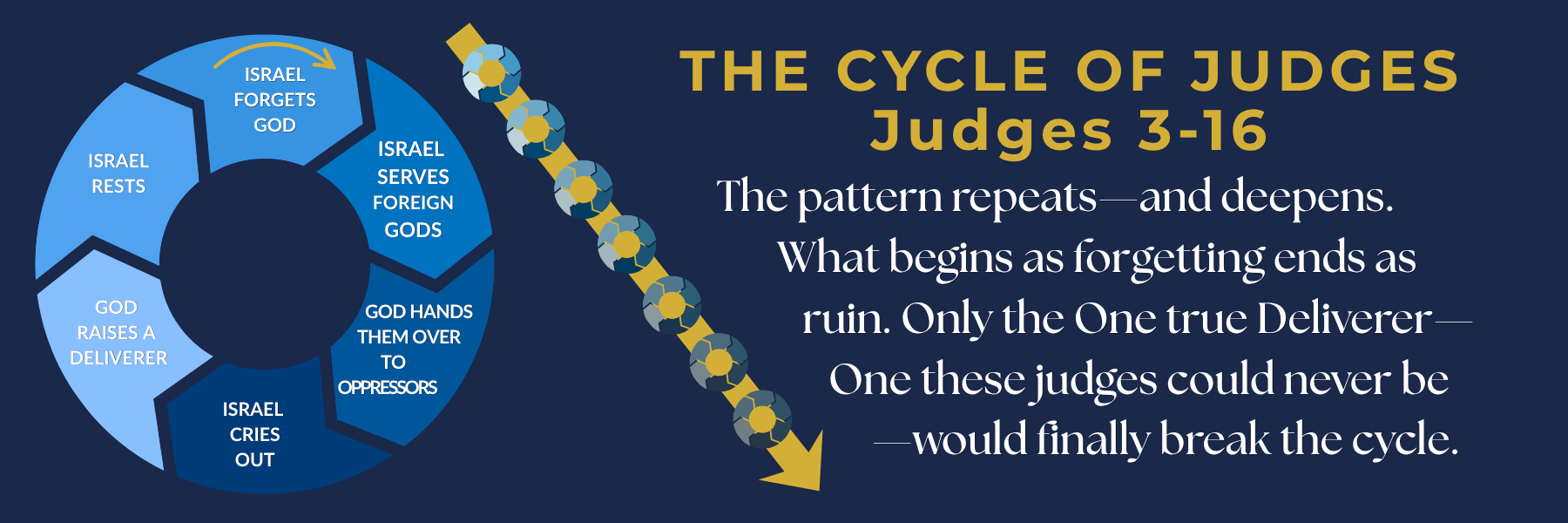
We have reached the appendix of Judges. Chapters 17–21 are not the next episode in the cycle— they are a deliberate literary addition, placed here by the author to illustrate the book's verdict. Chronologically, these events happened near the very beginning of the judges period, within a generation of Joshua's death, while Phinehas the grandson of Aaron was still serving as High Priest. The author saved them for last not because they happened last, but because they show most clearly what life looks like when God is refused as King. What we are reading in chapters 17 and 18 is not what Israel eventually became after centuries of decline. It is what Israel became almost immediately—and that makes it more devastating, not less.
The story is almost domestic in scale. A man. His mother. A shrine in a house. A hired priest. A tribe that comes looking for land and finds a god for sale instead. It would be easy to read this as a strange footnote after the drama of Samson. It isn’t. It’s the diagnosis underneath everything you’ve already read.
Today we see what happens when people who still want to worship God do it entirely on their own terms—and what that reveals about every attempt to manage God rather than obey Him.
1. Silver and Silence
Judges 17:1-6
There was a man of the hill country of Ephraim, whose name was Micah. 2 He said to his mother, “The eleven hundred pieces of silver that were taken from you, about which you uttered a curse, and also spoke it in my ears—behold, the silver is with me. I took it.”
His mother said, “May Yahweh bless my son!”
3 He restored the eleven hundred pieces of silver to his mother, then his mother said, “I most certainly dedicate the silver to Yahweh from my hand for my son, to make a carved image and a molten image. Now therefore I will restore it to you.”
4 When he restored the money to his mother, his mother took two hundred pieces of silver, and gave them to a silversmith, who made a carved image and a molten image out of it. It was in the house of Micah.
5 The man Micah had a house of gods, and he made an ephod, and teraphim, and consecrated one of his sons, who became his priest. 6 In those days there was no king in Israel. Everyone did that which was right in his own eyes.
A son steals from his mother. Confesses. Returns it. She blesses him and dedicates the silver “to Yahweh”—and then uses it to make an idol.
Notice what she thinks she’s doing. She isn’t rejecting God. She’s honoring Him, in her own mind, with the very silver she’s dedicating to Him. This is the danger the text wants you to see: not paganism dressed up as paganism, but idolatry dressed up as devotion.
Micah builds a private shrine, an ephod, household gods, and ordains his own son as priest. All of it aimed at God. None of it commanded by God. Sincerity was never the test God gave His people. God had already revealed how He was to be worshiped. The question was never whether Israel meant well, but whether they would trust His word enough to obey it.
Journaling/Prayer: Is there a place where you’ve quietly assumed God approves of something simply because your intentions were sincere? And what about the community you worship alongside—do they push you toward the plain, explicit word of God, or toward feeling comfortable calling your own wants “devotion”?
It’s possible to be devoted and disobedient at the same time—to genuinely want to honor God while quietly deciding what that honor should look like. It’s also possible for an entire church to do this together, affirming one another’s preferences under the language of worship rather than pressing each other toward what Scripture actually says. If either of those is uncomfortably familiar, you’re not alone, and you’re not without hope. Naming it honestly is the first step back toward what He actually asks.
2. Priest for Pay
Judges 17:7-13
7 There was a young man out of Bethlehem Judah, of the family of Judah, who was a Levite; and he lived there. 8 The man departed out of the city, out of Bethlehem Judah, to live where he could find a place, and he came to the hill country of Ephraim, to the house of Micah, as he traveled. 9 Micah said to him, “Where did you come from?”
He said to him, “I am a Levite of Bethlehem Judah, and I am looking for a place to live.”
10 Micah said to him, “Dwell with me, and be to me a father and a priest, and I will give you ten pieces of silver per year, a suit of clothing, and your food.” So the Levite went in. 11 The Levite was content to dwell with the man; and the young man was to him as one of his sons. 12 Micah consecrated the Levite, and the young man became his priest, and was in the house of Micah. 13 Then Micah said, “Now I know that Yahweh will do good to me, since I have a Levite as my priest.”
A wandering Levite, likely unemployed since the tithing system had collapsed along with everything else in this era, takes a job offer: room, board, ten pieces of silver a year, in exchange for legitimizing Micah’s homemade religion.
Micah’s closing line is the whole chapter in one sentence: “Now I know Yahweh will do good to me, since I have a Levite as priest.” Not because he obeyed God. Because he acquired the right credentials.
This is religion as a vending machine—insert the correct item, receive the guaranteed blessing. God cannot be hired, managed, or purchased into cooperation. Grace can never be manipulated—the God who freely gives Himself refuses to become our employee. He is not a resource to be properly equipped for; He is a Lord to be obeyed.
Journaling/Prayer: Have you ever treated your faith like a formula—do the right things, get the right outcome—and felt God go quiet when the formula didn’t work?
If you’ve been waiting for blessing to arrive because you finally assembled the right spiritual pieces, it’s worth asking whether you’re relating to God or trying to manage Him. He isn’t distant because your formula is incomplete. He was never asking for a formula.
3. Idols and Inheritance
Judges 18:1-26
18 In those days there was no king in Israel. In those days the tribe of the Danites sought an inheritance to dwell in; for to that day, their inheritance had not fallen to them among the tribes of Israel. 2 The children of Dan sent five men of their family from their whole number, men of valor, from Zorah and from Eshtaol, to spy out the land and to search it. They said to them, “Go, explore the land!”
They came to the hill country of Ephraim, to the house of Micah, and lodged there. 3 When they were by the house of Micah, they knew the voice of the young man the Levite; so they went over there and said to him, “Who brought you here? What do you do in this place? What do you have here?”
4 He said to them, “Thus and thus has Micah dealt with me, and he has hired me, and I have become his priest.”
5 They said to him, “Please ask counsel of God, that we may know whether our way which we go shall be prosperous.”
6 The priest said to them, “Go in peace. Your way in which you go is before Yahweh.”
7 Then the five men departed and came to Laish and saw the people who were there, how they lived in safety, in the way of the Sidonians, quiet and secure; for there was no one in the land possessing authority, that might put them to shame in anything, and they were far from the Sidonians, and had no dealings with anyone else. 8 They came to their brothers at Zorah and Eshtaol; and their brothers asked them, “What do you say?”
9 They said, “Arise, and let’s go up against them; for we have seen the land, and behold, it is very good. Do you stand still? Don’t be slothful to go and to enter in to possess the land. 10 When you go, you will come to an unsuspecting people, and the land is large; for God has given it into your hand, a place where there is no lack of anything that is in the earth.”
11 The family of the Danites set out from Zorah and Eshtaol with six hundred men armed with weapons of war. 12 They went up and encamped in Kiriath Jearim in Judah. Therefore they call that place Mahaneh Dan to this day. Behold, it is behind Kiriath Jearim. 13 They passed from there to the hill country of Ephraim, and came to the house of Micah.
14 Then the five men who went to spy out the country of Laish answered and said to their brothers, “Do you know that there is in these houses an ephod, and teraphim, and a carved image, and a molten image? Now therefore consider what you have to do.” 15 They went over there and came to the house of the young Levite man, even to the house of Micah, and asked him how he was doing. 16 The six hundred men armed with their weapons of war, who were of the children of Dan, stood by the entrance of the gate. 17 The five men who went to spy out the land went up, and came in there, and took the engraved image, the ephod, the teraphim, and the molten image; and the priest stood by the entrance of the gate with the six hundred men armed with weapons of war.
18 When these went into Micah’s house, and took the engraved image, the ephod, the teraphim, and the molten image, the priest said to them, “What are you doing?”
19 They said to him, “Hold your peace, put your hand on your mouth, and go with us. Be a father and a priest to us. Is it better for you to be priest to the house of one man, or to be priest to a tribe and a family in Israel?”
20 The priest’s heart was glad, and he took the ephod, the teraphim, and the engraved image, and went with the people. 21 So they turned and departed, and put the little ones, the livestock, and the goods before them. 22 When they were a good way from the house of Micah, the men who were in the houses near Micah’s house gathered together and overtook the children of Dan. 23 As they called to the children of Dan, they turned their faces, and said to Micah, “What ails you, that you come with such a company?”
24 He said, “You have taken away my gods which I made, and the priest, and have gone away! What more do I have? How can you ask me, ‘What ails you?’”
25 The children of Dan said to him, “Don’t let your voice be heard among us, lest angry fellows fall on you, and you lose your life, with the lives of your household.”
26 The children of Dan went their way; and when Micah saw that they were too strong for him, he turned and went back to his house.
Long before this, Dan had been given territory in Joshua’s allotment. They never fully possessed the inheritance God had already given them (Judges 1:34). Now, generations later, they’re still landless—so five scouts go looking for somewhere easier to conquer.
On the way, they find Micah’s private shrine and simply take it. All of it—the ephod, the idols, and the priest, who switches employers without apparent hesitation. When Micah objects, Dan threatens him into silence.
Notice the irony baked into verse 6: the Levite tells Dan their mission is “before Yahweh”—a blessing spoken by a priest over an idol he installed himself. When worship has no standard outside personal preference, even the language of blessing becomes empty.
Dan’s landlessness wasn’t God’s failure. It was the unfinished consequence of their own earlier unbelief (Judges 1:34)—and instead of returning to God in repentance, they simply took what wasn’t theirs.
Journaling/Prayer: Where in your life have you taken a shortcut around obedience rather than dealing honestly with an unfinished, unresolved place?
Shortcuts around obedience don’t actually resolve anything—they just relocate the problem. If there’s a place you’ve been managing instead of surrendering, you don’t have to fix it today. You just have to stop pretending it’s fixed.
4. Conquest and Consequence
Judges 18:27-31
27 They took that which Micah had made, and the priest whom he had, and came to Laish, to a people quiet and unsuspecting, and struck them with the edge of the sword; then they burned the city with fire. 28 There was no deliverer, because it was far from Sidon, and they had no dealings with anyone else; and it was in the valley that lies by Beth Rehob. They built the city and lived in it. 29 They called the name of the city Dan, after the name of Dan their father, who was born to Israel; however the name of the city used to be Laish. 30 The children of Dan set up for themselves the engraved image; and Jonathan, the son of Gershom, the son of Moses, and his sons were priests to the tribe of the Danites until the day of the captivity of the land. 31 So they set up for themselves Micah’s engraved image which he made, and it remained all the time that God’s house was in Shiloh.
Dan attacks Laish—a peaceful, unsuspecting, defenseless people—and burns the city. They rename it Dan and settle in. Verse 30 tells us the priest’s lineage traces to Moses himself—a jarring detail. A descendant of Israel’s great deliverer becomes a priest of a stolen idol.
Verse 31 closes with something the text wants you to sit with: this illegitimate shrine ran “all the time that God’s house was in Shiloh.” The real tabernacle, the real priesthood, the real place of worship—standing not far away, ignored, while an entire tribe worshipped a homemade god they’d stolen from a thief. Israel wasn’t lacking access to God. They were ignoring the access He had already provided.
A counterfeit worship, left unaddressed, doesn’t stay small. It outlasts generations. This shrine would eventually become the seedbed for the golden calves King Jeroboam later sets up in the very same city (1 Kings 12:29)—idolatry with roots this deep.
Journaling/Prayer: Is there a “quiet arrangement” in your life—something small and unaddressed—that’s had more time to grow than you realized?
Small compromises don’t stay small on their own; they need to be named and brought into the light to actually change. You don’t have to untangle all of it today. Naming even one part of it honestly to God is enough to start.
Summary
Judges 17–18 doesn’t show you Israel being oppressed. It shows you Israel oppressing itself with a religion of its own making—sincere, well-intentioned, and entirely disconnected from what God had actually commanded.
Micah dedicated stolen silver “to Yahweh” and made an idol with it. He hired a Levite and called it security. Dan stole the whole operation and called it blessing. None of them appears to think they are abandoning Yahweh. Instead, they reshape worship until it serves their own purposes.
Many interpreters across church history have seen in this a contrast every reader needs: a hired priest who could be bought stands against the true Priest who cannot be—Christ, who mediates not for wages but out of covenant faithfulness (Hebrews 7:23-25). Micah wanted a priest he could pay. Dan wanted a priest who would bless whatever they had already decided to do. But God has given us a better Priest. Jesus does not exist to baptize our plans. He intercedes to reconcile us to the Father’s will.
The refrain returns: no king in Israel, everyone doing what is right in their own eyes. Tomorrow we see where that verdict leads—and then Ruth brings relief.
Action / Attitude for Today
If you’ve been assembling the right spiritual pieces—the right routines, the right language, the right effort—and quietly expecting God to owe you blessing in return, let today loosen that grip. Obedience was always His call. Not assembly.
Say honestly to Him: “Lord, I have sometimes tried to manage You instead of obey You. I’ve built things in Your name that You never asked for. I don’t want a religion I can control. I want You—as You are, on Your terms, not mine.”
If you’re in a season where nothing you’ve tried has produced the outcome you expected—and you’re starting to wonder if the formula is broken, or if you are—hear this: you were never meant to manage God into blessing you. You were meant to know Him. That’s not a smaller offer. It’s the real one. Sometimes the deepest freedom comes not when our circumstances change, but when we stop carrying the impossible burden of trying to make God behave predictably.
And if today all you can do is notice one small, unaddressed compromise without fixing it yet—that noticing is enough. Bring it into the light before God, even without a plan for what comes next. He is not waiting for your religion to be perfect. He is waiting for you to stop pretending it already is.

The Bible for the Broken is published by Aurion Press LLC. © Aurion Press LLC. All rights reserved.