
Day 211—One of Our Redeemers
When What You Couldn't See Finally Comes Into View
However you can engage today, we’re here. Read, listen or both.
The written portion gives an overview, with verses broken down into smaller bites, and journaling/prayer prompts for reflection. In the podcast, Steve Traylor reflects on today’s passage with Scripture reading, a deeper pastoral teaching, and prayer (about 15 minutes). Perfect for morning coffee, commutes, or when your eyes need a rest.
📚 Resource Library:
Printable Bible Book Guides: Discipleship charts for books we’ve completed together
Hard Questions, Honest Answers: Deeper dives on difficult topics that arise along the way
Ruth 2:17–23
Something quietly shifts in this passage. It’s not a loud, tearful announcement. Pay attention to Naomi. A woman who named herself Mara, who said God had dealt bitterly with her, is about to say something different.
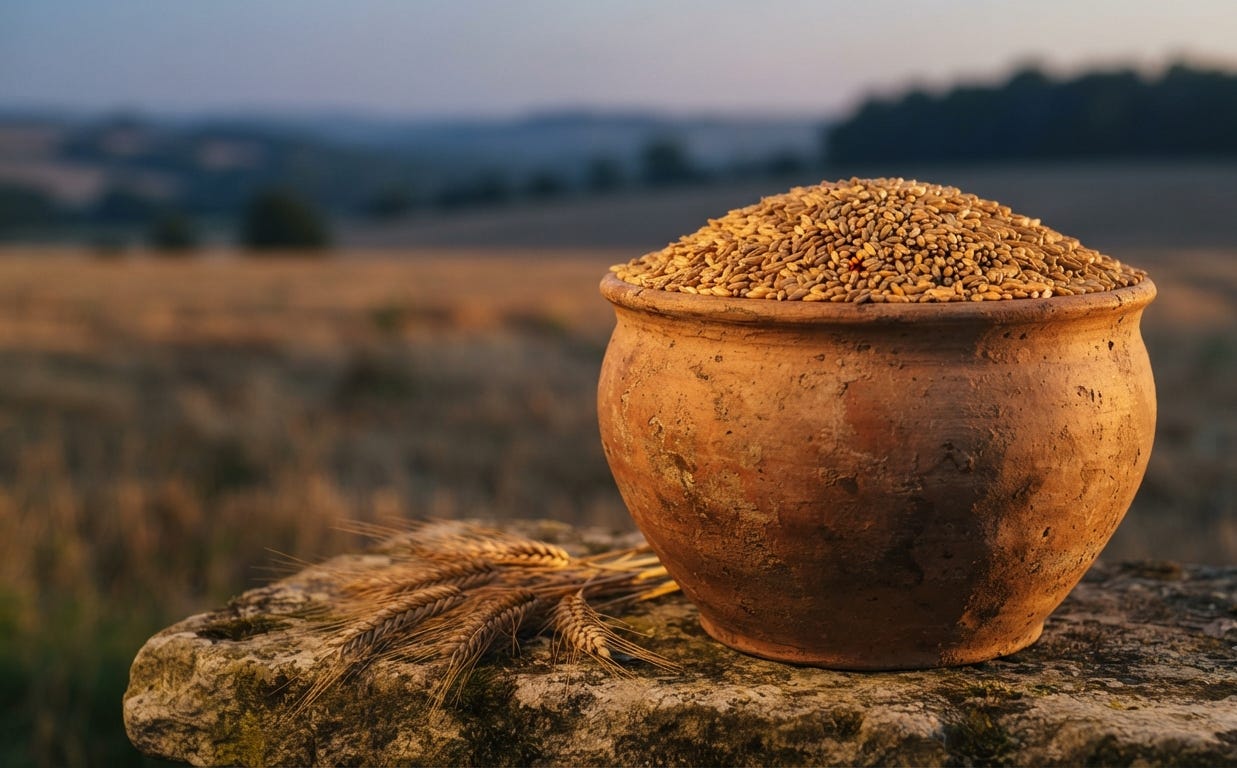
Ruth comes home from the field with an ephah of barley (roughly thirty pounds), more grain than a day’s gleaning should have produced. Naomi sees it and asks where she has been. Ruth names the field… and the man.
As connections begin to materialize, Naomi’s thinking begins to change.
She has not been healed. She has not stopped grieving. The shift is smaller than healing and more important than comfort: she saw something she had missed before. But a door she didn’t know was there cracked open, just enough to let in light.
God’s faithfulness often comes quietly as we take the next step we know to do. And slowly, we carry home more than we did the day before.
1. Carried and Counted
Ruth 2:17–18
17 So she gleaned in the field until evening; and she beat out that which she had gleaned, and it was about an ephah of barley. 18 She took it up, and went into the city. Then her mother-in-law saw what she had gleaned; and she brought out and gave to her that which she had left after she had enough.
An ephah—thirty pounds of grain—is not a normal day’s gleaning.
Mosaic law required landowners to leave field edges unharvested, to let the poor gather what remained. It did not require generosity—handfuls dropped on purpose, workers instructed to let her glean among the sheaves (2:16). Boaz provided beyond the law’s requirement. Ruth carries the generosity home.
Naomi sees the abundance before she hears the name.
Ruth worked morning to evening, then beat the grain out herself before walking home. But her diligence alone can’t account for thirty pounds.
Naomi recognizes more at work than Ruth’s faithfulness.
Journaling/Prayer: Has God ever allowed the evidence of His provision to arrive before the explanation did—where you saw what He had done before you understood why?
Naomi didn’t yet know Boaz’s name when she saw the grain. The provision was tangible. God’s hand in the provision was becoming more real. If you are in a season where you cannot yet name what God is doing, the grain may already be testifying.
2. Named and Known
Ruth 2:19–20
19 Her mother-in-law said to her, “Where have you gleaned today? Where have you worked? Blessed be he who noticed you.”
She told her mother-in-law with whom she had worked, “The man’s name with whom I worked today is Boaz.” 20 Naomi said to her daughter-in-law, “May he be blessed by Yahweh, who has not abandoned his kindness to the living and to the dead.” Naomi said to her, “The man is a close relative to us, one of our near kinsmen.”
Naomi’s first response is a blessing: “Blessed be he who noticed you.” She doesn’t know the name in the blessing. She only knows what she can see. Someone with a field saw Ruth and gave her more than she had any right to expect.
Then Ruth says the name: Boaz.
Imagine the fullness and gratitude building in Naomi as she speaks: “May he be blessed by Yahweh, who has not forsaken his kindness to the living and to the dead.”
The Hebrew word translated kindness here is hesed—the same word Naomi prayed over Ruth and Orpah (1:8). Something has changed, though, in how she uses it. In chapter 1, she prayed the Lord would show hesed to her daughters-in-law. Here she is recognizing that the Lord has already shown it to her as well.
The grammar of verse 20 is deliberately ambiguous. The subject of “who has not forsaken his kindness” can be Boaz or Yahweh. Scholars note it may be intentional: Boaz’s faithfulness and God’s faithfulness are so bound up in this moment that the language cannot cleanly separate them. God was working through what Boaz did. Boaz was enacting what God required. Their hesed is not the same thing. But in this verse it arrives as one.
Then Naomi adds one more sentence that advances the story yet again: “The man is a close relative to us, one of our near kinsmen.”
Go’el. A legal term—not a spiritual metaphor. Under Israelite law, the kinsman-redeemer had both the right and the responsibility to act on behalf of a family in crisis: redeem land sold under pressure, advocate for a vulnerable family member, and in certain circumstances, marry a widow to preserve the family name and inheritance. Legal weight that carries obligation.
Naomi recognizes Boaz as one who might carry this obligation. In naming it, she recognizes something more: that God had not placed them in a random field. Boaz, who both noticed Ruth and acted more generously than the law required, is a man who has the standing and, she now begins to believe, perhaps the willingness to act.
Journaling/Prayer: Has there been a moment in your own story when something you thought was ordinary turned out to be connected to something larger—where you saw, even briefly, that God might not have been absent after all?
Naomi had been calling herself Mara. She was not wrong to name the bitterness. But bitterness had become her whole frame, with nothing outside it. Possibilities begin to bleed outside the frame with verses 19 and 20. Not because Naomi decided to feel better. But because Ruth came home with thirty pounds of grain and a name. Evidence arrived—not in a vision, but in grain and a familiar family name. And Naomi paid attention. This is what the first glimpse of renewed hope looks like—not with feeling, but with new facts.
3. Staying and Safe
Ruth 2:21–23
21 Ruth the Moabitess said, “Yes, he said to me, ‘You shall stay close to my young men until they have finished all my harvest.’”
22 Naomi said to Ruth her daughter-in-law, “It is good, my daughter, that you go out with his maidens, and that they not meet you in any other field.” 23 So she stayed close to the maidens of Boaz, to glean to the end of barley harvest and of wheat harvest; and she lived with her mother-in-law.
Boaz’s instruction—stay close to my servants until the harvest is finished—is a gift beyond the grain. He is not offering Ruth only a few days’ gleanings. He is offering her the whole harvest season: barley first, then wheat. Weeks of protected access. The provision doesn’t end today.
Naomi’s response is practical: stay in his field. Other fields would not offer Ruth the same protection. Boaz had noticed, spoken to his workers, and provided real safety. More gratitude flows outside Naomi’s grief-bounded frame.
The chapter closes with a rhythm of growing protection and provision: Ruth gleaned through the barley harvest and the wheat harvest. She lived with Naomi. The season passed. They were together. They were fed. A season’s margin instead of today’s desperation. A woman named Mara is beginning, very slowly, to see that she is not as alone as she believed.
Journaling/Prayer: Is there a provision in your life right now—something sustaining you—that you have not yet connected to the faithfulness of God?
Naomi’s shift didn’t come from deciding to act happier and more positive. It came from paying attention to what had actually happened: the safe field where Ruth had been, the provision she’d carried home, the name she’d spoken. If you are in a long grief, the invitation here is not to manufacture hope. Look at what is actually present. Sometimes the first movement toward hope is just noticing what is just as real as the grief.
Summary
Seven verses, a harvest season, and a significant development—“The man is a close relative to us, one of our near kinsmen.”
Naomi came back to Bethlehem empty, calling herself Mara, naming what God had taken. She wasn’t wrong. But grief had become the frame through which she read everything. Life begins to overflow the frame.
Naomi engineered none of it. She did not trust her way in. Ruth went to a field, gleaned more than she should have been able to, came home, and said a name. And Naomi—the woman who had told her daughters-in-law to return to their mothers, who had said the Almighty had dealt bitterly with her—recognized the name’s significance.
God’s faithfulness does not always arrive as the thing we prayed for. Sometimes it arrives as a fact we did not expect, weighing thirty pounds, carried in the arms of someone who loved and stayed.
Naomi recognizes that the hesed she prayed for was moving long before she knew it. She can see light through a crack—partially. It began shining through a man who had every legal right to look away and didn’t. Those who trust in Christ know the light of a Redeemer who is not merely legally obligated, but who chose to come, see, and pay the great cost. What Boaz did in his field, in his generation, with what he had, is a shadow of what the greater Redeemer would do on a hill outside Jerusalem. He noticed the helpless, gave more than was required, bound himself when others walked away.
The harvest was long. The future still uncertain. But Naomi had seen something real. What is seen cannot be unseen.
Action / Attitude for Today
If grief has been so long you’ve started naming yourself by it—if empty or bitter or forgotten has become the identity you carry—today’s passage does not ask you to stop telling the truth.
It asks you to pay attention to other truths present at the same time.
Look at what is actually present in your life—not what you hoped for, not what you lost, but what is genuinely here. A person who stayed. A provision that arrived. A kindness you did not manufacture. A door that is, against all logic, still open. Naomi’s first glimpse of hope did not come from inside her but from truth outside her—in the form of grain and a name.
Today, hold one actual evidence of God’s care, however small. Let it be real. You don’t have to build a statement of faith around it. You don’t have to announce that you trust now. Just see what is there.
“Lord, I have been naming myself by what I’ve lost. Help me see what is actually present. Show me where Your hesed has arrived without my noticing it—in a provision I’ve taken for granted, a person who stayed, a grace I’ve been too grief-worn to recognize. I do not have to understand it all. Let me see the protection and provision.”
The Redeemer was there before you knew to look for Him.

The Bible for the Broken is published by Aurion Press LLC. © Aurion Press LLC. All rights reserved.