
Day 212—The Threshing Floor
When Courage Asks for What It Cannot Guarantee
However you can engage today, we’re here. Read, listen or both.
The written portion gives an overview, with verses broken down into smaller bites, and journaling/prayer prompts for reflection. In the podcast, Steve Traylor reflects on today’s passage with Scripture reading, a deeper pastoral teaching, and prayer (about 15 minutes). Perfect for morning coffee, commutes, or when your eyes need a rest.
📚 Resource Library:
Printable Bible Book Guides: Discipleship charts for books we’ve completed together
Hard Questions, Honest Answers: Deeper dives on difficult topics that arise along the way
Ruth 3:1–9
The harvest is ending. The moment to act has come.
What we are watching in these nine verses is rarer than it first appears. It’s not romance. Not recklessness. It’s a kind of courage that moves on incomplete information when the window is closing—and trusts character more than certainty.
The harvest in Bethlehem is ending. In a few days, Boaz will go back to ordinary life when work on the threshing floor is done. From her place in the quiet margins, Naomi sees this, and with decisive initiative, lays out a plan.
The woman who arrived in Bethlehem calling herself bitter, who said the Almighty had dealt harshly with her, is making a move on behalf of someone else’s future. She has not recovered what she lost, but something outside her grief—just as real, just as true—is doing its work. A perspective that was folded inward is now looking outward.
Real courage is not the absence of risk. It is the decision to move anyway, in the dark, trusting the character of the one you are moving toward.
1. Naomi’s Plan
Ruth 3:1–5
Naomi her mother-in-law said to her, “My daughter, shall I not seek rest for you, that it may be well with you? 2 Now isn’t Boaz our kinsman, with whose maidens you were? Behold, he will be winnowing barley tonight on the threshing floor. 3 Therefore wash yourself, anoint yourself, get dressed, and go down to the threshing floor; but don’t make yourself known to the man until he has finished eating and drinking. 4 It shall be, when he lies down, that you shall note the place where he is lying. Then you shall go in, uncover his feet, and lie down. Then he will tell you what to do.”
5 She said to her, “All that you say, I will do.”
Do not read this as manipulation. Read it as covenant initiative from a woman who has observed the situation carefully and understands that time is running out.
She has read Boaz correctly: he is their kinsman-redeemer—a go’el, a relative with both the legal standing and the evident character to act. The harvest window is closing. The gleaning that has sustained them for weeks will soon end. If Ruth is going to ask for redemption, the time is now.
Naomi’s instructions are culturally specific for a reason. A threshing floor at night, outside the town walls, was no place for a single foreign woman. If Ruth was seen—if her intentions were misread—the resulting rumor could permanently end any hope she had of honorable integration into Israelite society. The request she is about to make is an unmistakable marriage proposal: spread your garment over me was the recognized gesture of marital protection. If Boaz refused, she would leave humiliated, with no recourse, and the relationship keeping her and Naomi alive would be permanently severed.
Naomi knew all of this. She chose midnight anyway—not despite the risk, but because of it. A public appeal in broad daylight would have handed the situation to the legal mechanism, which could easily route to the closer relative who wanted the land but not the Moabite widow. A private midnight approach targeted the one variable that actually mattered: Boaz’s character. Naomi traded reputational safety for personal connection. She gave Boaz room to choose, freely, before anyone else knew there was anything to choose.
Naomi has moved from naming her bitterness to acting on behalf of someone else’s future. Her grief has not disappeared, but it is no longer the only thing directing her.
“All that you say I will do.” Ruth asks no questions, offers no negotiation. Remarkable trust in Naomi’s wisdom—even though the instructions make her vulnerable with no guarantees.
Journaling/Prayer: Is there something you know you need to do—something that requires trust in another person’s wisdom or character—that you have been holding back from because you cannot guarantee how it ends?
Ruth did not wait for certainty before she moved. She moved on character—Naomi’s character, Boaz’s character—and she acted when the window was open. If you are holding back from something because you cannot see the outcome clearly, bring that hesitation to God today. He knows what you cannot see.
2. The Floor at Night
Ruth 3:6–7
6 She went down to the threshing floor, and did everything that her mother-in-law told her. 7 When Boaz had eaten and drunk, and his heart was merry, he went to lie down at the end of the heap of grain. She came softly, uncovered his feet, and lay down.
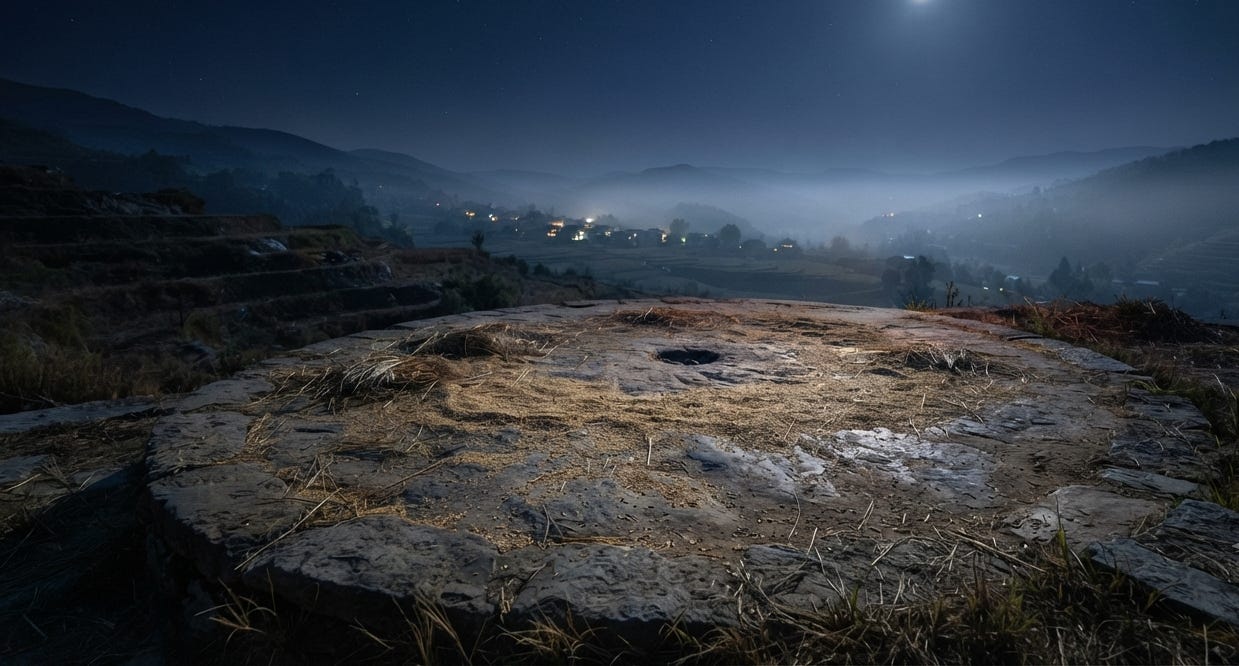
A threshing floor in ancient Israel was not an enclosed building. It was an open, elevated platform—often at the edge of a hill, exposed to wind—where grain was winnowed at harvest’s end. Owners or their workers slept there through the night to guard the grain against theft.
Boaz is guarding the grain. Ruth goes alone, at night, to an open outdoor space where she has no protection, to lie down at the feet of a man whose response she cannot predict. The text gives it one line: she came softly. As Naomi directed.
The positioning matters. Ruth does not lie down beside Boaz. She lies at his feet, beneath the edge of his cloak, used as a blanket. The posture is that of a servant seeking a master’s covering, not a woman making a romantic advance. Ruth’s intention is simply to let the cool night air do the work—a gentle waking, nothing alarming. He will find her there, and what he sees will be unmistakable in its covenantal meaning.
She is trusting the character of Boaz. Now she waits.
Journaling/Prayer: Have you ever had to place yourself in a position of complete dependence—on God or on another person—without any guarantee of how it would turn out?
Ruth did not wait for certainty. She moved on character—Naomi’s character, Boaz’s character—and she moved when the window was open. If you are holding something back because you cannot see how it ends, bring that hesitation to God today. He sees and knows what you cannot.
3. The Waking and the Word
Ruth 3:8–9
8 At midnight, the man was startled and turned himself; and behold, a woman lay at his feet. 9 He said, “Who are you?”
She answered, “I am Ruth your servant. Therefore spread the corner of your garment over your servant; for you are a near kinsman.”
Boaz wakes in the cold and finds a woman at his feet in the dark. The Hebrew word for his startled waking suggests something between a shudder and a jolt—he had not expected this, and his body responded before his mind caught up.
But he asks a question before he does anything else: Who are you?
And Ruth tells him—not just her name, but her request.
“Spread the corner of your garment over your servant; for you are a near kinsman.”
Some translations render the word cloak as wings. In Hebrew, the word for wings here is kanaph. It is the same word Boaz used in chapter two, when he prayed over Ruth: “May the LORD repay you for what you have done. May you be richly rewarded by the LORD, the God of Israel, under whose wings you have come to take refuge.”
He had prayed that God would cover her.
She is now asking him to be the answer to his own prayer—a quietly stunning moment.
Boaz spoke a blessing over a foreign woman who had chosen faithfulness. She came back to him privately and said: You. You are the wings you were praying for. Will you spread them?
Not asking him to love her, exactly. Asking him to act—legally, covenantally, as kinsman-redeemer—in a way that would fulfill both the law of God and his own expressed care. Extraordinary theological precision. Extraordinary personal courage.
And there the chapter ends, for today. The request has been made. Boaz has not yet answered.
Sit in the pause.
Journaling/Prayer: Is there a prayer you have prayed—for yourself or for someone you love—that God seems to be answering through the willingness of a specific person to act?
God often chooses to intervene from on high by moving the heart of someone here below. Someone with standing, resources, character, and an inclination toward your good. Ruth had asked for nothing specific. But Boaz had prayed for her. Now she stands in the dark offering his prayer back to him, asking him to make it real. Pay attention today to who is already near you—already inclined toward your good—and what they might already be willing to do.
Summary
Naomi made a plan. Ruth obeyed it. A woman walked alone at night to a threshing floor, uncovered the feet of a sleeping man, lay down, and waited. When he woke and asked who she was, she told him—and then asked for the one thing she could not demand.
What looks like vulnerability and risk is Ruth making a covenant appeal to a kinsman-redeemer on the basis of his legal standing and his revealed character. She is asking him to be exactly who he already is and to answer what he has already prayed.
God is not named in these nine verses, nor does He appear or speak. But the narrator shows us how God answers prayer—both Naomi’s and Boaz’s. Providence moves through the courage of people who act on incomplete information and trust the character of those they are moving toward.
Tomorrow we find out what Boaz says.
Action / Attitude for Today
If there is something you know you need to do—a request you need to make, a step you need to take, a door you need to knock on—and you have been waiting for certainty before you move, consider what Ruth did. No guarantee—only the harvest window, Naomi’s wisdom, and Boaz’s character. She moved.
If you can do that today, name the thing that requires courage, and take one step toward it without knowing the outcome. Name the fear, but hold it lightly and move anyway.
If you are not in a place of courage right now—if you are in the dark, waiting, wondering whether the person you are depending on will come through—you are on the threshing floor too. Ruth did not know what Boaz would say. She lay down and waited. Sometimes the most faithful thing is to stay where God has placed you and wait for His answer to come.
If you are too depleted to act and too exhausted to wait well—offer your limitations to God exactly as they are.
Lord, I am not always brave. I am not always sure of the next step, and sometimes the dark feels very dark. But You know what I need. You know the prayers that have already been prayed over me that I cannot hear. Give me the courage to ask for what is needed, the wisdom to know when the window is open, and the grace to trust Your character when I cannot see the outcome. Amen.
Courage is not certainty. It is the decision to trust the character of the One you are moving toward.

The Bible for the Broken is published by Aurion Press LLC. © Aurion Press LLC. All rights reserved.