
Day 69 — Wisdom's Wonder
The One Thing That Cannot Be Mined
However you can engage today, we’re here. Read, listen or both.
The written portion gives an overview, with verses broken down into smaller bites, and journaling/prayer prompts for reflection. In the podcast, Steve Traylor reflects on today’s passage with Scripture reading, a deeper pastoral teaching, and prayer (about 15 minutes). Perfect for morning coffee, commutes, or when your eyes need a rest.
📖 Resources: Printable Genesis Guide · Through the Wilderness: A Lenten Prayer Guide · Hard Questions, Honest Answers · Genesis-Job: Two Stories—One Foundation
Job 28:1–28
Step into this day quietly.
The debates have been brutal. Weeks of accusations, defenses, theological volleys. Eliphaz, Bildad, Zophar—one after another, each insisting they have the answer to Job’s suffering. Job has pushed back, torn at the heavens, cried for a mediator, confessed “I know my Redeemer lives.”
And now—suddenly—everything goes quiet.
Job 28 reads unlike anything surrounding it. No accusations. No self-defense. No anguish. Just a breathtaking poem about wisdom. About where it is, what it costs, and why only God holds it.
Think of it as an intermission in a very heavy play.
If you’ve been exhausting yourself searching for answers—for explanations, for formulas, for the reason behind what you’re going through—this poem is for you.
Today we see: wisdom cannot be mined, purchased, or argued into existence—but God has spoken, and what He said changes everything.
1. Mastery and Mining
Job 28:1–11
“Surely there is a mine for silver,
and a place for gold which they refine.
2 Iron is taken out of the earth,
and copper is smelted out of the ore.
3 Man sets an end to darkness,
and searches out, to the furthest bound,
the stones of obscurity and of thick darkness.
4 He breaks open a shaft away from where people live.
They are forgotten by the foot.
They hang far from men, they swing back and forth.
5 As for the earth, out of it comes bread.
Underneath it is turned up as it were by fire.
6 Sapphires come from its rocks.
It has dust of gold.
7 That path no bird of prey knows,
neither has the falcon’s eye seen it.
8 The proud animals have not trodden it,
nor has the fierce lion passed by there.
9 He puts his hand on the flinty rock,
and he overturns the mountains by the roots.
10 He cuts out channels among the rocks.
His eye sees every precious thing.
11 He binds the streams that they don’t trickle.
The thing that is hidden he brings out to light.
Pause here.
Before the poem makes its great argument, it makes its great concession: human beings are remarkable.
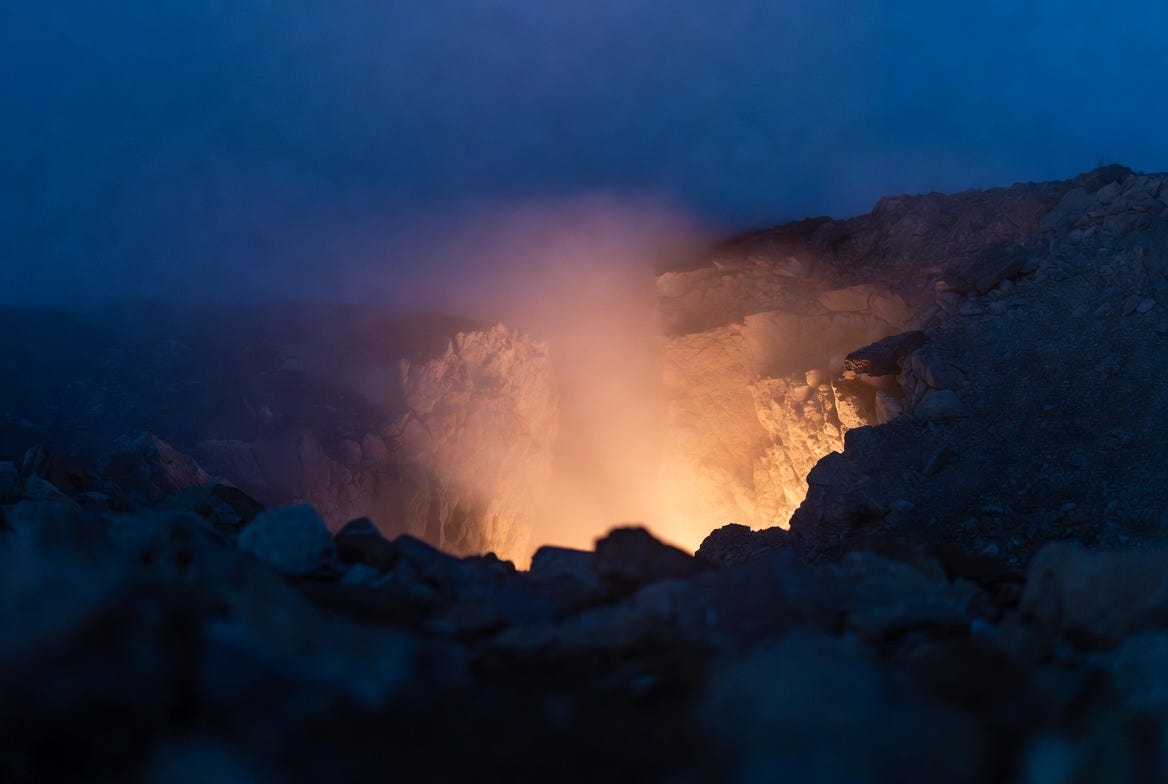
Miners descend into darkness no falcon can reach, no lion has trodden. They crack apart flint, overturn mountains, redirect rivers, bring hidden treasures to the light.
In the ancient world, this was extraordinary technology. Silver, gold, sapphires, copper—all extracted from depths no living creature had accessed.
The poem is not dismissing human intelligence. It is honoring it.
And then—right at the height of that honor—the question drops like a stone.
If human ingenuity can do this—can reach places no bird or beast can find, can bring hidden things to light—then surely we can find wisdom too.
Can’t we?
Journaling/Prayer: Where have you trusted your own intelligence or effort to find answers—to questions about God, about your suffering, about why life turned out the way it did?
If you’ve worn yourself out searching for the explanation, the formula, the reason—you’re in good company.
Job’s friends had impressive minds and deep traditions. Job himself was no fool. And not one of them, together, could reach wisdom.
This isn’t a rebuke. It’s a relief.
If you can’t yet see the relief in that, tell God honestly: “I’ve been trying so hard to figure this out, and I’m exhausted.”
He already knows. And He has something better than your conclusions.
2. Priceless and Purchased
Job 28:12–19
12 “But where will wisdom be found?
Where is the place of understanding?
13 Man doesn’t know its price,
and it isn’t found in the land of the living.
14 The deep says, ‘It isn’t in me.’
The sea says, ‘It isn’t with me.’
15 It can’t be gotten for gold,
neither will silver be weighed for its price.
16 It can’t be valued with the gold of Ophir,
with the precious onyx, or the sapphire.
17 Gold and glass can’t equal it,
neither will it be exchanged for jewels of fine gold.
18 No mention will be made of coral or of crystal.
Yes, the price of wisdom is above rubies.
19 The topaz of Ethiopia will not equal it.
It won’t be valued with pure gold.
The poem repeats its central question: Where shall wisdom be found?
And then answers it, emphatically, in the negative.
Not in the deep. Not in the sea. Not purchasable with gold, silver, sapphires, onyx, glass, coral, crystal, rubies, topaz.
Job names seven precious stones and two precious metals. Everything of enormous earthly value—and not one of them can buy wisdom.
Think about what this meant to Job in particular. He had been wealthy. He had lost everything. And now he is being told that even at his wealthiest—even with all the gold of Ophir in his hands—he could not have purchased the one thing he now desperately needs.
This is not cruelty. This is clarity.
Wisdom is not for sale. And here is the hidden mercy in that: it means the poor and the broken and the stripped-bare are not at a disadvantage.
You cannot outbid someone for wisdom. Job on the ash heap has the same access as Job at the height of his wealth.
Neither of them could purchase it. And neither of them had to.
Journaling/Prayer: What have you tried to trade for understanding? Suffering long enough. Being good enough. Reading enough. Arguing enough. What have you offered up in hopes that God would finally explain?
If you can’t pray anything else today, try this:
“I’ve been trying to buy answers I can’t afford. I release the effort. I’m listening now instead.”
He hears that.
And He honors it.
3. Hidden and Holy
Job 28:20–27
20 Where then does wisdom come from?
Where is the place of understanding?
21 Seeing it is hidden from the eyes of all living,
and kept close from the birds of the sky.
22 Destruction and Death say,
‘We have heard a rumor of it with our ears.’23 “God understands its way,
and he knows its place.
24 For he looks to the ends of the earth,
and sees under the whole sky.
25 He establishes the force of the wind.
Yes, he measures out the waters by measure.
26 When he made a decree for the rain,
and a way for the lightning of the thunder,
27 then he saw it, and declared it.
He established it, yes, and searched it out.
The central question returns a third time—and this time, the answer is not another negative.
It is a Name.
God understands its way. He knows its place.
Wisdom is not absent from the universe. It is woven into all of creation—but it belongs to God alone.
Look at what God does with wisdom here: He measures the wind. He apportions the waters. He makes a path for lightning. When He established the great laws of creation, He looked on wisdom, declared it, searched it out.
Even Death and Destruction have only heard a rumor of it.
This might feel discouraging at first. If wisdom belongs only to God — if it is hidden from every living creature—what hope do we have?
But the poem is not finished.
The same God who holds wisdom to Himself is also the God who speaks. He is not a God who hoards understanding to make you feel small—He is a God who speaks to make you wise.
Journaling/Prayer: How does it feel to consider that the one who holds every answer is also the one who created you and knows your name?
If you’re tired and confused and desperately short on understanding right now, hear this:
God knowing the location of wisdom—and God being willing to speak—are two very different things.
If you can’t feel the hope in that yet, tell Him: “I need You to speak. I can’t find answers on my own. I’m listening.”
He hears that prayer—and He answers in His way and time.
4. Fear and Foundation
Job 28:28
28 To man he said,
‘Behold, the fear of the Lord, that is wisdom.
To depart from evil is understanding.’”
One verse.
After twenty-seven verses of magnificent poetry—mining expeditions and precious stones and cosmic questions and the wind and the rain—it all comes down to one sentence.
Fear God. Turn from evil. That is wisdom. That is understanding.
Notice the extraordinary phrase: “To man He said.”
Wisdom isn’t something man discovered or reasoned out. It was revealed. Spoken. Given.
All the mining in the world—all the silver and gold and sapphires and topaz—could not purchase the one thing God simply said to His creation.
The Hebrew word for “fear” here is yirat YHWH—the fear of the Lord. It is not terror. It is not cowering.
It is reverential awe: treating God as God, orienting your whole life around who He is. And what “turning from evil” adds is this: wisdom is not only a posture of the heart, it is a pattern of the life.
Now here is the breathtaking detail scholars have noticed: this verse describes Job exactly as he appears at the beginning of the book.
Job 1:1: “This man was blameless and upright, fearing God and turning away from evil.” Job 1:8: God Himself says it of Job. Job 2:3: God says it again.
Job was already living the answer to the poem’s question. All through the ash heap, all through the accusations, all through the silence—Job had been doing the only thing God called wisdom.
This is why God would later say of Job, “You have spoken rightly of me” (Job 42:7). Not because Job had all the answers. But because Job had the right relationship.
The wisdom Job needed was not an explanation. It was a Person. And Job, without knowing it, was already holding on.
The New Testament carries this forward in ways Job could not have seen. Paul writes that “in Christ are hidden all the treasures of wisdom and knowledge” (Colossians 2:3). The wisdom the poem calls inaccessible—the cosmic logic of creation—became flesh. Walked among us. Was crucified and raised.
What was once hidden is now available. Not because we dug for it. Because God spoke it into a manger and a cross.
Journaling/Prayer: What would it mean today, in your actual situation, to “fear God”—to orient your whole self around who He is rather than around what you don’t understand?
You may not have an explanation for what you’re going through. Job didn’t have one either.
But you can have what Job had: a life ordered toward God. A heart that, even through confusion, turns toward Him rather than away.
That, the poem says, is wisdom.
Not the answer. The posture.
If you can’t yet believe your suffering has meaning, try this prayer:
“I don’t understand. But I choose to face You instead of facing away. That’s all I have today. Let that be enough.”
It is. It always has been.
Summary
Job 28 is the still point at the center of a storm.
Weeks of debate. Accusations and defenses, theological arguments and raw lament. All of it circling the same question: Why is Job suffering? And all of it—every brilliant word from every brilliant mind—has come up empty.
Then the poem steps in and says: you were looking in the wrong places.
Wisdom cannot be mined from the depths of the earth. It cannot be purchased at any price. It is hidden from every living creature—even Death has only heard rumors.
But God knows its place. And God has spoken.
What He said—the accessible form of the inaccessible wisdom of creation—is this: fear the Lord, turn from evil. No formula. No “if you do these things, suffering will stop.” Just an orientation: treat God as God, and let that shape everything else.
The mercy hidden in this poem is that wisdom cannot be bought—which means it cannot be priced out of reach. It is given, freely, to anyone who will receive it: the wealthy and the destitute, the healthy and the broken, those with answers and those with none.
Job was already walking through this door. He didn’t know it yet. But the story is about to confirm it.
Jesus, who is the wisdom of God made flesh (1 Corinthians 1:24), walked this same path—trusted, obedient, facing suffering He did not deserve. He is not a distant philosopher. He is the Word who entered the world’s ash heap and still calls you by name.
You are not without wisdom. You are not without the One who holds it.
Action / Attitude for Today
Walk through today holding this truth: wisdom is not an answer you find—it is a posture you choose.
Choose one moment today, just one, to orient yourself toward God rather than toward the question you can’t answer.
This might look like sitting quietly for two minutes and saying: “You are God. I am not. You know what I don’t. I choose to trust that.”
If you are barely functioning today, this is enough: say the words of Job 28:28 out loud. Let them be your prayer and your anchor.
If you have a little more to give, ask yourself one honest question: Is there something I’ve been trying to figure out or control that I need to release to God today? Name it. Hand it over.
Say this simple prayer: “God, I’ve been mining for answers I can’t reach. I stop digging today. You know the way to wisdom. You’ve already told me what I need: to fear You, to turn from what’s wrong, and to trust what I can’t see. That’s what I’m choosing. Help me hold that posture even when the answers don’t come. Amen.”
That’s enough.
Because the God who wove wisdom into the fabric of creation sent His Son as the living answer to every question you’re carrying. Jesus is not a formula—He is the wisdom of God made flesh, walking into your ash heap today.
Hold onto Him today.
The Bible for the Broken is published by Aurion Press LLC. © Aurion Press LLC. All rights reserved.