
The Devoted Thing
What Cherem Means—and Why It Matters That Joshua 6 Is Not Comfortable
📚 Resource Library:
Printable Bible Book Guides: Discipleship charts for books we’ve completed together
Hard Questions, Honest Answers: Deeper dives on difficult topics that arise along the way
JOSHUA RESOURCE: A map of the Joshua campaigns and a reference outline is available here.
A companion resource for The Bible for the Broken, Day 180 and following
Something happens in Joshua 6 that the text does not soften, and neither should we flatten it—but we must also read it carefully within the full character of God revealed in Scripture.
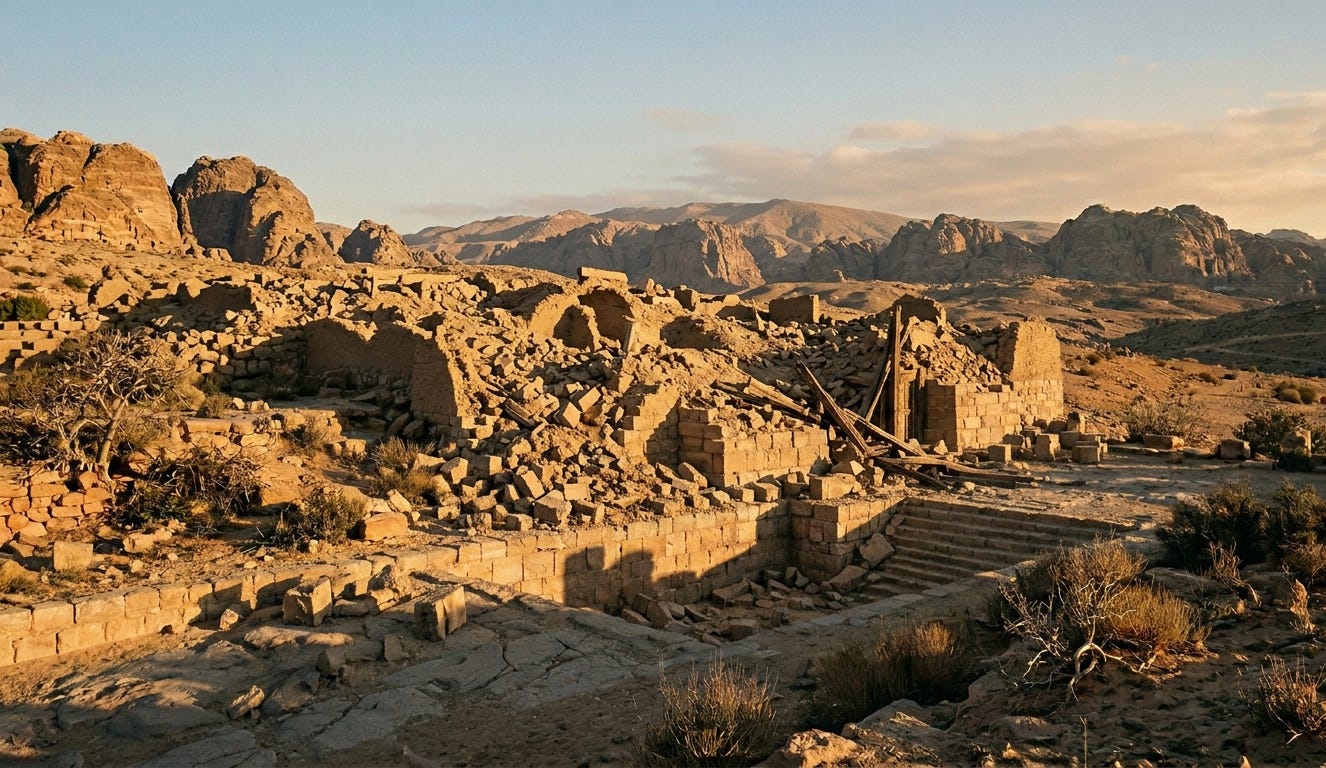
The walls collapse. The city is burned. Nearly everyone inside is killed. A few surviving stories get told—Rahab, her household, the scarlet cord still hanging in the window. But the larger story is a city given over to total destruction by divine command. Jericho is not just defeated. It is devoted. Every living thing inside the walls, every piece of gold and silver and bronze and iron, every structure—given entirely to God.
The word the text uses for this act is cherem (pronounced KHEH-rem—the first syllable sounds like clearing your throat). It appears in Joshua 6 and throughout the conquest narrative, and most English translations render it as “devoted to destruction” or “the ban” or simply “utterly destroyed.” None of those translations are wrong. None of them quite captures what the word carries in its Hebrew context.
This article takes the word seriously—not to explain away what happened at Jericho, but to understand what the text itself is doing when it records it.
What Cherem Actually Means
At its root, cherem is a category of holiness, not a description of violence.
The word comes from a Hebrew root meaning to separate, to set apart, to place something beyond the reach of ordinary use. When something was declared cherem, it crossed a boundary—from the common world into the exclusively divine. It became God’s property in the most absolute possible sense. And because Scripture treats what is devoted to God as removed from ordinary use entirely, the only way to handle something cherem was to remove it from human use completely. For objects, that meant they went to the Lord’s treasury (Joshua 6:19). For everything else, destruction was the mechanism of transfer—not to violence as an end, but to God as the destination.
Leviticus 27:28–29 states the principle plainly: “No devoted thing (cherem) that a man devotes to the Lord, of anything that he has—whether man or beast, or of his inherited land—shall be sold or redeemed; every devoted thing is most holy to the Lord.”
The phrase “most holy” is the key. Cherem is not a lesser category of holiness. It is holiness at its most absolute and its most irreversible. What enters the sphere of the divine under cherem cannot be retrieved, renegotiated, or repurposed. The transfer is complete and permanent.
This is why the visual metaphor of burning works so well for the ancient mind: something burned entirely as an offering goes up in smoke toward God. No human hand can take it back. Jericho, consumed by fire, was devoted wholly to God—much as a whole burnt offering was wholly surrendered to Him, with nothing withheld and nothing reclaimed.
Cherem in the Context of Ancient Warfare
To understand what cherem warfare meant, you have to understand what ordinary ancient warfare looked like—because cherem was its precise inversion.
In the ancient Near East, war was an economic enterprise. Soldiers fought for plunder. The winning army kept the gold, the livestock, the grain stores, and the surviving population—who became slaves or tribute workers. The wealth of the conquered city flowed to the conquering army and its commanders. Winning a war meant getting rich. The military victory glorified the strength of the army and its king.
Cherem warfare reversed every element of that logic.
The army could take nothing. The gold went to the Lord’s treasury, not to military commanders. The city was not occupied, repurposed, or rebuilt. The victory was not claimed by the army’s strength but attributed entirely to God. And because nothing could be taken, there was no personal incentive for any individual soldier—only the obedience of completing a command from a God whose reasons were not always explained.
This is what makes Jericho’s method of conquest so deliberate. Israel did not bring siege equipment. They marched in silence. For six days they walked around the walls and returned to camp. There was no military strategy, no tactical explanation, no human logic to what they were doing—only the obedience of following specific, unusual instructions from God. When the walls fell on the seventh day, Israel could not claim credit. The victory had no other explanation.
Jericho was also the firstfruits of the conquest—the first city taken across the Jordan. In Israel’s theology, firstfruits belonged to God by default. The harvest’s first yield was not the farmer’s to keep; it was presented to God as acknowledgment that the whole harvest came from Him. Jericho, as the first city of the land, belonged to God in the same category. The silver, gold, bronze, and iron went to the Lord’s house (Joshua 6:19). Everything else was burned. The firstfruits of Canaan went entirely to the One who had given them Canaan.
What Achan Understood Too Late
The danger of cherem was not simply that breaking it carried a penalty. Scripture shows that violating cherem brought corporate consequences on all Israel—not as a mechanical transfer of guilt, but because what one member of the covenant community did in secret was not hidden from the God of that covenant.
Because cherem items were devoted entirely to God, taking them for personal use was not merely a private transgression. It was a breach of the covenant that bound the whole community to God. They crossed the boundary they were not permitted to cross, and the entire camp bore the consequences.
This is exactly what the next chapter records. Achan saw a beautiful Babylonian robe, two hundred shekels of silver, and a wedge of gold among the ruins of Jericho. He wanted them. He took them. He buried them under his tent. And in the very next battle—an attack on the small city of Ai, which should have been trivial—Israel was defeated. Thirty-six soldiers died. Joshua fell on his face before the Lord, devastated.
God’s explanation was immediate: “Israel has sinned; they have transgressed my covenant that I commanded them. They have taken some of the devoted things (cherem); they have stolen and lied and put them among their own belongings” (Joshua 7:11).
Note the language. Israel—singular—has sinned. One man’s hidden act compromised the whole community. The cherem had not stayed buried under Achan’s tent. It had spread. It had infected the camp. Israel’s standing before God was affected by something no one else knew about, that no one else had done, that was hidden under the floor of a tent.
Achan’s confession when he was found is one of the most honest sentences in Joshua: “Truly I have sinned against the Lord God of Israel, and this is what I did: when I saw among the spoil a beautiful cloak from Shinar, and 200 shekels of silver, and a bar of gold weighing 50 shekels, then I coveted them and took them. And see, they are hidden in the earth inside my tent” (Joshua 7:20–21).
He saw. He coveted. He took. He hid.
The sequence has been familiar since Eden. What we take from a forbidden category does not stay contained. It burrows under the tent and waits, and the consequences are larger than we imagined when we first reached for the thing.
Why God Commanded This in the First Place
The question that every honest reader of Joshua carries is the one that should not be dismissed: Why did God command the destruction of entire populations? Why were children and animals included? Why the totality?
The text offers two answers, and they are both worth sitting with.
The first is spiritual quarantine. Deuteronomy 20:17–18 states the reason explicitly: “You shall devote them to complete destruction (cherem)... that they may not teach you to do according to all their abominable practices that they have done for their gods, and so you would sin against the Lord your God.” The religious practices of the Canaanite cultures were not simply different customs. They included child sacrifice—the systematic killing of children as religious offerings. They included cult prostitution as acts of worship. They included practices so ingrained in the structures of family, land, and culture that partial absorption, the text argues, would inevitably mean complete corruption. The concern was not ethnic. It was moral and theological. A partial quarantine against these practices, the text argues, was not a real quarantine.
The second is delayed judgment. Genesis 15:16 contains a sentence that is easy to miss but sits underneath the entire conquest narrative. God tells Abraham that his descendants will return to Canaan in the fourth generation, “for the iniquity of the Amorites is not yet complete.” The conquest is not presented as ethnic warfare or as God arbitrarily favoring Israel. It is presented as judgment held back for centuries—God waiting, in what can only be called patience, until the fullness of sin had come.
And the text does not permit Israel to feel superior about this. Deuteronomy 9:4–6 anticipates the temptation clearly: “Do not say in your heart, after the Lord your God has thrust them out before you, ‘It is because of my righteousness that the Lord has brought me in to possess this land.’” Israel was not given the land because they deserved it. The Canaanites were not destroyed because Israel was better. And Leviticus 18:28 warns Israel explicitly that if they committed the same sins, the land would vomit them out as well—as it later did, precisely, when the Assyrian and Babylonian exiles came. The standard was not Israel’s standard. It was God’s.
None of this makes Joshua 6 comfortable reading. It should not be artificially softened. What it does is locate the discomfort correctly: not in a God who is arbitrary, but in a God who is holy—and who takes both sin and justice more seriously than we do.
What Cherem Points Forward To
There is one more dimension of cherem that the New Testament illuminates, and it connects directly to the broken reader who encounters this passage and wants to know what it means for them.
Paul uses the cherem concept in one of its most striking applications in Romans 9:3, when he says—in what sounds like a shocking statement—“For I could wish that I myself were accursed (anathema, the Greek equivalent of cherem) and cut off from Christ for the sake of my brothers, my kinsmen according to the flesh.” The word anathema in Greek carries the same logic as cherem: given over entirely, placed beyond ordinary use, removed from the common world.
Paul wishes he could be cherem—devoted, given over, cut off from blessing—if it would mean Israel’s salvation. He cannot be. But someone was.
It is important to hold two things together here. Cherem in Joshua was a specific act of judicial judgment in history—God’s sentence on particular peoples for particular sins in a particular moment. Christ’s atoning work is not simply cherem repeated on a larger scale. It is something distinct: a substitutionary bearing of the covenant curse, in which the sinless Son of God stood in the place of sinners and absorbed what divine justice required.
What cherem does is prepare the mind to feel the weight of both. Jesus, in the language of Galatians 3:13, “became a curse for us—for it is written, ‘Cursed is everyone who is hanged on a tree.’” He bore the divine judgment we deserved, carrying the covenant curse in our place so that those who trust Him might receive the blessing He earned. He was vindicated, resurrected, and triumphant—but the path to that triumph ran through the full bearing of what sin requires from a holy God. Cherem helps us feel the seriousness of divine holiness—the absolute incompatibility between what belongs to God and what stands against Him. That seriousness is what makes the cross legible. It is a category that finds its ultimate expression in the cross: Jesus, treated as the sin-bearer under the ultimate ban, absorbed the judgment that would have fallen on the camp of God—so that those who trust Him are not devoted to destruction, but brought near. What cherem foreshadowed, Christ bore in a distinct and saving way. What we deserved, He absorbed.
If the weight of cherem troubles you, that reaction is understandable. Scripture intends us to feel it. The wonder of the gospel is not that judgment is unreal, but that Christ stepped into it for sinners who could never escape it on their own. The pattern of total devotion that runs through Joshua was not incidental to Israel’s story. It was preparation for understanding the cost of what God would do in His Son.
This does not make Jericho less serious. It makes it more.

The Bible for the Broken is published by Aurion Press LLC. © Aurion Press LLC. All rights reserved.