
Day 182—Ai and the Altar
When Victory Leads Straight to Worship
However you can engage today, we’re here. Read, listen or both.
The written portion gives an overview, with verses broken down into smaller bites, and journaling/prayer prompts for reflection. In the podcast, Steve Traylor reflects on today’s passage with Scripture reading, a deeper pastoral teaching, and prayer (about 15 minutes). Perfect for morning coffee, commutes, or when your eyes need a rest.
📚 Resource Library:
Printable Bible Book Guides: Discipleship charts for books we’ve completed together
Hard Questions, Honest Answers: Deeper dives on difficult topics that arise along the way
JOSHUA RESOURCE: A map of the Joshua campaigns and a reference outline is available here.
Why did God command total destruction—and what does that mean for us? Learn more at: The Devoted Thing: What Cherem Means
Joshua 8
Take a breath before you read today.
Yesterday, Israel was reeling. A man’s hidden sin had cost thirty-six soldiers their lives and left Joshua face-down in the dirt asking God why. The Valley of Achor had been named—the Valley of Trouble—and the weight of it was real.
Today God speaks first. Before Joshua can recalibrate. Before Israel can regroup on their own terms. The Lord opens the chapter by saying, in essence: Get up. I haven’t changed my mind about any of this.
What follows is a battle won—not by Jericho’s silence and shouting, but by ordinary military strategy. An ambush. A feigned retreat. A javelin held aloft until the work was done. God still gave the victory, but this time through tactics rather than miracle, through planning rather than procession. The means were different. The outcome was the same.
And then, before anyone could settle into celebration, before the dust had fully cleared from Ai—Joshua led all of Israel on a thirty-mile march north to build an altar.
Today we see that God’s people in the promised land live by the same principle that governed them in the wilderness: the ground under their feet is not secured by military strength but by covenantal faithfulness.
1. Restored and Ready
Joshua 8:1–2
Yahweh said to Joshua, “Don’t be afraid, and don’t be dismayed. Take all the warriors with you, and arise, go up to Ai. Behold, I have given into your hand the king of Ai, with his people, his city, and his land. 2 You shall do to Ai and her king as you did to Jericho and her king, except you shall take its goods and its livestock for yourselves. Set an ambush for the city behind it.”
God does not wait for Joshua to recover. He speaks.
“Don’t be afraid, and don’t be dismayed”—the same words He had given Joshua at the very beginning, in Joshua 1:9. The defeat at Ai had not cancelled the commission. The sin of Achan had been dealt with. God had not abandoned His covenant promise to Israel—though the nation’s fellowship and blessing had been disrupted by that hidden sin, His purposes for His people remained unchanged.
This time the spoil was permitted. At Jericho, everything was cherem—devoted to destruction, belonging entirely to God. Achan had violated that. Now at Ai, God extended what had been withheld at Jericho: the plunder and livestock could be taken. This was grace, not renegotiation. God was not loosening His standards; He was demonstrating that His first command had been singular and specific, not a permanent rule about all conquest.
When God restores what sin disrupted, He doesn’t do it grudgingly. He speaks it directly, and He speaks it first.
Journaling/Prayer: Is there a defeat in your recent past that has made you hesitant to move forward—a failure you’ve taken as a sign that God has changed His mind about you?
Israel’s defeat at Ai came from disobedience, not from God withdrawing His promise. The restoration came through repentance—and it came fully. What God had spoken over Joshua in chapter 1 still stood. If you are in Christ, His word over you still stands. For those who are in Christ, the guilt that separates us from God has been dealt with at the cross—“there is therefore now no condemnation for those who are in Christ Jesus” (Romans 8:1). The command to move forward may be the same one He gave before the failure.
2. Strategy and Surrender
Joshua 8:3–29
3 So Joshua arose, with all the warriors, to go up to Ai. Joshua chose thirty thousand men, the mighty men of valor, and sent them out by night. 4 He commanded them, saying, “Behold, you shall lie in ambush against the city, behind the city. Don’t go very far from the city, but all of you be ready. 5 I and all the people who are with me will approach the city. It shall happen, when they come out against us, as at the first, that we will flee before them. 6 They will come out after us until we have drawn them away from the city; for they will say, ‘They flee before us, like the first time.’ So we will flee before them, 7 and you shall rise up from the ambush, and take possession of the city; for Yahweh your God will deliver it into your hand. 8 It shall be, when you have seized the city, that you shall set the city on fire. You shall do this according to Yahweh’s word. Behold, I have commanded you.”
9 Joshua sent them out; and they went to set up the ambush, and stayed between Bethel and Ai on the west side of Ai; but Joshua stayed among the people that night. 10 Joshua rose up early in the morning, mustered the people, and went up, he and the elders of Israel, before the people to Ai. 11 All the people, even the men of war who were with him, went up and came near, and came before the city and encamped on the north side of Ai. Now there was a valley between him and Ai. 12 He took about five thousand men, and set them in ambush between Bethel and Ai, on the west side of the city. 13 So they set the people, even all the army who was on the north of the city, and their ambush on the west of the city; and Joshua went that night into the middle of the valley. 14 When the king of Ai saw it, they hurried and rose up early, and the men of the city went out against Israel to battle, he and all his people, at the time appointed, before the Arabah; but he didn’t know that there was an ambush against him behind the city. 15 Joshua and all Israel made as if they were beaten before them, and fled by the way of the wilderness. 16 All the people who were in the city were called together to pursue after them. They pursued Joshua, and were drawn away from the city. 17 There was not a man left in Ai or Bethel who didn’t go out after Israel. They left the city open, and pursued Israel.
18 Yahweh said to Joshua, “Stretch out the javelin that is in your hand toward Ai, for I will give it into your hand.”
Joshua stretched out the javelin that was in his hand toward the city. 19 The ambush arose quickly out of their place, and they ran as soon as he had stretched out his hand and entered into the city and took it. They hurried and set the city on fire. 20 When the men of Ai looked behind them, they saw, and behold, the smoke of the city ascended up to heaven, and they had no power to flee this way or that way. The people who fled to the wilderness turned back on the pursuers. 21 When Joshua and all Israel saw that the ambush had taken the city, and that the smoke of the city ascended, then they turned back and killed the men of Ai. 22 The others came out of the city against them, so they were in the middle of Israel, some on this side, and some on that side. They struck them, so that they let none of them remain or escape. 23 They captured the king of Ai alive, and brought him to Joshua.
24 When Israel had finished killing all the inhabitants of Ai in the field, in the wilderness in which they pursued them, and they had all fallen by the edge of the sword until they were consumed, all Israel returned to Ai and struck it with the edge of the sword. 25 All that fell that day, both of men and women, were twelve thousand, even all the people of Ai. 26 For Joshua didn’t draw back his hand, with which he stretched out the javelin, until he had utterly destroyed all the inhabitants of Ai. 27 Israel took for themselves only the livestock and the goods of that city, according to Yahweh’s word which he commanded Joshua. 28 So Joshua burned Ai and made it a heap forever, even a desolation, to this day. 29 He hanged the king of Ai on a tree until the evening. At sundown, Joshua commanded, and they took his body down from the tree and threw it at the entrance of the gate of the city, and raised a great heap of stones on it that remains to this day.
The strategy was straightforward: send an ambush behind the city, lure the defenders out with a feigned retreat, then close the pincer. God directed it, but it required planning, discipline, timing, and troops willing to run away from a battle they intended to win.
The detail that holds the chapter together is Joshua’s javelin.
He stretched it out at God’s command, and he did not lower it until the destruction of Ai was complete (v. 26). Thirty-one verses of military execution happened under the arc of that outstretched arm. Joshua’s sustained posture of dependence—arm extended, not drawn back—was not a military signal alone. It was an act of faith held long past the point of comfort.
The king of Ai was taken alive and hanged on a tree. At sundown, Joshua had the body taken down and buried under a heap of stones at the city gate (vv. 28–29)—following the law of Deuteronomy 21:22–23 precisely. Even in victory over an enemy, God’s law governed what was done with the dead.
Faithfulness in the details of victory matters as much as faithfulness in the crisis of defeat.
Journaling/Prayer: Is there a place in your life right now where you’re holding a posture of faith—arms extended—past the point where you can see the outcome?
That kind of sustained, patient obedience is not glamorous work. The battle was longer than expected, the strategy required discipline no one would see, and the work wasn’t finished until it was finished. Sometimes faithfulness looks exactly like that—holding the posture God directed, waiting for the completion you cannot yet see. And when it comes, the first instinct of people who know where the victory comes from is not to celebrate themselves. It is to build an altar.
3. Altars and Uncut Stones
Joshua 8:30–31
30 Then Joshua built an altar to Yahweh, the God of Israel, on Mount Ebal, 31 as Moses the servant of Yahweh commanded the children of Israel, as it is written in the book of the law of Moses: an altar of uncut stones, on which no one had lifted up any iron. They offered burnt offerings on it to Yahweh and sacrificed peace offerings.
Ai was still smoldering.
Joshua did not call a celebration. He did not establish a garrison or begin planning the next campaign. He gathered all Israel—an entire nation—and marched them thirty miles north to a mountain Moses had named before any of them had set foot in the land.
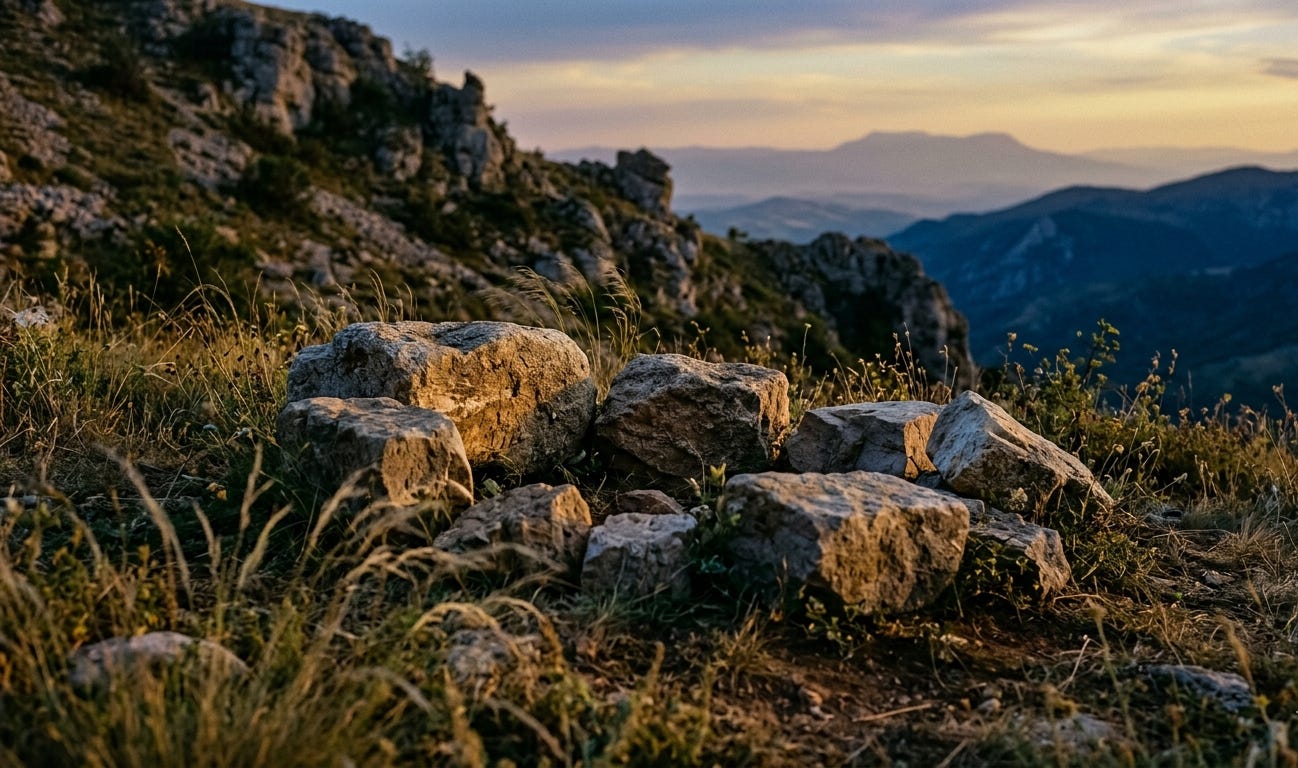
Mount Ebal was the mount of cursing. In Deuteronomy 27, Moses had divided the twelve tribes: six on Mount Gerizim to pronounce blessings, six on Mount Ebal to pronounce curses. The curses were what happened when Israel broke covenant with God. And it was on the mountain of cursing that Joshua built the altar.
This was not carelessness. Joshua was carrying out a profoundly theological act rooted in Moses’ covenant instructions.
It is striking that the altar stood on Mount Ebal, the mountain associated with covenant curses. The place of sacrifice stood where the consequences of covenant breaking had been proclaimed—a fitting reminder that God’s provision for atonement meets His people where the reality of sin is most honestly acknowledged. Moses had commanded this location specifically. Joshua obeyed. What they enacted in stone and offering, those who are in Christ now understand more fully: the one who “became a curse for us” (Galatians 3:13, Paul’s words) did not meet His people somewhere more comfortable either.
The stones were uncut, just as Moses had commanded (Deuteronomy 27:5; Exodus 20:25). No iron tool had touched them. Human craftsmanship was excluded from the altar’s construction. What was offered to God could not be improved by human skill—the altar had to come to God on His terms, not Israel’s.
God’s provision for atonement meets His people where sin’s reality is most honestly named—not somewhere easier.
Journaling/Prayer: Have you ever tried to locate your worship somewhere more comfortable—away from the parts of your life where the cost of sin is most visible?
God sent Israel to the mountain of cursing to build the altar. For those who are in Christ, something more has happened: the curse that stood on that mountain has been borne by the one who, in Paul’s words, “became a curse for us” (Galatians 3:13). The altar that belonged on the mount of cursing has been answered by a cross outside Jerusalem. Worship doesn’t require you to sanitize your history before you approach. The sacrifice has been made at the very site of the curse.
4. Law and Listening
Joshua 8:32–35
32 He wrote there on the stones a copy of Moses’ law, which he wrote in the presence of the children of Israel. 33 All Israel, with their elders, officers, and judges, stood on both sides of the ark before the Levitical priests, who carried the ark of Yahweh’s covenant, the foreigner as well as the native; half of them in front of Mount Gerizim, and half of them in front of Mount Ebal, as Moses the servant of Yahweh had commanded at the first, that they should bless the people of Israel. 34 Afterward he read all the words of the law, the blessing and the curse, according to all that is written in the book of the law. 35 There was not a word of all that Moses commanded which Joshua didn’t read before all the assembly of Israel, with the women, the little ones, and the foreigners who were among them.
Joshua wrote the law on plastered stones and then read every word of it aloud.
Every word. The blessings and the curses both. Nothing softened, nothing omitted, nothing edited for the occasion. And the assembly before him included “the women, the little ones, and the foreigners who were among them.” The law was not addressed only to soldiers, or leaders, or those who had been at Sinai. It was spoken to every person present in the land—including those who were not ethnically Israel.
The foreigner stood alongside the native Israelite before the ark. These were not curious bystanders—they were people who had chosen to live among Israel, submitting to the covenant and worshipping God with them. They stood in the same assembly, under the same word, as full participants in what was happening on that mountain.
This was not a spontaneous ceremony. Moses had commanded it before his death (Deuteronomy 27:1–8; 31:11–13). Joshua was completing a directive that had been given decades earlier and carried all the way across the Jordan. The ceremony was the final act of faithful obedience that began with Moses and passed through Joshua’s hands to completion.
God’s word was spoken to all—not as threat alone, but as the full accounting of what life in covenant looked like: blessing for faithfulness, consequence for turning away, and a God who meant every word of both.
Journaling/Prayer: Is there a part of God’s word you’ve been avoiding—blessings you can’t quite receive, or consequences you’ve tried not to think about?
Joshua didn’t read a curated selection. The assembly heard everything—because the covenant required understanding what was at stake, not just the parts that felt encouraging. For those in Christ, the law’s full weight is not spoken as condemnation (Romans 8:1) but as the shape of the life God calls us into. The blessings are real. The warnings are real. And the God who spoke them is the same God who provided, in His own Son, the way through the curse to the blessing.
Summary
Joshua 8 doesn’t end at Ai. It ends at an altar.
After the defeat, God spoke. After the battle, Joshua didn’t celebrate—he led Israel to a mountain where Moses had commanded a covenant ceremony before any of them had crossed the Jordan. The altar was built on uncut stones, on the mount of cursing, exactly where it belonged. The law was written on plaster and read to every person present—every word, blessings and curses both.
The shape of this chapter is the shape of life in the land: God gives victory, and God’s people respond not by securing their position but by renewing their covenant. The altar on Ebal declares that the land is held not by military achievement but by fidelity to the God who gave it. Israel was not celebrating a conquest. They were acknowledging a gift—and standing under the word that defined what faithfulness looked like going forward.
For those who are in Christ, the altar on the mount of cursing has a deeper resonance than Joshua could have named. The curse was real. The sacrifice was required. And the One who became the curse on our behalf has turned the mount of cursing into the ground where blessing now stands.
Action / Attitude for Today
If you are in a season of restoration after failure—if God has spoken “don’t be afraid” into a situation you felt certain He had withdrawn from—receive it. What sin disrupted, repentance restored—fully. God did not revise His purposes for His people when the sin was dealt with. He simply said: get up, and go.
If you are in a long, unseeing stretch of faithfulness—holding a posture that has no visible result yet, no smoke on the horizon—know that the work wasn’t finished until it was finished, and when it was, the response was not a victory lap. It was an altar. That movement from battle to worship is not incidental to this chapter. It is the chapter’s whole point.
If you are sitting with parts of God’s word you’ve been avoiding—blessings that feel too far away to reach, or warnings that feel too close—hear this: the full word of God was spoken to all, and it was spoken so people could live within it, not be crushed by it. The curse has been addressed. The blessing is real. Both are spoken by the same God who is for you.
Say this prayer, as much of it as is true for you today: “Lord, You spoke first after Israel’s defeat. You speak first into mine. I want to receive Your restoration without treating it as fragile—to move forward again on the commission You gave before I failed. Help me hold whatever javelin You’ve placed in my hand long enough to see the work complete. And let the altar be built where it belongs—on the ground where the cost was named—because that is where You meet us. Amen.”
The ground where the curse stood is precisely where God chose to receive the sacrifice. He has not moved the altar to somewhere easier. He has met us on the mountain.

The Bible for the Broken is published by Aurion Press LLC. © Aurion Press LLC. All rights reserved.