
Day 216—The Redeemer Noticed
Judges-Ruth Review

However you can engage today, we’re here. Read, listen or both.
The written portion gives an overview, with verses broken down into smaller bites, and journaling/prayer prompts for reflection. In the podcast, Steve Traylor reflects on today’s passage with Scripture reading, a deeper pastoral teaching, and prayer (about 15 minutes). Perfect for morning coffee, commutes, or when your eyes need a rest.
📚 Resource Library:
Printable Bible Book Guides: Discipleship charts for books we’ve completed together
Hard Questions, Honest Answers: Deeper dives on difficult topics that arise along the way
Free Judges-Ruth Discipleship Resource: We've put together two companion charts for the Judges and Ruth books—How God Shapes His People in Judges and Ruth and Bringing It to God—ten principles from these two books and ten prayers for wherever you actually are standing right now. Print them, keep them, share them. Find them here.
Judges-Ruth Review
You have just finished two books that belong together.
Judges and Ruth were not written as companions. They do not share characters or storylines or even a narrator’s voice. Judges is loud and violent and accumulating toward disaster. Ruth is quiet and domestic and accumulating toward joy. They feel like opposite books. But they are not opposite books. They are the same era, told from two different perspectives.
Judges shows you the foreground: the national story, the cycles of failure, the judges who rose and fell, the descent that ended in one of Scripture’s bleakest sentences. Ruth shows you the background: one small family, one foreign woman’s decision, one man who noticed someone others had overlooked. Neither book is the whole picture. Together, they are.
That is what this review is for—to stand back far enough to see both at once.
The Cycle and Its Verdict
Judges is a book with a structure. Once you see it, you cannot unsee it, and by the end of the book, that is exactly the point.
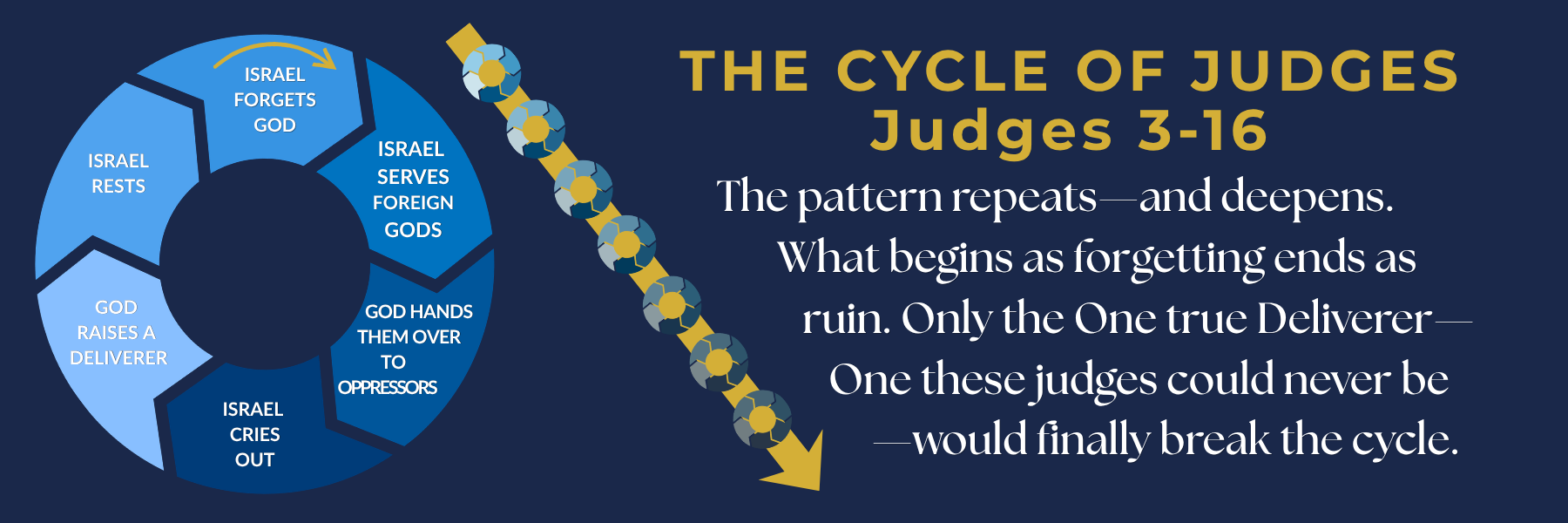
The pattern repeats: Israel abandons the LORD and serves the gods of the surrounding nations. God allows an enemy to oppress them. Israel cries out. God raises a deliverer—a judge. The enemy is defeated and the land has rest. Then the judge dies, and Israel abandons the LORD again. The next cycle begins. And with each repetition, something gets worse.
Othniel is nearly flawless. Ehud is clever and effective. Deborah is wise and willing. Gideon starts with genuine faith and ends with an idolatrous ephod and a harem of wives and a son who murders his seventy brothers. Jephthah makes a vow he cannot undo. Samson never learns anything from any of his failures. The pattern is not just repetition. It is a downward spiral with increasing velocity.
What does not change—in any cycle, in any generation—is this: God answered. Whether their cries sprang from deep repentance or merely desperate distress, the LORD repeatedly showed covenant mercy by raising up deliverers they did not deserve. The failure was always Israel’s; the faithfulness was always His. Judges is not the story of a God who eventually gives up. It is the story of a people who cannot seem to learn, and a God who keeps responding to their cry anyway.
But the verdict at the end of the book is honest. Judges 17–21 is not the result of the judges’ cycles—it is an appendix that shows you what Israel looked like very early in the period of the judges. Before the cycles even began in earnest, this was the condition of the people: a Levite turned hired priest, a tribe that kidnaps six hundred women to survive its own civil war, an atrocity in Gibeah so terrible that the rest of Israel goes to war. The placement is deliberate. The author is showing you the soil the cycles grew in—the baseline from which the spiral descended. And the sentence that brackets these chapters: “In those days there was no king in Israel. Everyone did what was right in his own eyes.” That is Judges 21:25—and it is not just a verdict on one moment. It is a diagnosis of what human beings do when they have forgotten that God is King.
The book of Judges exists to make one thing viscerally clear: the refrain “there was no king in Israel” is not a political observation. It is a spiritual indictment. Israel had a King. They had always had a King. The problem was not the absence of a monarchy—it was the refusal of the people to live under the kingship they already possessed. Every man doing what was right in his own eyes is not a problem a human king can solve. It is what happens when a people has decided that God’s rule over them is optional. Judges does not build toward a political solution. It exposes a spiritual condition that no judge—and eventually no earthly king—would be able to fix.
The Sentence That Names the Warning
Buried in the Samson account is a verse that may be the most chilling in the book.
Samson had surrendered himself to Delilah. He had told her the source of his strength. She had called in the Philistines. They shaved his head as he slept.
“He awoke from his sleep, and said, ‘I will go out as at other times, and shake myself free.’ But he didn’t know that the LORD had departed from him.” (Judges 16:20)
He did not know. He thought the morning would work the way it always had. He expected the strength to still be there. And the text doesn’t tell us what it felt like when he reached for what was gone—only that he didn’t know, at first, that it was gone.
That sentence is Judges’ deepest warning. The danger is not the obvious catastrophe. The danger is the slow departure you do not notice because each accommodation seemed small enough to survive. Samson did not fall in a single moment. He had been negotiating with Delilah’s questions for days. Each compromise revealed a heart already drifting. By the time he gave the true answer, he had already made every other compromise.
This is for readers who recognize themselves in the slow drift—who have not experienced a single dramatic falling away but find themselves further from God than they remember deciding to go. Judges 16:20 is a warning and an invitation at the same time. You can notice now what Samson did not notice until too late.
The Other Story
In the days when the judges ruled, in the town of Bethlehem in Judah, a man named Elimelech took his family to Moab because of a famine. His two sons married Moabite women. Elimelech died. His sons died. His wife Naomi was left with two daughters-in-law in a foreign country, with no husband, no sons, no provision, and no clear path home.
That is where Ruth begins. It is not a setup you would choose. But it is the setup God used.
One daughter-in-law, Orpah, kissed Naomi and returned to her own people. The other one, Ruth, refused to go. Her refusal became one of the most quoted declarations in Scripture: “Where you go, I will go. Where you lodge, I will lodge. Your people shall be my people, and your God my God.” This was not sentiment. This was theological conversion. Ruth was choosing the God of Israel over every familiar thing she had ever known, at a moment when that God had, from the outside, given her very little reason to choose Him.
The two women arrived in Bethlehem at the beginning of the barley harvest. Empty, exhausted, and—on Naomi’s part—convinced that the Almighty had dealt bitterly with her.
And then a man named Boaz looked up from his harvest field and noticed a gleaner he did not have to notice.
Beyond the Study: A Note on Naomi
The eight days we spent in Ruth focused, rightly, on Ruth—her loyalty, her declaration, her hesed. But before we leave, Naomi deserves one more look. Many of our readers know what it is to be faithful in a situation not of their choosing—and this story has something to say to them that the study didn’t have room to develop.
Elimelech’s decision to take his family to Moab was, in all likelihood, a failure of leadership and covenant faithfulness. To leave the land God had established them in, in a season that called for trust, and to allow his sons to marry outside the covenant—the text does not editorialize, but the trajectory speaks. When everything he chose brought ruin, Naomi was the one left holding it.
Her bitterness in chapter 1 is not the bitterness of a woman who walked away from God. She is still addressing Him—still holding Him accountable, still believing He governs her life. The words she speaks are about emptiness and loss. But bitterness directed at God rather than away from Him implies she believed she had a case to bring—that the outcome was not what faithfulness was supposed to cost. The lament psalms know this voice. Job knows this voice. God does not rebuke it. And it was this fierce, immovable anchor to Yahweh that Ruth witnessed in Moab—a faith real enough to hold both grief and God in the same breath.
What the text shows, quietly, is that Naomi never stopped praying. She released her daughters-in-law unselfishly when holding them tightly would have been the natural survival instinct. And Ruth converted to the God of Israel in Moab—which means Naomi’s life among those women was already a testimony, long before she set foot back in Bethlehem.
God’s faithfulness found a faithful woman. He did not restore Naomi because she earned it—His initiative always precedes and exceeds anything we bring. But He worked through her sustained faith rather than around it, and what He gave back exceeded what she had lost: the daughter-in-law who chose her God, the kinsman-redeemer who noticed, the grandson in her arms, the great-grandson on a throne.
If you are living someone else’s choices right now, this story is for you. God has not lost track of what your faithfulness has cost you.
Hesed: The Word That Ran Through Everything
The book of Ruth uses a single Hebrew word three times, and each occurrence marks a hinge in the story.
The first time, it belongs to Naomi. She blesses Orpah and Ruth with the prayer that the LORD would show them hesed—covenant lovingkindness—as they had shown it to her and to their dead husbands. It is a prayer lifted in the dark, over two women she is releasing. She prays it because such a prayer is consistent with all she knows God to be, even when she is disappointed in how her own life has played out.
The second time, it appears when Ruth returns from Boaz’s field. Naomi hears his name and then says: “The LORD has not abandoned his loving kindness to the living and to the dead.” The word she prayed in Moab is now something she can see in Bethlehem. She has moved from praying hesed into the darkness to recognizing it already at work around her.
The third time, the word belongs to Boaz. At the threshing floor, he calls Ruth’s coming to him a greater act of hesed than her first loyalty to Naomi. All three occurrences now stand visible: hesed as prayer, hesed as recognition, hesed as embodiment. The word moved from the dark into the open—and every person in the story became a demonstration of the very thing Naomi had asked God for.
Gibbor Chayil: Same Title, Different Men
When Boaz is introduced in Ruth 2:1, the text calls him a gibbor chayil—a mighty man of valor.
If you have been reading with us chronologically, you have heard that phrase before—twice. In Judges 6, Gideon is called gibbor chayil. In Judges 11, Jephthah receives the same title. All three men are called mighty. All three are people of means and standing in their communities. But what they do with that strength could not be more different.
Gideon began with genuine faith and ended with an idolatrous ephod, a harem of wives, and a legacy of bloodshed among his own sons. He delivered Israel—that was real and significant—but he could not steward the strength that made it possible. Jephthah also delivered Israel, driving back the Ammonites when no one else would answer the call. But he made a vow no one asked for and could not undo, and in the end his daughter paid the price of his ambition. Both men accomplished what they were sent to do. Neither left behind much worth inheriting.
Boaz was not a judge. He delivered no army and fought no battle. But he used his strength quietly and left a legacy that carried further than either of them. He instructed his workers to leave extra grain in the field. He made sure Ruth was protected from harassment. He went to the city gate to conduct redemption properly, legally, with witnesses—not because anyone required it of him, but because his integrity would not let him do it any other way. He paid what the closer redeemer would not pay, for someone who had no claim on him. And when the legal transfer was complete, a Moabite widow was folded into the covenant community before the chapter closed.
The title gibbor chayil names the capacity. What a person does with that capacity is a different story entirely. Judges gave you two expressions of it. Ruth gave you another. The books belong together not just chronologically but morally—they are asking the same question about human strength and whether it will be used for others or for itself.
The Redeemer Who Noticed
Many readers across centuries have seen in Boaz a portrait—partial, imperfect, but genuine—of what a redeemer does. Boaz is not the Redeemer. He is not a substitute for what comes later. But his actions carry the shape of what redemption looks like in practice.
None of these encounters were accidental. Behind every ordinary decision—Ruth choosing to glean in that particular field, Boaz looking up at that particular moment—stood the quiet providence of God, arranging what no human being could have orchestrated. He noticed someone no one was required to notice. He provided for someone who had no claim on his provision. He paid the price others either could not or would not pay—not because he had to, but because he was a gibbor chayil in the truest sense. The closer redeemer declined because redemption was going to cost him something he couldn’t spend. Boaz did not decline. He went to the gate. He conducted the transaction in front of witnesses. He took on what others walked away from because he was both willing and able.
For readers who feel unnoticed—who have been in the field of someone else’s harvest, hoping not to be harassed, grateful for what scraps are left—the book of Ruth holds out a particular kind of hope. Not that your circumstances will resolve the way Ruth’s did. But that the God who was working in the background of Judges, quietly assembling what no one could see yet, is not less present in your story than He was in hers.
The redeemer noticed when no one required him to. That is the nature of hesed—it is never merely what is owed.
What the Genealogy Is Doing
The book of Ruth ends with a list of names. Ten generations from Perez to David. It is not a footnote. It is the payoff. (Hebrew genealogies characteristically omit generations, naming significant ancestors rather than recording every link in the chain — this is a feature of the form, not an error in the record.)
Ruth the Moabite widow—who chose hesed when she could have chosen otherwise, who gleaned in a field she had the legal right to enter but no guarantee anyone would honor, who lay at the feet of a man she could only trust—is in this list. She is also in Matthew 1:5. She is in the genealogy of Jesus Christ.
The road that began in a famine, in Moab, over three graves, carried this. Naomi called herself Mara and said the Almighty had dealt bitterly with her. She was in the middle of a genealogy she could not see. The generation living through Judges could not have known that ordinary faithfulness in Bethlehem was building the line that would bring the King the whole era was aching for. They only knew what was in front of them. We know how it ends.
Judges closes: “There was no king in Israel.” Ruth closes with the great-grandmother of the king. The books belong together.
What You Would Have Missed
If you had skipped Judges, you would not recognize the condition of the people who are about to ask for a king—or understand why that request will not solve what is actually wrong with them. You would not feel in your chest what it costs a nation to live without an anchor. You would not understand what the book of Ruth was written against—what backdrop makes one woman’s faithful choice shine the way it does.
If you had skipped Ruth, you would leave Judges with only the spiral and the verdict. You would not know that in the same era, in the background, God was working through quiet choices that no newspaper would have covered, no one at the time would have called significant, and no one living through it could have known would matter. You would have mistaken the foreground for the whole story.
The foreground of history is often Judges. The background is always Ruth. God is not only working where you can see it. He is working in the ordinary faithfulness of ordinary people who choose hesed when nothing requires them to—and He is doing something with it that extends far beyond what any of them can see.
You stayed through Judges. You stayed through Ruth. You now carry truths and perspectives that are reshaping you.
Action/Attitude for Today
There is no new passage today. This is a day to receive what you have already read.
If you have the energy: find one place in your own story where the foreground looks like Judges—chaotic, repetitive, descending—and ask whether there could be a Ruth story happening in the background that you cannot yet see. It may not resolve the way hers did. But God has not suspended His practice of working through ordinary, unseen faithfulness simply because you cannot see the genealogy you are in.
If that is more than you can do right now: simply sit with Naomi. She called herself Mara. She arrived empty. She held the end of the story in her arms and named him Obed, which means servant. She did not know his grandson would be David. She only knew that her arms were no longer empty. Sometimes the gift that arrives is not the one you lost—it is something you could not have imagined when you were naming yourself bitterness.
And if even that feels too far: take only the genealogy. Ruth the Moabite is in Matthew 1. The road that looked like it led nowhere was carrying the name of Jesus all along. Whatever road you are on, it is not outside the reach of a God who weaves redemption through choices that seem small and people that seem unlikely.
If you are willing, bring this prayer into 1 Samuel: Father, I have walked through Judges and Ruth and I have seen both what human beings do when they have no anchor, and what ordinary faithfulness looks like when someone chooses hesed. I cannot always manage Boaz. I am often more like Israel—forgetting, drifting, finding myself further from You than I meant to be. But You answered every cry in Judges, and You noticed every act of faithfulness in Ruth. You notice mine too, even the ones I cannot see. Meet me in both stories. Amen.
The foreground does not tell the whole story. The God who ruled Judges is the God who quietly wove together every event in Ruth—and He is still writing stories that cannot yet be fully seen.
A note before tomorrow:
Day 217 is not a new study. It’s a RETREAT DAY. Before we move into 1 Samuel, we’re pausing to look back at the ground we’ve covered: Genesis through Ruth, seven months in God’s Word. Tomorrow asks one question worth sitting with: What has God been doing in you while you were walking through His story? Come ready to rest. The work of 1 Samuel will wait one more day.

The Bible for the Broken is published by Aurion Press LLC. © Aurion Press LLC. All rights reserved.